
Disentangling Black Hole Photon Rings with Machine Learning
by Anavi Uppal | Oct 17, 2026 | Daily Paper Summaries | 0 comments
Title: Convolutional Neural Network for Extraction of n=1 Photon Ring of Black Holes
Authors: Courtney Duong, Frank Myhre, Joseph R. Farah
First Author’s Institution: Department of Physics, University of California, Santa Barbara, CA
Status: Accepted by ApJ [open access]
The first-ever image of a black hole was revealed by the Event Horizon Telescope (EHT) in 2017, and it excited the scientific community. This incredible photo shows hot gas swirling around the shadow of a supermassive black hole at the center of the Messier 87 (M87) galaxy.
While some news outlets may have compared this blurry image to a coffee cup stain, it actually took an incredible combination of radio telescopes across the globe to create this image through a technique called interferometry, which allows us to combine signals from many telescopes into an image that is brighter and sharper than would be possible with just one of these telescopes.
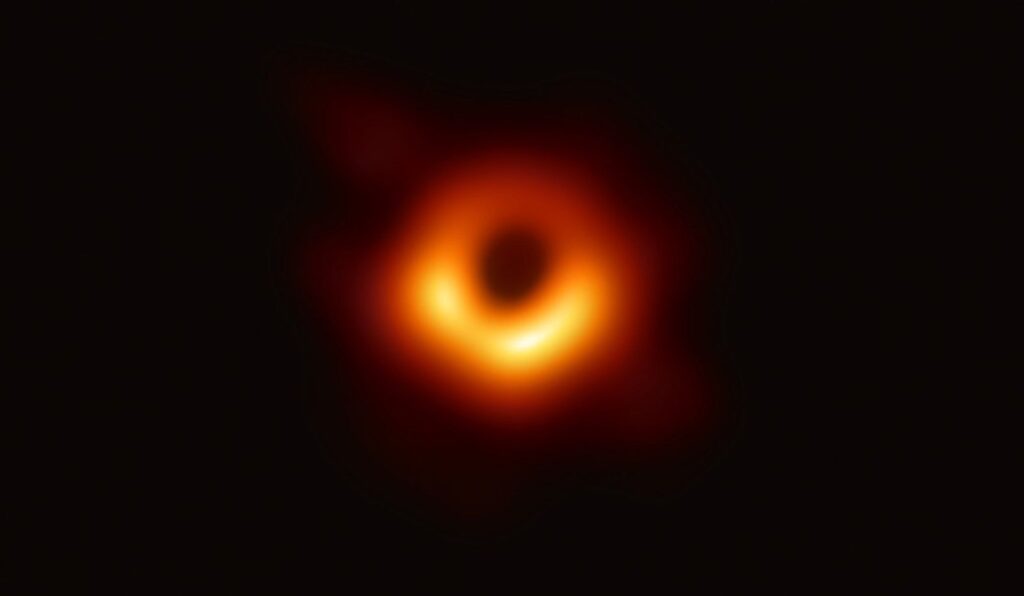
While this image is revolutionary, it’s still admittedly pretty fuzzy. The resolution of the EHT is limited by the distance between the furthest two telescopes, and currently, the furthest two telescopes are literally separated by the entire diameter of the Earth. This means that we can’t improve the resolution of an Earth-based interferometer any further.
To get a finer picture of a supermassive black hole, the proposed Black Hole Explorer (BHEX) mission would extend the EHT to space, which would improve its imaging resolution from 20 microarcseconds to just 6 microarcseconds. This would allow us to see theory-predicted structures such a black hole’s photon ring, which is a shell of photons in unstable orbits around the black hole.
A photon ring consists of several numbered subrings, where the number indicates how many half-orbits its photons have completed around the black hole. The n=1 subring is made up of photons that have completed one half-orbit, and it’s particularly valuable because its radial and angular brightness profiles encode information about a black hole’s spin.
Unfortunately, the n=1 subring is blended with the more diffuse n=0 subring (higher-order subrings are too faint and generally negligible), which can make it difficult to reliably retrieve the information encoded in the n=1 subring. In today’s paper, the authors explore whether a machine learning algorithm called a Convolutional Neural Network (CNN) could disentangle the two subrings.
A CNN can “see” photon ring images and learn to separate the different subrings
The architecture of CNNs was inspired by the structure of a human visual cortex. A CNN can be trained to “see” the patterns, edges, and shapes in an image and classify them based on a set of labeled training data. A classic use case for a CNN would be to look at many different images of pets and to identify which ones show cats, which ones show dogs, etc.
But CNNs aren’t just limited to classifying images — they can also generate them. Today’s authors aimed to teach a CNN to take in simulated images of photon rings and output images of just the n=1 subring. To train the model, they simulated about 70,000 images of black hole photon rings, each with a different combination of parameters (brightness, diameter, width, horizontal offset, asymmetry strength, and asymmetry angle).
In order to also train the CNN on photon rings where the n=0 and n=1 subrings were rotated with respect to each other, they augmented their dataset by 41,000 images. These extra images were created by randomly selecting 1,000 images from the original 70,000 simulated images and rotating the n=0 and n=1 photon rings with respect to each other by a variety of angles.
Simple, noiseless photon rings can be detangled… but observations are rarely simple or noiseless
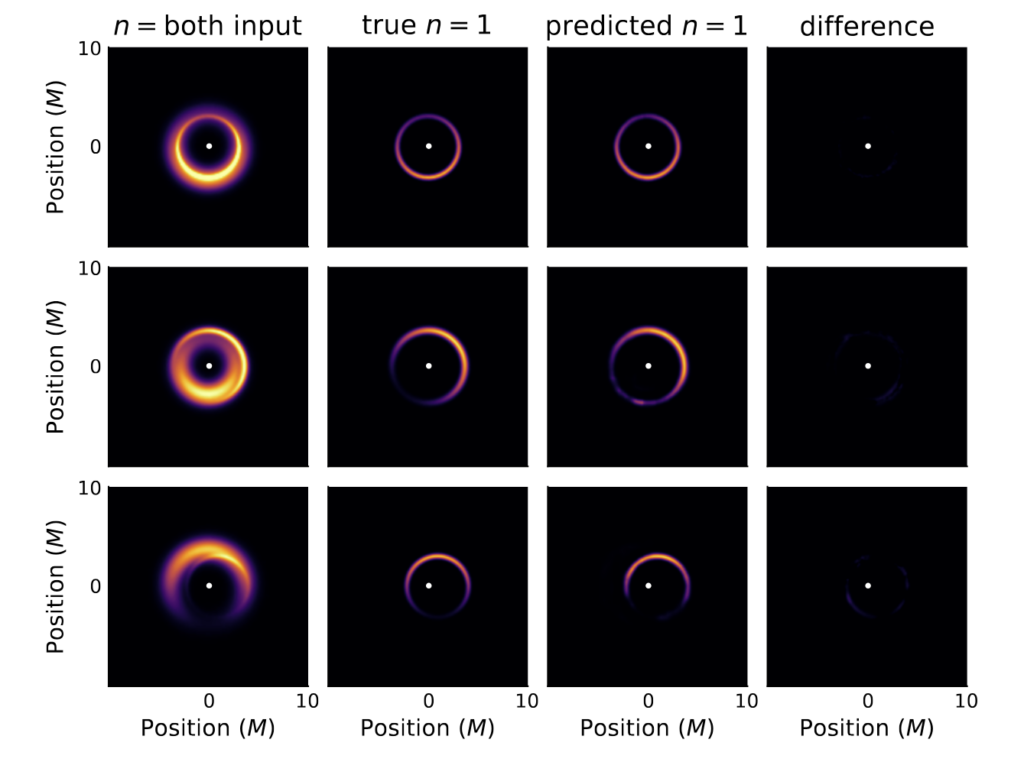
As seen in Figure 2, the CNN did a pretty solid job at disentangling n=1 rings from n=0 rings in simulated photon ring images that it hadn’t seen during training. However, these simulated rings didn’t include any observational noise and weren’t blurred by BHEX’s actual predicted sensitivity, which means that they were pretty unrealistic.
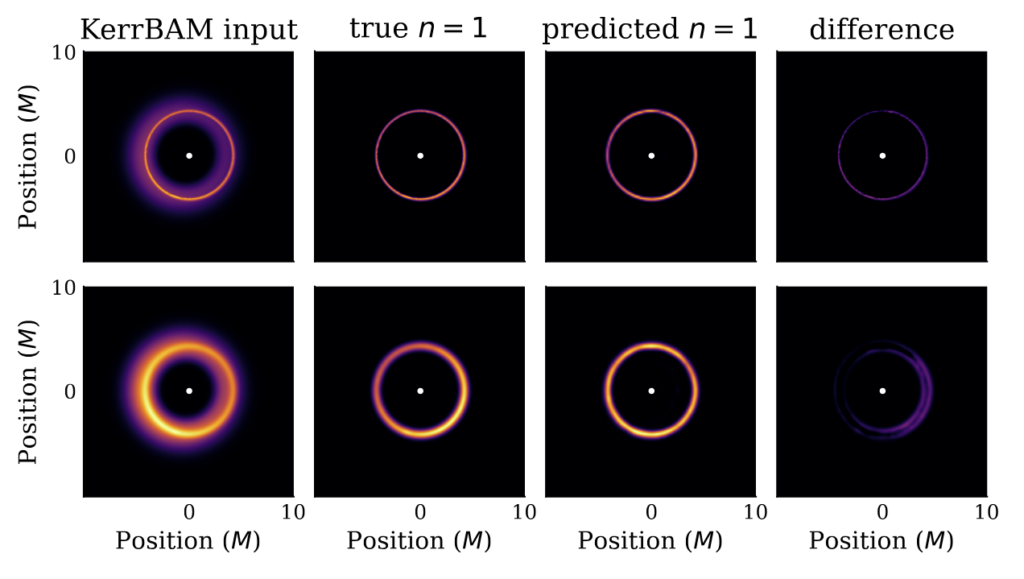
The authors also tested the CNN on photon ring images that were more complicated than the ones used to train the model, such as photon rings from different simulations and photon rings blurred by the predicted sensitivity of BHEX. Unfortunately, while the CNN was generally able to recover the correct size of the n=1 ring, it didn’t do a good job at recovering the intensity profile, which is necessary for extracting information about the black hole’s spin. The CNN also did especially poorly on photon ring images from a general relativistic magnetohydrodynamic (GRMHD) simulation.
Much more work will be needed if we want to use CNNs to extract the n=1 ring from real photon ring observations
Using CNNs to disentangle the n=1 photon ring is an interesting idea, but the authors acknowledge that much more work needs to be done before we can use this method for real observations. Future efforts should use more realistic training data that takes into account the predicted sensitivity of BHEX and includes observational noise. Still, this study is a good first step in using today’s tools to try and solve future astronomy problems.
Astrobite edited by Ryan White
Featured image credit: Event Horizon Telescope Collaboration
Author
-
View all posts
I’m a third-year Astronomy & Astrophysics PhD student at the University of California, Santa Cruz. I’m interested in using machine learning and telescope surveys to explore a variety of topics in extragalactic astronomy. Beyond research, I love science outreach/journalism, photography, archery, fiber arts, and being outdoors.