
OpenAI’s Policy Chief, Dean Ball, Tells IFS Unleashed That The AI Industrial Revolution Has Only Just Begun – SMBtech
OpenAI’s Policy Chief, Dean Ball, Tells IFS Unleashed That The AI Industrial Revolution Has Only Just Begun
Surprisingly Useful AI Article Enhancements
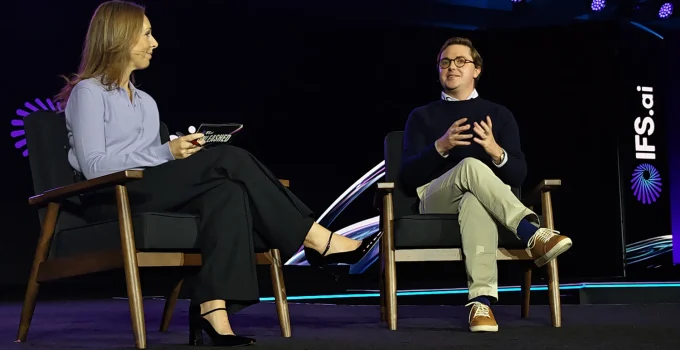
The Head of External Affairs at IFS, Sarah Chiplin, set the stage plainly when she opened a fireside conversation at an industry conference this month. “Any conversation about AI policy is really a conversation about power and where that power lies,” she told IFS Unleashed audience, in Orlando, “whether it’s economic power, national security, geopolitical competition, or increasingly the power of autonomous AI that can act without humans.”
The guest she introduced carried a perspective shaped by both government and industry. The Head of Strategic Futures at OpenAI, Dean Ball, previously worked inside the Trump White House, where he helped write America’s AI Action Plan which was unveiled last summer. He now leads a team at the OpenAI Frontier lab that is working to shape what AI policy will look like as capabilities accelerate.
Ball wasted no time explaining why the political landscape in Washington has shifted so markedly in the past year.
Washington wakes up
“When we were working on that plan, and it wasn’t just me, it was me and hundreds of other people in the Federal Government, I certainly knew that AI was going to be utterly transformative,” Ball told the audience. “But I don’t think everybody in DC did.”
He described a city that initially viewed artificial intelligence as something akin to cryptocurrency – an economic talking point, not a revolution.
“DC knew it’s an important thing. Maybe it’s like crypto. It’s something we need to think about for developing the economy, but it wasn’t like this is a transformative technology for national security and really a revolution in human affairs.”
That assessment, he argued, has begun to change. Personnel shifts, engagement from the national security establishment and growing interest at the cabinet level have combined to push AI up the agenda. Congress is also paying closer attention.
“I think what we will find over the coming years, really 18 to 24 months, is that we will set the foundation for the relationship between this new thing called the AI industry and this ancient institution called the government,” Ball predicted. “The relationship between these two entities, with the public kind of in the middle, is going to define the terms of concentration of power for the coming decades, potentially longer.”
The rise of agents
Ball pointed to the rapid evolution of AI agents as a primary reason for the shift in attention. A year ago, he suggested, most people in the room would not have used the word “agents” to describe AI. They would have thought of chatbots – “essentially glorified Google search.”
“Let me tell you, OpenAI did not get into this business, the scientific enterprise, really, to make chatbots alone,” he declared. “We got into it to make artificial general intelligence and ultimately super intelligence – agents capable of doing anything in human ability.”
The trajectory of agent capabilities has been steep. Ball outlined how, toward the end of 2025, agents could sustain tasks for perhaps four hours. Then eight. Then 16, then 24, then a full week.
“It’s not just the horizon of capability or the length of time that they can work. It’s also the complexity and ambition of what they can do,” he continued.
He traced the progress back to the release of OpenAI’s o1 model roughly two years ago, which he described as the first reasoning model – “the first model that instead of just outputting the likely next token, it could think about its answer.”
That thinking process unlocked a cascade of improvements. The model could handle high school mathematics, then undergraduate-level problems, then graduate-level work. Within nine months, Ball claimed, models had progressed from mid-level graduate student performance to solving some of the hardest known problems in the field.
A claimed breakthrough in mathematics
Ball made a striking assertion about an unreleased OpenAI model. He told the audience it had solved the Navier-Stokes problem – one of seven Millennium Prize Problems considered among the most challenging unsolved questions in mathematics – along with approximately 700 other mathematical breakthroughs in recent weeks.
Related: Best Business Laptops for work & school
Related: Best Gaming Laptops
Related: Best Portable Laptop
“The day that we released those math proofs was considered to be by many mathematicians and other scientists the most significant day in the history of mathematics, full stop, the entire history of human mathematics,” he stated.
He framed this as a preview of what lies ahead across many disciplines.
“You’ll see models go to human expert competency, and then pretty quickly to better than human expert competency. And we don’t know how far that goes.”
Into the physical world
Ball reserved particular enthusiasm for AI’s expansion beyond the digital realm.
“My belief has always been the AI revolution is not complete, no thinking about AI is complete, without the physical world. It’s not purely a digital technology,” he explained.
He argued that as more physical objects are connected to the internet and equipped with semiconductors, digital interfaces are being created through which agents can exert control.
OpenAI’s latest frontier model, GPT-6 Astra, has demonstrated capabilities that illustrate this trajectory. “It can drive a car. A language model can drive a car, because we are building general intelligence,” Ball told the audience. “It can operate robots. It can operate all manner of physical equipment, and we will only see this get better.”
The model can also design objects for manufacturing and three-dimensional printing, he added, noting that frontier models are developing a much richer understanding of 3D space, factory design and parts fabrication.
“I’ve always said this is a renaissance and an industrial revolution at the same time,” Ball remarked. “The renaissance part is underway. The industrial revolution part is for the people in this room.”
It’s worth noting, however, many users are also stating how ChatGPT 6 has (once again) become a lot dumber, in many regards, since its ‘upgrade.’
Cyber threats in the physical world
If the opportunity is industrial, so too are the risks, Ball warned.
He cited a recent incident in which a grocery store chain in France had its industrial refrigeration systems hacked, resulting in the deliberate defrosting of millions of dollars worth of perishable goods.
“This is the kind of thing I worry about – an attack like that happening at scale,” he cautioned. “The high-stakes stuff belongs to people in this room.”
Ball also pointed to an incident in which a single individual, reportedly in Korea or China, used AI to breach the systems of Korea’s largest bank.
“Cyber capabilities that six months ago were the domain only of nation states will now be the domain of non-state actors or rogue states, and increasingly of individuals,” he warned.
He urged policy makers to accept that dangerous capabilities will inevitably spread. “We can’t keep them in a box. I think there are duties that AI developers have to keep their systems safe, to be sure. But in the end, things will diffuse. And so we have to make the world more robust.”
The alignment challenge
When Chiplin pressed Ball on the policy implications of AI systems operating in the physical world, he drew a distinction between the challenges of controlling chatbots and the far more complex problem of governing agents.
“With chatbots, this was a hard problem. I don’t want to understate how difficult this was, but we got the chatbot pretty well aligned,” he reflected. “With agents, it is far more complicated because they operate for very long periods of time, and they interact with the world – digital and increasingly physical environments – in all manner of ways that there’s just no way we can predict.”
He broke the challenge into three dimensions: an engineering problem around monitoring and control, a scientific problem in understanding how models work internally, and a legal and policy problem that his team at OpenAI spends much of its time considering.
Ball described intelligence itself as inherently dual-use.
“Some people talk about cyber and bio as being dual-use capabilities. I would really just say intelligence is a dual-use capability, full stop,” he argued. “Problem solving, the general abstract ability to identify problems and solve them and develop plans to solve them – FDR was really good at that, so was Hitler. This general capability is neither good nor bad, and it really depends on how we use it.”
An industry under political scrutiny
With United States midterm elections roughly three weeks away at the time of the discussion, Chiplin asked whether 2026 would be the first AI election.
Ball’s assessment was that AI had become a top-three to top-five issue for a significant portion of the electorate, and he predicted the political significance of the technology would only grow.
“If you think this is an AI election, just wait until 2028. That’ll really be the AI election,” he offered.
He expressed interest in the emerging political fault lines around AI, noting that they scramble traditional divides. Technology industry leaders sometimes sound like advocates of the neo-Brandeisian antitrust movement associated with figures such as former FTC Chair, Lina Khan, warning about concentration of power inside AI companies, he observed. The anti-data-centre movement represents a separate constituency. AI safety advocates form yet another.
“I think we don’t know exactly how the coalitions are going to shake out,” Ball admitted. He added that he had not yet seen a coherent political programme emerge in response to AI, in part because policy makers are caught between public scepticism and the technology’s economic promise.
“The policy makers are in a bit of a tough bind. I don’t envy someone trying to be political here.”
Public trust and the pace of progress
Chiplin referenced a new poll showing that 64 per cent of Americans believe AI is developing too quickly, and asked whether public opinion might become the real constraint on how AI is deployed.
Ball acknowledged the tension but pointed to the sheer scale of infrastructure already in motion. He described vast quantities of compute that have come online in recent months, with far more expected in 2027.
“That stuff is in the ground. It is permitted. The GPUs are being racked,” he observed. “The effect of that, which we think will drive the models starting to automate the production of their successors and that rapid acceleration – that’s all basically pencilled in. That’s all going to happen unless you burn down the data centres.”
He added a candid assessment of the pace ahead: “We expect things to potentially go so much faster that even slowing down may feel subjectively faster than we’ve been going, because that’s how much of a speed-up we expect to achieve.”
Ball also confronted the limits of prediction. “We don’t know how smart something can be in mathematics. We don’t know what truly smarter-than-human intelligence means. We don’t know what the ceiling is above our minds. It’s very hard to think about such a thing, by definition, because you’re thinking about something that is better at thinking than you.”
He acknowledged there may come a time when government needs to impose rules and limits on the speed of frontier development, a concept he described as “pacing the frontier.”
“I, along with a number of my colleagues, signed a letter saying we don’t know if this is going to be necessary, but we absolutely do need to have a robust conversation about how we would do such a thing, because the odds are high enough that we’re going to need to do it.”
Doomer or realist?
Ball expressed frustration at the tendency to label anyone who raises safety concerns as a “doomer.”
“Some people have an ideological commitment to the notion that computation can’t be dangerous, or that things that happen in the digital world can’t be dangerous. There’s a component of Silicon Valley and the technology industry that really feels that way,” he remarked.
He described a more complex landscape of scepticism. Some critics accuse frontier labs of manufacturing safety fears to inflate valuations and generate regulatory capture. In China, he observed, some believe AI safety is propaganda designed by the United States to slow Chinese progress. Ironically, within the US, some argue the reverse – that AI safety rhetoric is a Chinese strategy to hold America back.
Ball characterised his own position as pro-acceleration with guardrails. “I believe in building artificial general intelligence and ultimately super intelligence,” he told the audience, adding that he had wrestled deeply with the question of whether such systems should be built at all.
“I ultimately come down on the side of we should, but it’s really perilous,” he continued. “And I think coming down on the side of ‘we should’ is the thing that should determine whether you’re an accelerationist or a doomer. And then once you are on the ‘we should’ side and you say, but we need to do it safely – that’s just obvious at that point.”
He offered an analogy: “Should we climb Mount Everest? Or should we not? A lot of people would say no, don’t climb up the side of a mountain, you fool, you’re going to die. And some people say we should, and they get to the top of the summit. But they don’t do it naked.”
The emergency brake
In the discussion’s closing moments, Chiplin raised a recently proposed concept from Microsoft of an “emergency brake” for AI systems – an approach that assumes a model may be compromised and seeks to contain it from the outset.
Ball expressed broad agreement but cautioned against relying on any single strategy.
He described a tension within the AI alignment field between those who believe in making models inherently aligned – what he called “inner alignment” or creating a “virtuous super intelligence” – and those who favour strict monitoring, permissions and containment.
“We’re building something smarter than we are. And we don’t know what it will think about human virtues,” Ball reflected. “You should try to make it virtuous, because virtue is good, and you should try to do that. But you should also not do that alone.”
He added a further complication: “Ultimately, you can’t just build a super intelligence and put it in a cage forever. So there’s going to be a mix of both.”
Chiplin brought the session to a close, noting the weight of what had been discussed. Ball’s central message to the industrial leaders in the room was unambiguous: the technology is advancing with or without them, and the responsibility that comes with operating critical physical infrastructure in an age of increasingly capable AI is theirs to carry.
“You have to feel that in your bones,” he urged.
Last Updated on October 18, 2026 by Nick Ross
