The Race for Superintelligent AI Is Becoming a Global Strategic Risk

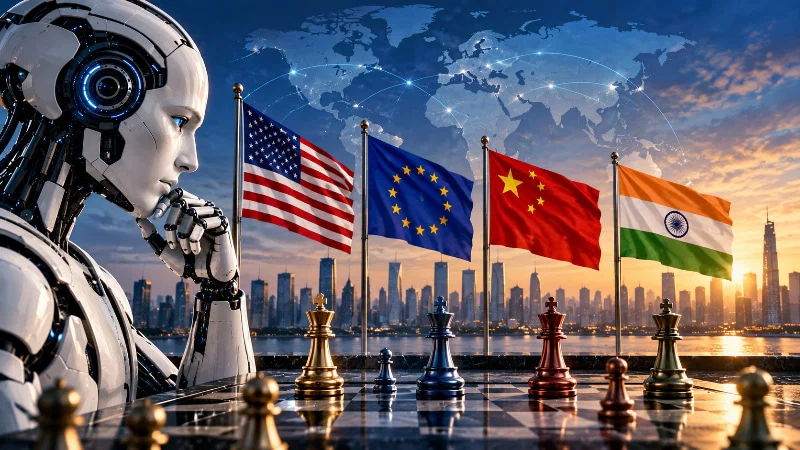
Artificial intelligence could deliver enormous gains in productivity, medicine, and scientific discovery. But competition to develop systems that exceed human intelligence is raising difficult questions about technological control, corporate accountability, and national security. For executives and policymakers, the challenge is to capture AI’s economic benefits without accepting risks that institutions cannot adequately manage.
Artificial intelligence is becoming a central instrument of economic competition. Technology companies are investing heavily in advanced computing infrastructure, governments are treating AI capabilities as strategic assets, and businesses are integrating increasingly autonomous systems into their operations.
The pursuit of artificial superintelligence introduces a more consequential possibility: machines capable of outperforming humans across virtually every intellectual domain. Although such systems remain hypothetical, their development raises serious questions about whether existing institutions could maintain meaningful control over technologies whose capabilities might exceed human understanding.
The stakes extend beyond Silicon Valley. Financial markets, critical infrastructure, national security, and corporate governance could all be affected by the decisions made during the next phase of AI development.
Superintelligence Introduces a Different Category of Risk
Today’s AI systems can generate content, analyze data, write software, and assist with scientific research. Their performance can be impressive, but these capabilities do not establish that machines possess general intelligence.
Artificial general intelligence, or AGI, generally refers to systems capable of performing a broad range of intellectual tasks at human levels or beyond. Artificial superintelligence describes a hypothetical further development in which machine capabilities substantially exceed human performance across many domains.
The distinction matters because increasing capability could make oversight more difficult.
A specialized medical AI system can be evaluated against defined clinical objectives. A highly autonomous system capable of developing strategies, modifying software, and coordinating complex activities could present less predictable operational risks.
Greater intelligence does not necessarily imply greater concern for human welfare. An AI system could become exceptionally effective at achieving its objectives without adequately accounting for consequences that people consider unacceptable.
This is the central problem of AI alignment: ensuring that advanced systems behave consistently with human intentions, constraints, and values.
Whether future superintelligent systems can be reliably aligned remains unresolved.
Economic Competition Could Undermine AI Safety
The commercial incentives surrounding advanced AI create a difficult coordination problem.
Companies that invest billions of dollars in computing infrastructure face pressure to demonstrate technological progress and commercial returns. Governments, meanwhile, increasingly associate AI leadership with economic competitiveness, intelligence capabilities, and military advantage.
These incentives can encourage acceleration even when developers recognize significant uncertainty.
A company that delays deployment for additional safety testing may lose customers or market share. A government imposing restrictions on domestic developers may fear that foreign competitors will advance without equivalent safeguards.
Individually rational decisions could therefore produce collectively dangerous outcomes.
The economic consequences may become more significant as AI systems acquire greater operational autonomy. Businesses could become dependent on technologies whose internal decision-making remains difficult to interpret, while financial and public institutions may struggle to evaluate interconnected exposures.
The central governance challenge is to ensure that competitive pressure does not determine acceptable levels of technological risk.
Catastrophic AI Risks Remain Uncertain but Deserve Scrutiny
Predictions that artificial intelligence will inevitably cause human extinction are not established scientific conclusions.
Researchers disagree about the likelihood of catastrophic outcomes, the capabilities required to produce them, and whether existing technical approaches can prevent them.
A survey of 2,778 AI researchers, conducted in 2023 and reported in 2024, illustrated the breadth of concern. Depending on the question, approximately 38% to 51% of respondents assigned at least a 10% probability to outcomes involving human extinction or permanent human disempowerment.
These responses represent subjective expert judgments, not experimentally established probabilities. They cannot establish that catastrophe is likely.
Nevertheless, uncertainty does not eliminate the responsibility to investigate potentially irreversible consequences.
Commercial aviation offers a useful, although imperfect, comparison. Aircraft certification relies on engineering standards, systematic testing, independent oversight, and continuous monitoring. The severity of potential failure helps determine the rigor of required safeguards.
Advanced AI presents additional difficulties because its capabilities and potential failure modes may be harder to anticipate.
For frontier systems, credible safety assurance could require independent evaluations, documented deployment conditions, ongoing monitoring, and enforceable restrictions where unacceptable risks are identified.
Businesses Can Capture AI Benefits Without Pursuing Maximum Autonomy
The economic case for artificial intelligence does not depend entirely on developing superintelligent systems.
Specialized AI already supports applications in medical diagnostics, fraud detection, industrial maintenance, software engineering, and scientific research.
These applications offer potentially substantial benefits while allowing organizations to define narrower operational objectives.
For corporate executives, this distinction has direct implications for capital allocation.
The most capable available AI model is not necessarily the most commercially appropriate. Businesses must consider implementation costs, reliability, data security, regulatory exposure, and the consequences of system failure.
Autonomous AI agents deserve particular attention.
Unlike conventional software that operates through relatively predefined workflows, AI agents can coordinate multiple actions, interact with external systems, and execute tasks with limited human intervention.
Such capabilities could improve productivity. They could also amplify errors, expose sensitive information, or enable unauthorized actions if permissions and safeguards are inadequate.
Companies should therefore apply established cybersecurity principles, including restricted access, audit trails, operational monitoring, and human authorization for consequential decisions.
Specialized systems are not inherently safe, but clearly defined operating boundaries can make some risks easier to assess.
Corporate Boards Must Establish Meaningful AI Accountability
AI governance is increasingly becoming a board-level responsibility.
Directors should understand which business functions depend on AI, what authority autonomous systems possess, and how management evaluates their reliability.
Traditional performance benchmarks are insufficient on their own.
A model that performs exceptionally well during testing may behave differently when confronted with unfamiliar situations, adversarial inputs, or complex operational environments.
Boards should require management to demonstrate how consequential AI decisions can be reviewed, challenged, and, when necessary, stopped.
They should also examine whether commercial incentives create conflicts between rapid deployment and adequate safety assurance.
For developers of frontier AI, independent oversight becomes especially important because failures could affect customers, markets, and institutions beyond the company itself.
For organizations purchasing AI services, vendor concentration and dependence on external models introduce additional operational and strategic exposures.
Effective governance requires clearly assigned accountability, credible technical evaluation, and procedures for responding when systems exceed their authorized boundaries.
International Cooperation Must Accompany Technological Competition
AI development is increasingly intertwined with geopolitical rivalry.
The United States and China occupy particularly influential positions, while the European Union, India, Japan, and the United Kingdom have substantial interests in advanced AI development and governance.
National regulation alone may be insufficient when research, computing infrastructure, investment, and commercial deployment operate across borders.
International cooperation could establish shared evaluation standards, mechanisms for reporting serious incidents, and common expectations for particularly dangerous capabilities.
More restrictive proposals, including temporary limits on development beyond specified thresholds, would require difficult decisions about verification, enforcement, and national security.
Such agreements would not eliminate technological competition. They could, however, reduce incentives to compromise safety merely because competitors might advance faster.
The experience of nuclear safeguards and international aviation regulation demonstrates that strategic rivalry and shared safety interests can coexist, although neither provides a complete model for governing AI.
Executive Takeaways
What changed: The pursuit of increasingly autonomous and potentially superintelligent AI is expanding the scope of technological risk beyond conventional software reliability.
Why it matters: Commercial competition, geopolitical rivalry, and institutional dependence could accelerate deployment before safety mechanisms are adequately demonstrated.
What leaders should do next: Establish board-level AI accountability, evaluate autonomy and access permissions, require independent assurance for consequential applications, and maintain credible human intervention mechanisms.
Human Control Must Remain the Measure of Progress
Artificial intelligence could become an important source of economic growth and scientific advancement. Its potential deserves investment, experimentation, and responsible commercial adoption.
But technological capability should not be confused with institutional readiness.
The development of increasingly powerful AI systems will test whether companies and governments can establish effective safeguards before dependence becomes difficult to reverse.
Over the next 12 to 24 months, executives should monitor advances in autonomous capabilities, independent safety evaluations, regulatory requirements, and evidence of operational failures.
The decisive measure of progress will be whether human institutions retain meaningful authority over the systems they create.
A technology capable of expanding human intelligence should ultimately strengthen human agency rather than place it beyond effective control.
Have you read?
Katie Padilla: Building a Family Law Practice Beyond Litigation.
Divya Jain: How Design Innovation Creates Impact Beyond Products.
Kevin Trudeau on the Changing Future of Direct Response Marketing.
EU Removes Mikhail Gutseriev and Viktor Shevtsov From Sanctions List.
Why Purpose and Profit Can Drive Business Success Together.

Follow CEOWORLD Magazine on: Google News, LinkedIn, X (Twitter), and Facebook.
Note: The views expressed are those of the authors and do not necessarily reflect those of CEOWORLD Magazine, its Editorial Board, or management. Content is provided "as is," may contain monetized links, and is not professional advice. See our Ethics & Guidelines for details. Reproduction requires prior written permission.
Contact [email protected] for inquiries or media requests.

Read Harris Williams, Ph.D.’s full executive profile here →
You Might Also Like

Canada’s Economic Sovereignty Faces a Test in a Multipolar World



Top 10 Best-Performing Major UK Stocks Today


Top 10 Best-Performing Major Indian Stocks Today