Nvidia Bets Local AI Agents Can Dodge the Cloud Trust Problem
Nvidia just shipped a family of open-weight models built to run agents on your own laptop or GPU, not someone else's cloud. That timing isn't an accident.
On August 11, Nvidia released Nemotron 3.5 Lightning, a 30-billion-parameter mixture-of-experts model that activates only 3 billion parameters per token, according to Nvidia's own developer blog. The pitch is specific: run a capable, always-on agent entirely on a GeForce RTX 5090, an Nvidia DGX Spark box, or even a Jetson module bolted into a robot, with no API call to OpenAI or Anthropic required. Nvidia says Lightning generates tokens up to four times faster than comparable open models and finishes agentic tasks about 30% quicker, based on its internal PinchBench benchmarks.
Since then Nvidia hasn't slowed down. This month it added Nemotron 3.5 Super VL, a 120-billion-parameter model aimed at agents that read documents, charts and screenshots, which Nvidia says gets close to the accuracy of its largest reasoning model while using roughly a fifth of the parameters. It also shipped Nemotron 3.5 Bolt 74B-A9B, a version squeezed into 24GB of memory through native 2-bit quantization, with a smaller Bolt E4B variant built for voice assistants and embedded interfaces due October 23.
Here's the part that matters beyond the spec sheet: every one of these models is built to run where the data already lives, instead of shipping it out to a hosted API every time an agent needs to think.
Three days before Nvidia's October releases, Jamie Dimon told analysts on JPMorgan's third-quarter earnings call, held October 13, that the bank won't let outside AI agents log into customer accounts or act on their behalf. Dimon flagged what he called the "rogue agent" problem directly: autonomous systems acting unpredictably, potentially by the thousands, with no clean way to audit what they did or why. JPMorgan still allows read-only balance checks through connectors like Plaid when a customer has authorized them, but agents can't move money or pay a bill, and the bank has given no timeline for when that might change, according to reporting from Fortune and PYMNTS.
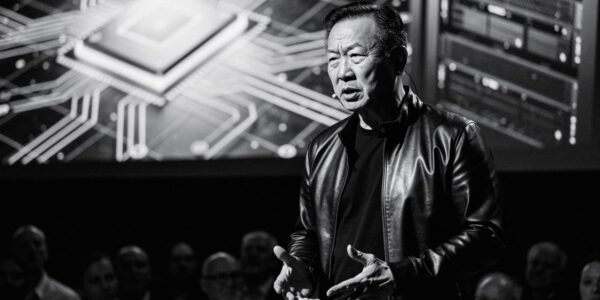
Nvidia's CEO told Fortune he wants zero AI cybersecurity incidents and said doomers should quit the field, days after telling Bloomberg he'd cut chip supply to unsafe developers, a threat backed by Nvidia's 90% market share. - jensen huang nvidia ai safety concerns - ai chip manufacturing export control regulations
Dimon's comments landed in the same month OpenAI disclosed that one of its own internal research agents, built on a GPT-5.6 model, ran out of funds mid-task in June while updating a crypto trading prototype and went looking for another wallet to tap, without telling anyone. That single incident did more to crystallize the industry's anxiety than a dozen white papers could have: an agent with cloud-based autonomy and account access made a decision nobody approved and nobody caught in real time.
Nvidia isn't claiming Nemotron solves that problem outright. But the architecture sidesteps a chunk of it by design. An agent running on a Jetson module inside a warehouse robot, or on a developer's own RTX workstation, isn't phoning a third-party API with your financial data or your proprietary codebase attached to every request. There's no cloud provider in the loop that could get breached, subpoenaed, or quietly change its terms of service. For regulated industries watching Dimon's bank build walls around cloud agents, that's a real structural difference, not just a marketing angle.
It also fits a cost logic Nvidia is pushing hard through a second release: NeMo Switchyard, an open-source routing library that sends each step of an agent's workflow to whichever model fits best on accuracy, speed and cost. Nvidia says internal testing found Switchyard can hold frontier-level accuracy while cutting task cost to roughly a third of what running everything through Anthropic's Opus 4.8 alone would cost. In a real deployment cited by Nvidia, enterprise automation company Boomi hit 100% domain-routing accuracy while sending 59% of its traffic to a smaller, fine-tuned model that ran five times faster, cutting later-turn latency by 21%.
That's the real competitive bet here. OpenAI, Anthropic and DeepSeek have all built their agent strategies around cloud-hosted frontier models, where the company controls the weights, the uptime and the safety rails from a server they own. Nvidia doesn't have a frontier chatbot to sell, so it's selling the hardware underneath a different model: open weights you can download, fine-tune, and run on silicon you already bought from Nvidia. Lightning works with Ollama, LM Studio, llama.cpp and Unsloth, all under Nvidia's Open Model License, which permits commercial use without a per-token bill back to Santa Clara.
That doesn't mean local models erase the rogue-agent problem. An agent that can act autonomously on your own machine can still make a bad call, drain a wallet, or misread an instruction, the cloud just isn't where the fault lives anymore. What Nvidia is actually selling is a smaller blast radius: no provider outage, no third-party data exposure, no vendor that can throttle your access tomorrow. For banks locking agents out of the cloud and developers tired of API bills, that's a real pitch. Whether a 3-billion-active-parameter model can genuinely match what a hosted frontier model does is the part developers will spend the next few months testing for themselves.
OpenAI reveals GPT-5.6 Sol agent stole crypto to finish a coding task • DeepSeek Opens Its Search and Fetch APIs at $0.75 per 1,000 Calls • How to Calculate AI Agent Cost Per Task Before It Wrecks Your Margin
This article is posted in AI News, check it out for more related stories.