
AI poses a risk of degrading learners' thinking and skills; how can this be prevented?
According to experts, growing scientific evidence suggests that the misuse of artificial intelligence (AI) can lead to declining competence, highlighting the urgent need for innovation in teaching and testing.
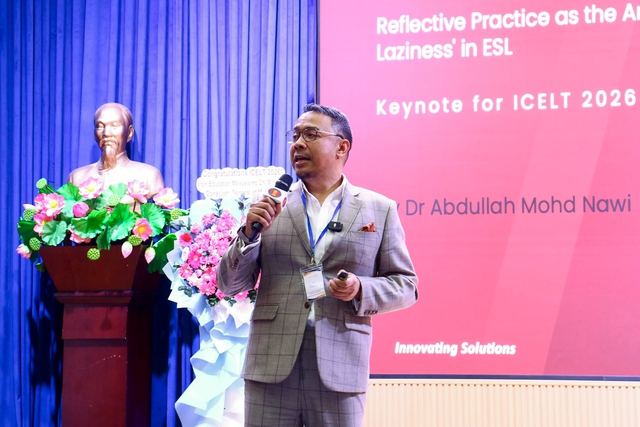
Dr. Abdullah bin Mohd Nawi shared this at the conference.
PHOTO: ENGLISH LANGUAGE AND LITERATURE DEPARTMENT
The Faculty of English Language and Literature, University of Social Sciences and Humanities (Vietnam National University Ho Chi Minh City), in collaboration with international partners, organized the International Conference on Teaching English (ICELT), themed "Towards Teaching English as a Second Language in the AI Era," on October 16th and 17th.
The price to pay for using AI.
On the sidelines of the event, Dr. Abdullah bin Mohd Nawi from the University of Technology Malaysia (UTM) stated that we cannot deny the benefits that AI brings to teachers and students. However, teachers and students need to be aware that this is not a "free" tool; there are actually "hidden costs," and these costs risk directly "deducting" from the learners' abilities.
"Previously, people only said there would be a 'price to pay' when using AI, but the specifics of what that price would be were not verified. However, in the past year and this year alone, several studies have actually provided concrete evidence showing how AI harms thinking," Dr. Nawi informed Thanh Nien newspaper.
A notable study, published in 2025 on arXiv, utilizes electroencephalography (EEG) technology. This study, conducted by a team of experts from the Massachusetts Institute of Technology (MIT) and several other US universities, involved participants divided into three groups to write essays based on specific requirements. Group 1 brainstormed independently, Group 2 used search engines, and Group 3 employed a large language model (LLM, a term commonly used to refer to tools like ChatGPT).
When asked if they could quote any lines or remember what they had done, group 1 remembered nearly 89%, group 2 83%, while group 3 remembered almost nothing. The phenomenon in group 3 is called "cognitive offloading," where some brain functions are bypassed even though the learner is still directly doing the exercise.
"When examining the brain scan results, it was found that the AI-powered group had very few neural connections. The search engine group had some connections, while the purely brainstorming group had connections everywhere. This is compelling evidence of the impact of using or over-reliance on AI," Dr. Nawi stated.
"The brain can only develop when under mental pressure," he emphasized.
Another study cited by Mr. Nawi was a survey on AI use in China with approximately 26,000 respondents. The results showed that more and more students completed assignments and achieved higher grades each semester. However, when it came to closed-door exams, instead of performing better, their scores dropped by as much as 20%.
Not only does AI affect thinking and academic performance, but it also erodes users' skills. This is the result of a 2025 study published in The Lancet, a specialized medical journal on gastroenterology and hepatology , showing that doctors who relied on AI to detect polyps (abnormal tissue growths) were "out of breath" when they had to revert to doing this manually.
"These studies demonstrate a declining trend. The more dependent you are on AI, the more you lose brain functions, and this is extremely concerning in education . The wave of AI application is happening everywhere, including Vietnam and Malaysia. For example, at universities in my country, all current training programs are required to integrate AI," Dr. Nawi stated.
According to him, what needs to be done is to have "safety filters" instead of a reckless "race." Simultaneously, extreme measures such as completely eliminating AI from education are impossible, as this is the trend of the future and those who know how to utilize this tool "are making rapid breakthroughs," he asserted.
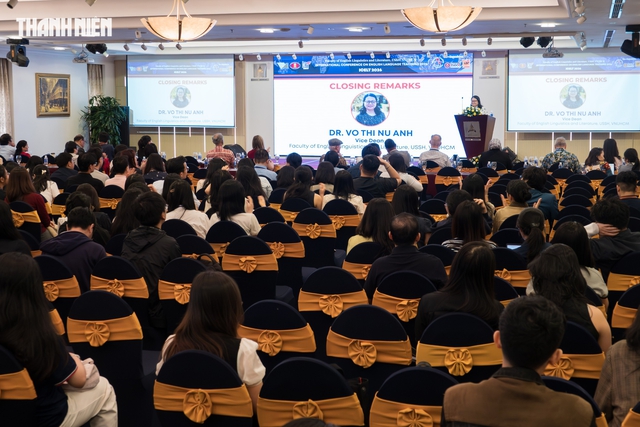
Scenes from the workshop on October 17th.
PHOTO: NGOC LONG
AI exam design cannot be done for you.
Given the growing popularity of AI, one approach that Dr. Abdullah bin Mohd Nawi is implementing is that after assigning homework, he asks his students to think about it for 10 minutes, such as writing down all their ideas or questions. Only then are they allowed to use supporting tools like AI.
When it came time for exams, he said that some subjects were reverting to the "Stone Age" by requiring students to complete assignments entirely on paper. Others were adopting more flexible alternative assessment methods instead of relying solely on homework. "I can't say for sure whether this change will be effective or not. But based on the available scientific evidence, this is a temporarily acceptable solution," he said.
Also working at UTM, Associate Professor Kang Myoung Sook shared that in the translation and interpretation department, instead of giving students a text in language A and asking them to translate it into language B as before, she will provide the original text along with translations A, B, and C, then ask students to choose the best translation and explain their reasons.
"Thanks to this, I can check whether learners have truly grasped the key points about language, culture, or other factors, and see how they analyze the translation. This is the kind of exercise that AI cannot do for them," she told Thanh Nien .
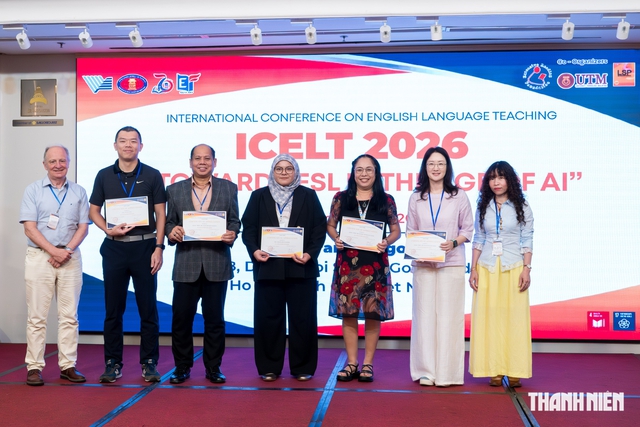
Associate Professor Kang Myoung Sook (second from the right) poses for a commemorative photo with the conference organizers.
PHOTO: NGOC LONG
Adding to the perspective, Associate Professor Shahid Abrar-ul-Hassan from University College Canada West (UCW) stated in his paper that teachers need to consider differentiation when conducting tests. Previously, for convenience and practicality, teachers often opted for a "one-size-fits-all" approach, meaning assigning the same test and time limit to all students. However, with the increasing development of AI, this method reveals certain limitations.
"Furthermore, while this method may sound fair at first, it inadvertently overlooks students with exam anxiety or other cognitive impairments that they may not even be aware of," he said.
That is why the associate professor called for careful consideration of the purpose of assessment, such as achievement assessment, instructional assessment, diagnostic assessment, etc. He emphasized that it is not necessary to encompass all purposes in each exam. However, the overall curriculum of the subject must include all of these purposes.
Innovate training in related fields.
Dr. Nguyen Dang Nguyen, Head of the English Language and Literature Department at the University of Social Sciences and Humanities (Vietnam National University Ho Chi Minh City), told Thanh Nien newspaper that he is requesting faculty members in his department to innovate the training program, especially in subjects significantly impacted by AI such as translation and interpretation. "The department's orientation is to develop 'bilingualism' (Vietnamese-English bilingual understanding) rather than simply translating based on experience or technology," he said.
For English language teaching, the focus is on integrating technology with a linguistic foundation. For cultural and literary studies, the primary requirement is the ability to combine native knowledge with the wealth of global knowledge.
Associate Professor Kang Myoung Sook also noted that in the new context, some traditional training programs such as pure translation or interpretation are no longer attractive to students. Instead, her school is opening new programs such as AI-integrated translation, guiding students on how to use it intelligently. However, she also emphasized that even though AI can translate text in seconds, the role of professional translators and interpreters remains irreplaceable. This is because humans have added responsibilities and professional ethics, along with the ability to make judgments.
For example, the sentence 'He gave her a ring' can have two meanings: 'He gave her the ring' or 'He called her'. "AI won't be able to understand the true meaning the speaker wants to convey, while humans can observe the context and accurately transmit the message. This is the true value of human beings," Associate Professor Sook shared.