AI Reverse Engineering Shakes Software Industry
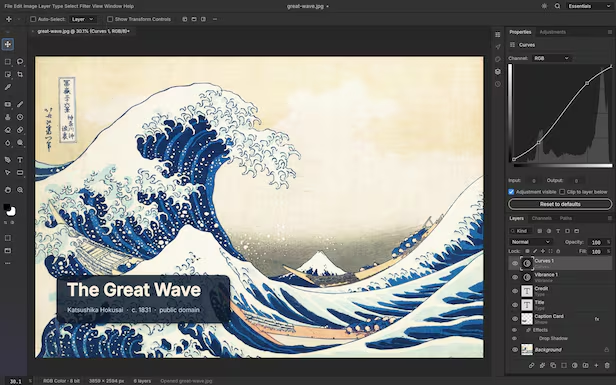
Brandon Thomas, a U.S. software developer, recently created software with functionalities similar to Adobe’s Photoshop, Illustrator, and Premiere Pro, as well as seven other programs, using artificial intelligence (AI). He later developed programs modeled after Microsoft’s Word, Excel, and PowerPoint. Thomas, who founded AI video and voice generation company Storyteller AI, released these programs for free. As news spread that core features of existing commercial software could be replicated with AI, financial markets reacted. On the 13th, British financial firm HSBC lowered its investment rating for Adobe from “Buy” to “Hold” and reduced its target stock price from $310 to $267, a 13.9% decrease.
The repeated cases of cloning Adobe and Microsoft programs have made AI-powered “reverse engineering” a new topic of discussion in the software industry. Reverse engineering involves analyzing the internal structure and operation of completed software to implement similar functions in new code. It is akin to disassembling a newly released car to understand its engine and transmission structure, then using that knowledge to build a similar vehicle. With AI supporting such analysis and development, experts predict that the time and cost required to replicate existing software functions could decrease.
◇Reporter’s Test…Document Editing Function Replicated in 3 Minutes
While reverse engineering technology for software has existed before, it has recently gained significant traction with the release of the AI reverse engineering tool “REA (Reverse Engineer Anything)” on GitHub, the world’s largest software development platform. REA connects AI coding tools like OpenAI’s Codex and Anthropic’s Claude Code with specialized reverse engineering tools to help analyze a program’s structure and operation. Notably, it allows users to input only necessary information from vast analysis results, reducing token usage and costs. This lowered barrier to analyzing existing programs is expected to spur more attempts to replicate software functions using AI.
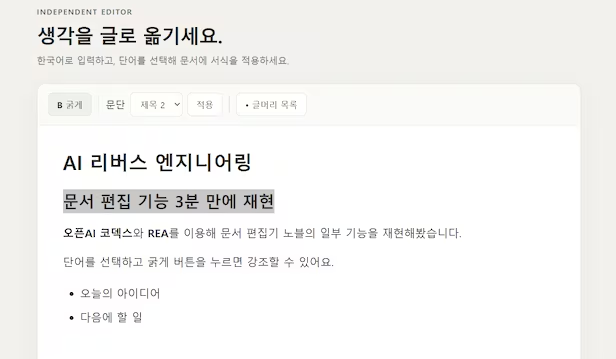
A reporter tested REA and OpenAI Codex to replicate some functions of “Novel,” an open-source document editor. Investigating the program’s structure with REA took approximately 7 seconds. Codex then read the open-source code and implemented and verified editing functions like titles, bold text, and bullet points in 3 minutes and 3 seconds. All 15 tests comparing the original and replicated results matched. An additional 3 minutes and 44 seconds were spent creating the editing interface, which passed 14 operational tests. When the reporter input Korean text and applied titles and bold formatting, it functioned normally.
AI reverse engineering is gaining attention because it can analyze not only the functions but also the design methods and development know-how accumulated by software companies over long periods. Unlike “vibe coding,” where users describe desired functions to AI to create programs, reverse engineering involves investigating completed programs to understand their implementation methods.
Reactions in the software industry are mixed. Dutch developer and entrepreneur Peter Levels stated, “Software is dead. People will create programs they need on demand or ask AI to do so.” He suggested that as AI enables anyone to create necessary programs, more users might opt to implement only required functions instead of paying expensive subscription fees for commercial software.
Conversely, Brazilian developer Fabio Akita refuted the “end of the software industry” theory, stating, “AI-generated alternatives have errors and missing functions, and it is difficult to analyze all features of commercial products externally.”
◇Domestic Attempt to Replicate ‘HWP’…Potential Copyright Disputes
In South Korea, a developer publicly released “Tangul2026,” a program capable of reading and editing Hancom’s HWP and HWPX file formats, using AI reverse engineering tools. The developer explained that the program was created for educational and demonstration purposes. While it does not fully replicate all functions of Hancom’s “HWP” or Microsoft Word, it marks the emergence of domestic attempts to recreate commercial software functions using AI.
As AI-driven reverse engineering and function replication attempts increase globally, legal disputes over copyright infringement are also expected to rise. South Korea’s Copyright Act permits analyzing a program’s operational principles or code for compatibility under certain conditions. However, using the obtained information beyond permitted purposes or unauthorized replication of protected code from the original can lead to copyright issues.
A source from the tech industry stated, “AI allows companies to implement functions that took decades to develop in a much shorter time. Conflicts over copyright and technology protection could intensify between companies that invested heavily in development and latecomers that replicate functions cheaply.”