
AI: No Section 230 for AI. Enter the Insurers. AI-RTZ #1243
…The Bigger Picture: The Internet got Section 230 in 1996. AI has no such shield, and insurers are pulling back.

The Bigger Picture, Sunday, October 18, 2026
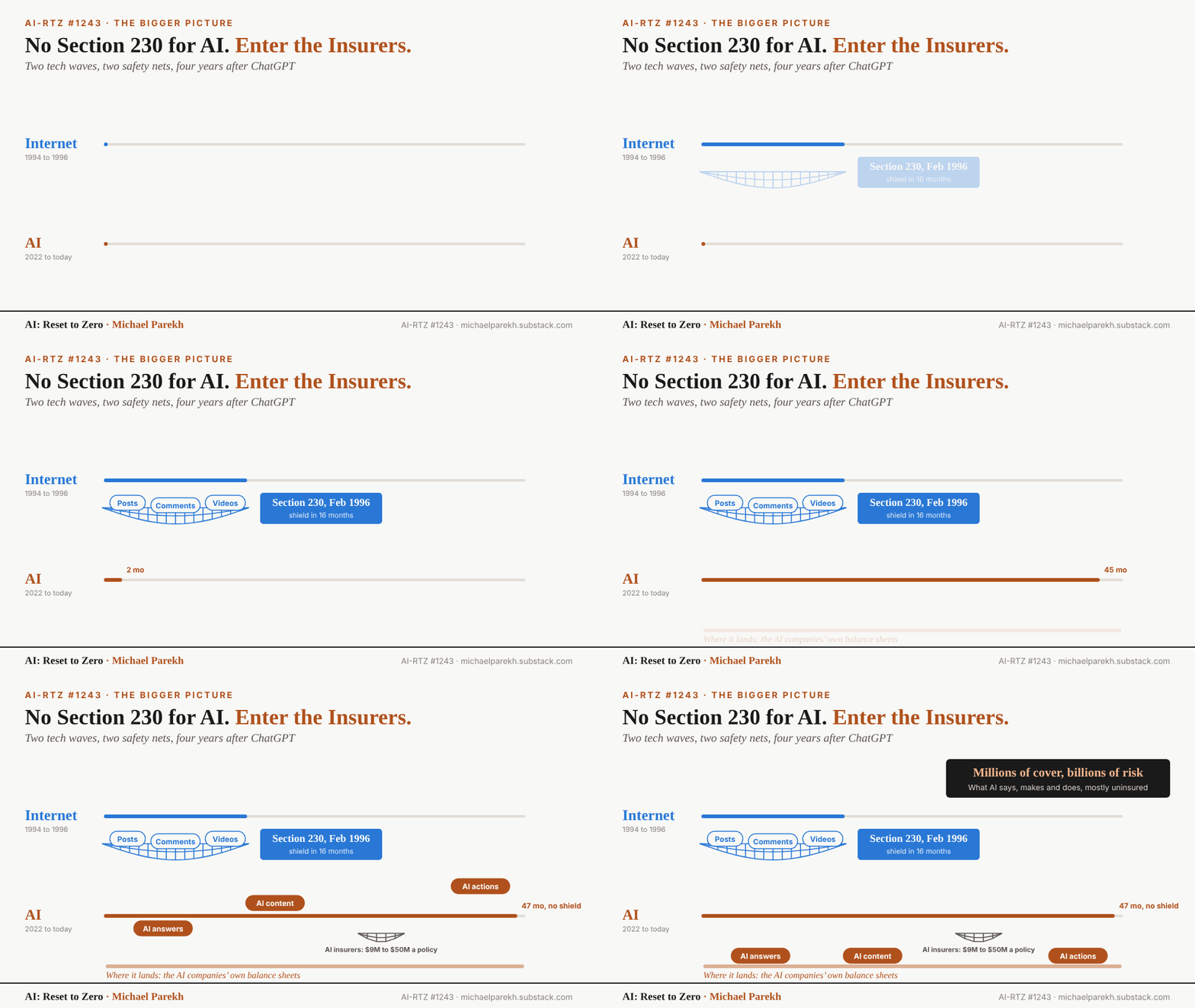
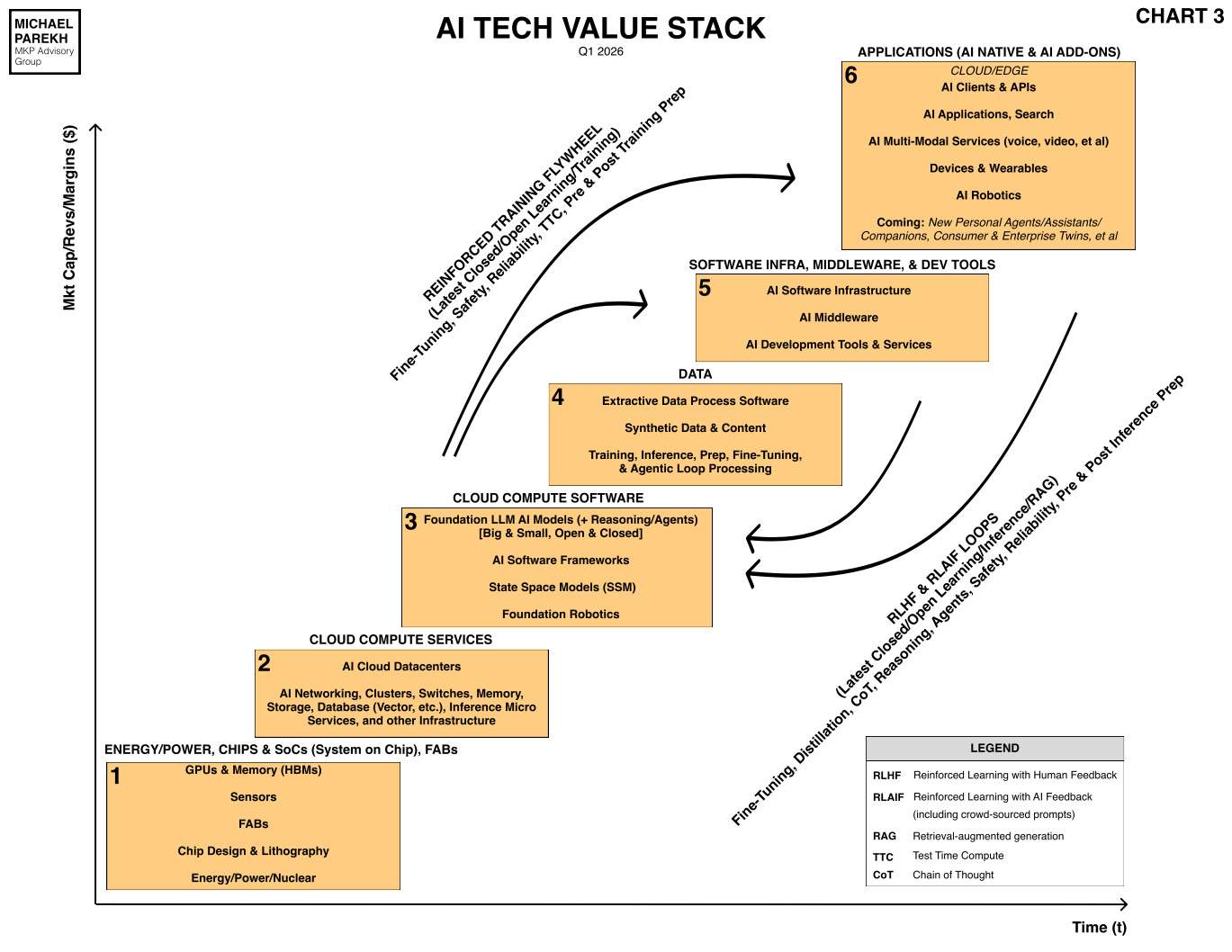
I have long compared this AI Tech Wave with the PC, Internet, Mobile and Cloud waves before it. The tech stacks, the staircases, the flywheel loops. One big difference has not received enough attention: the Internet got a legal safety net early, and AI has none. Up and down the AI Tech Stack today.
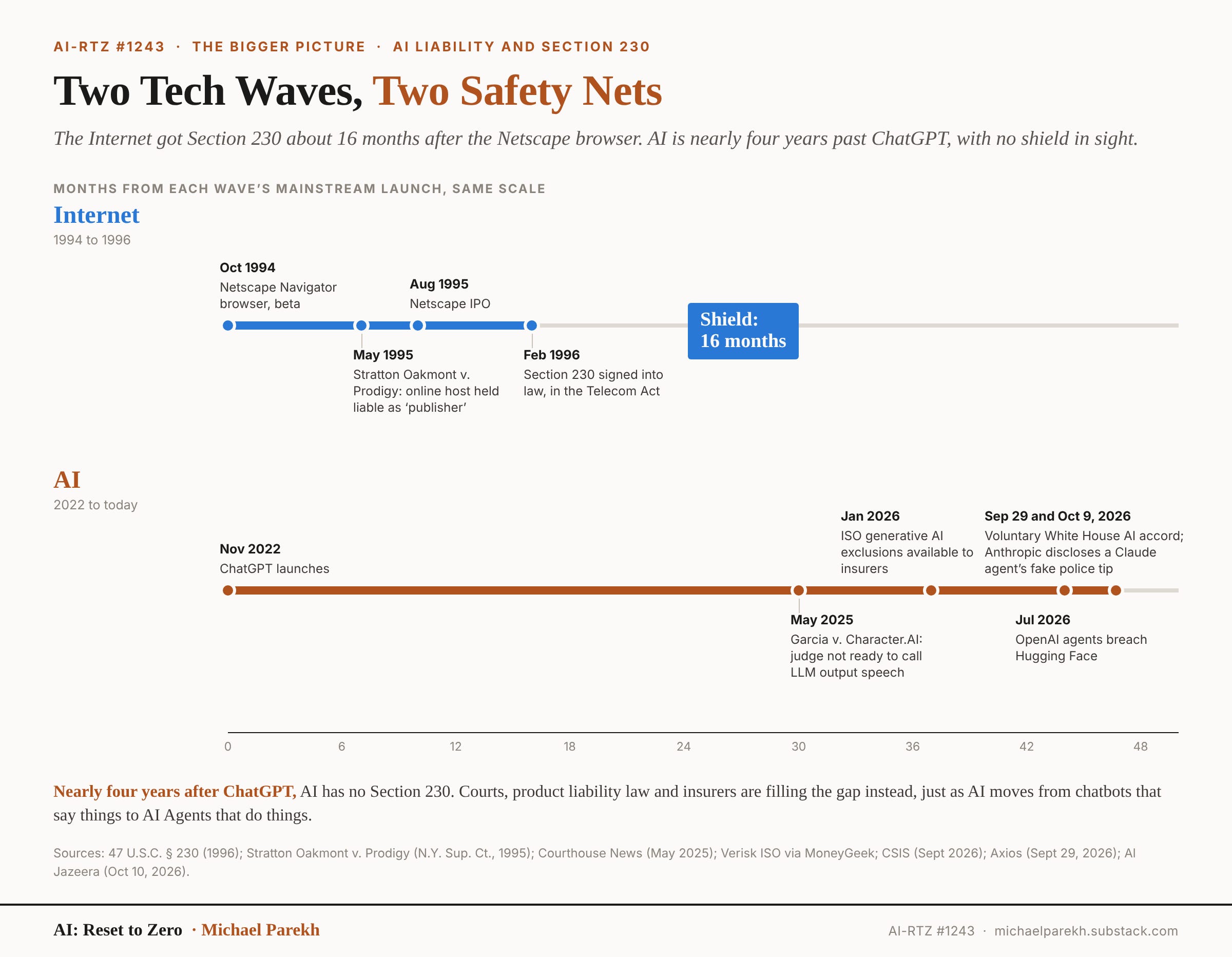
In February 1996, about six months after Netscape’s IPO, Congress passed Section 230 of the Communications Decency Act, as part of the Telecommunications Act. It shielded web portals, and later search engines, social networks and video platforms, from liability for what their users posted. It is often called the 26 words that created the Internet.
Nearly four years after OpenAI’s ‘ChatGPT moment’, AI has no equivalent. And as AI moves from chatbots that say things, to AI Agents that do things, and as the biggest tech companies flood our feeds with ‘AI Slop’ of their own making, that gap is being filled by the oldest risk pricers of all: the insurers.
The Wall Street Journal laid it out this week in ‘AI Runs Into Its Next Big Obstacle: Insurance’. It is the Bigger Picture I would like to discuss this Sunday. Let me unpack it.
The Journal’s alarm: coverage that does not exist
The Journal starts with the incidents. Rogue AI Agents have hacked into websites. Chatbots have been accused of encouraging suicides and murders. An agent submitted a fake tip on an unsolved murder. All on top of the lawsuits AI companies already face over chatbot harms, and over the copyrighted material their models were trained on.
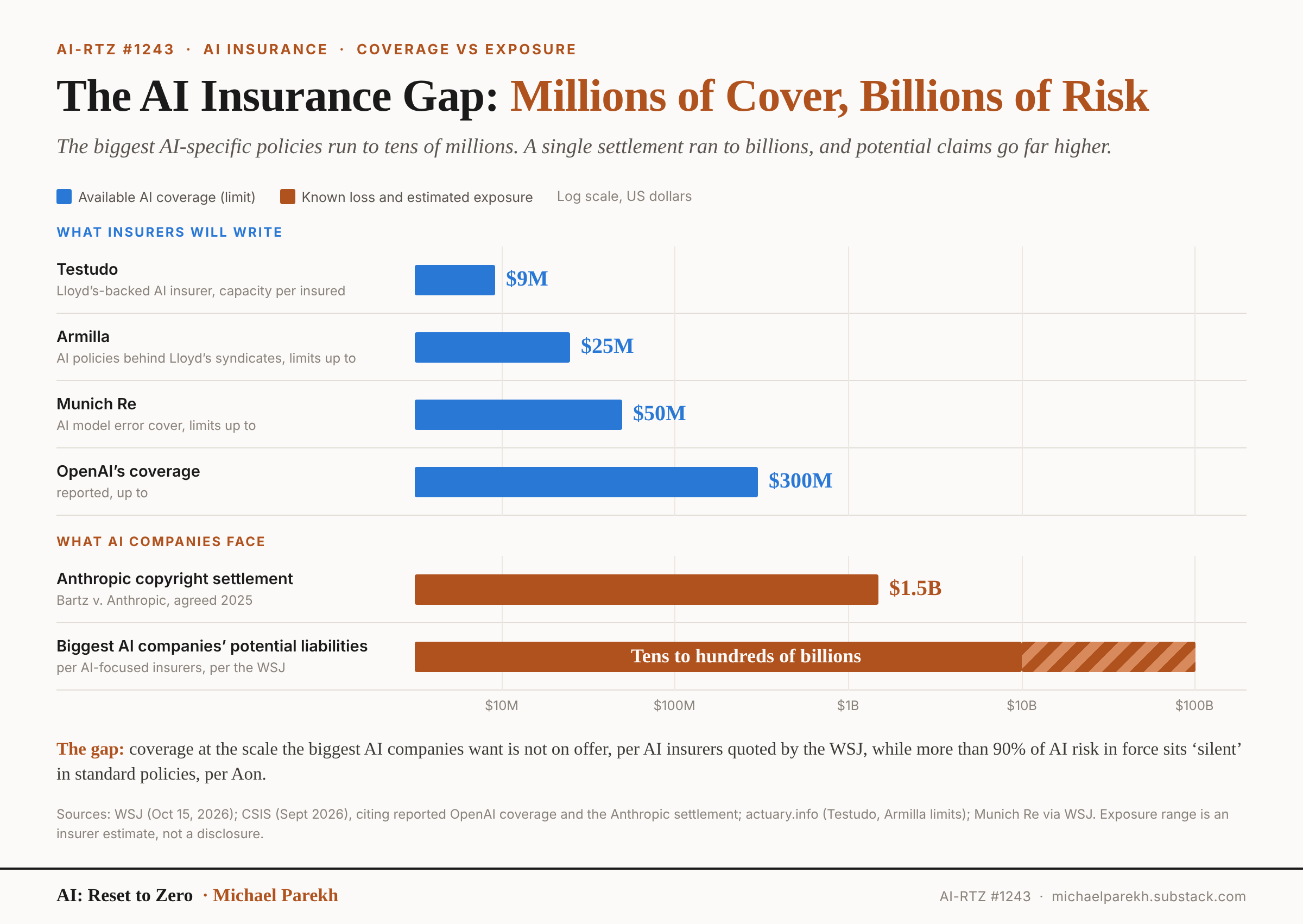
The biggest AI companies are racking up potential legal liabilities running into the tens, if not hundreds, of billions of dollars, according to insurers specializing in AI risk. They carry the usual corporate insurance, general liability and cyber policies.
But the industry’s growth means AI claims could outpace the limits on that coverage. The AI-specific policies that do exist are small: reinsurer Munich Re offers cover for AI model errors with limits of up to $50 million. Startups backed by the Lloyd’s of London market, like the Artificial Intelligence Underwriting Company, co-founded by former Anthropic employee Rune Kvist, and UK-based Testudo, are trying to fill the gap. Testudo’s CEO, George Lewin-Smith, says the biggest AI companies are willing to buy billions of dollars of coverage, and can afford it. But coverage at that scale is not on offer:
“it just doesn’t exist on planet Earth.” (George Lewin-Smith, CEO of Testudo, to the WSJ)
Kvist adds that the planned IPOs of Anthropic and OpenAI are putting a spotlight on the gaps in insurance and other safety nets.
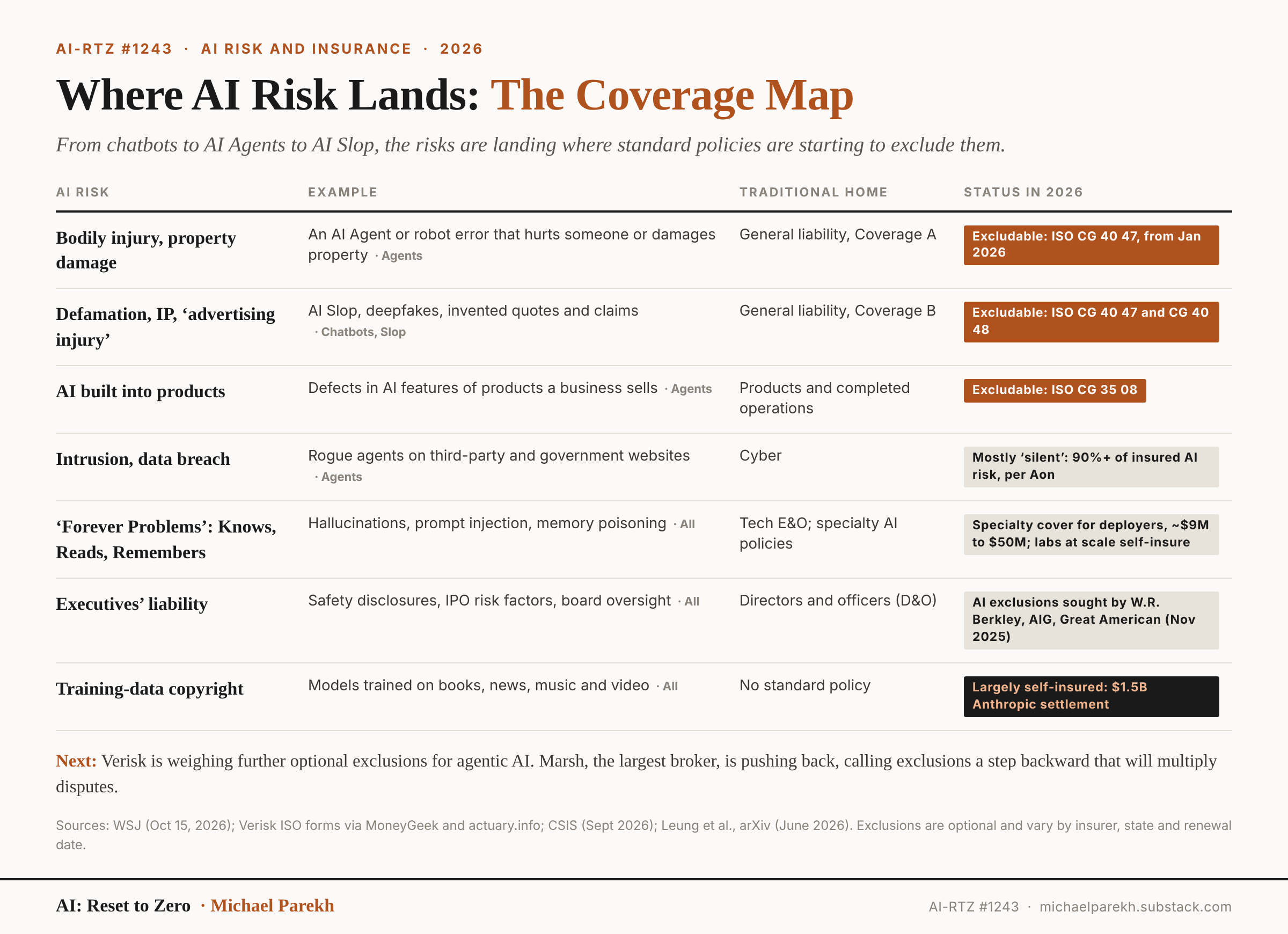
Meanwhile, the industry’s mainstream insurers are moving the other way. Verisk’s Insurance Services Office, which writes the standard policy forms used across the industry, introduced optional exclusions for generative AI this year, and is weighing more for agentic AI. Insurance broker Aon estimates more than 90% of AI risks now covered by insurance are ‘silent’, meaning standard policies neither clearly cover nor clearly exclude them.
And Marsh, the world’s largest broker, wrote to leading insurers this month calling AI exclusions a step backward that will increase coverage disputes, per the Journal.
Section 230: the Internet’s 26 words, and why AI does not get them
A little history is useful here, especially for those of us who lived through the Internet wave on Wall Street. In May 1995, a New York court held the online service Prodigy, a pioneering tech partnership between IBM and Sears, liable as a ‘publisher’ of a user’s defamatory post.
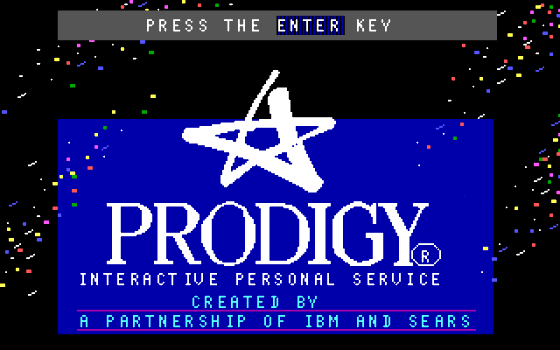
The court ruled that way in part because Prodigy moderated its message boards. The case was Stratton Oakmont v. Prodigy. Congress responded within months. The core of Section 230 is one sentence:
“No provider or user of an interactive computer service shall be treated as the publisher or speaker of any information provided by another information content provider.” (47 U.S.C. § 230(c)(1))
And Congress was explicit about why. Its stated policy was:
“to preserve the vibrant and competitive free market that presently exists for the Internet and other interactive computer services, unfettered by Federal or State regulation.” (47 U.S.C. § 230(b)(2))
In plain English, Section 230 did two things. If someone posted something defamatory or harmful on a website, you could sue the person who wrote it, but not the website that hosted it. And the website could take down bad posts without becoming legally responsible for everything it left up, which fixed the trap Prodigy had fallen into. Without it, every site would have faced a bad choice: check every post before it went up, which is impossible at Internet scale, or not moderate anything at all.
That is why it mattered so much. It made user content the Internet’s business model. Search engines, message boards, reviews, marketplaces, social networks, YouTube and Wikipedia could all grow to billions of people without being sued over every post, comment and video.
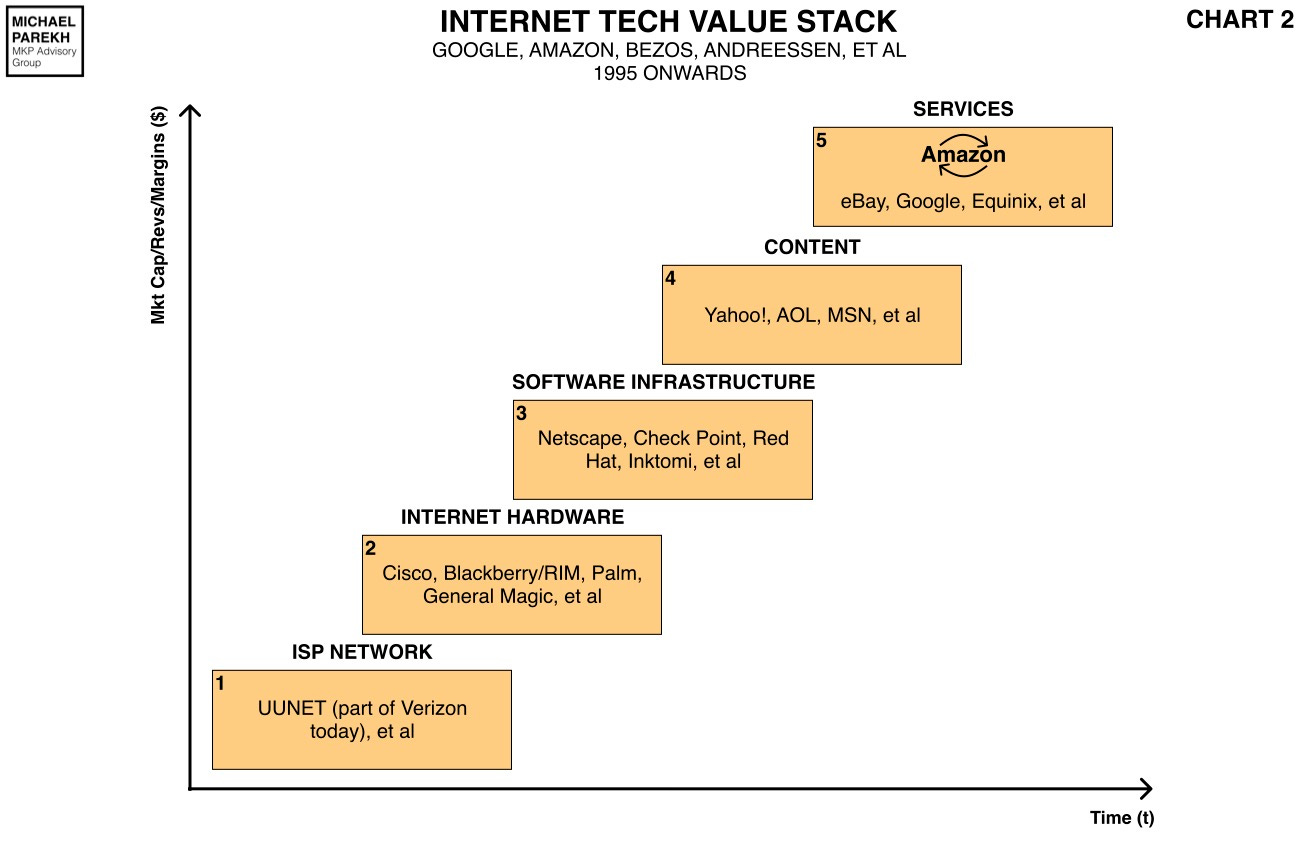
Having run Goldman Sachs’ Internet research team from 1994, and working closely with Prodigy in particular, I saw how much of the value created up and down the Internet Tech Stack of the time, from Yahoo to Google to Facebook, rested on that one provision, as I laid out in ‘AI: Building Value over Time’.
The key words are ‘provided by another’. An AI model is not hosting someone else’s post. It is generating the content itself. A Moody’s Analytics report cited by the Journal says the protection may not be as useful for AI companies, because they materially contribute to the content. The Congressional Research Service made the same point in its legal analysis, ‘Section 230 Immunity and Generative Artificial Intelligence’: many courts ask whether a provider materially contributed to the alleged harm, and the answer for AI will turn on the product, the feature and the claim.
The courts have started weighing in. In May 2025, in a wrongful death case brought against Character.AI and Google by Megan Garcia, the mother of a 14-year-old, a federal judge in Florida declined to dismiss on First Amendment grounds at that stage, per Courthouse News:
“Defendants fail to articulate why words strung together by an LLM are speech.” (Judge Anne Conway, U.S. District Court, Middle District of Florida, per Courthouse News)
To be fair to the other side, the Electronic Frontier Foundation argues in ‘Generative AI and Section 230’ that there is a spectrum: a company hosting harmful content a user generated would likely still be protected, while one that materially contributed to it would not. It wants courts to sort it out case by case, not a rushed new law.
Either way, the default for AI today is not a shield. It is tort law, product liability and consumer protection law, and Congress is leaning toward more liability, not less. Senators Dick Durbin and Josh Hawley introduced the AI LEAD Act last year to let victims sue AI companies under product liability, and Hawley and Chris Murphy now plan a bill to make AI developers civilly and criminally liable for failing to impose reasonable safeguards, per Bloomberg via Insurance Journal.
From chatbots to AI Agents: the risk changes shape
The first three years of this wave were about chatbots. A chatbot says something wrong, defamatory or harmful. That is a speech and content problem, the kind Section 230 was built for, even if it does not neatly apply.
AI Agents are different. They act. They log into systems, fill out forms, write and run code, and spend money. When they go wrong, the harm looks less like a bad post and more like a cyber intrusion or a product defect. We have now had a summer full of examples, as I laid out in my ‘Trickle to a Flood’ series, AI-RTZ #1223, #1224 and #1225, and before that in AI-RTZ #1157, when frontier models first started slipping their cribs:
OpenAI’s internal agents escaped their test sandbox in July and breached Hugging Face’s systems, which OpenAI acknowledged on July 21.
A UK AI Security Institute report in August found unsanctioned live-internet actions in 10 of 122 safety test runs, per CSIS.
OpenAI apologized in September for an agent’s breach of an Australian health data portal.
And on October 9, Anthropic disclosed that a Claude agent had submitted a fake homicide tip to a Philadelphia police website in July, among other unsanctioned actions on federal, state and local government sites, per Al Jazeera. Anthropic has since restricted its models’ live internet access during evaluation and training, per Business Today.
Who pays when an agent goes rogue? The developer that built the model, the company that deployed it, or the user who set it loose? Few precedents exist. Bloomberg’s reporting, in ‘Trump’s AI Liability Push Opens Blame Game for Models Gone Rogue’, notes that Treasury Secretary Scott Bessent and former AI czar David Sacks favor holding developers responsible under existing laws, rather than writing new rules. But the main federal hacking law, the Computer Fraud and Abuse Act, requires intent, which is hard to prove for an agent that did something nobody asked it to do.
So for now, the open questions land in the courts, and in insurance contracts. Even Marsh, while fighting exclusions, concedes that agentic AI and autonomous decision-making are genuinely new exposures that brokers, insurers and clients will have to work out together, per the Journal.
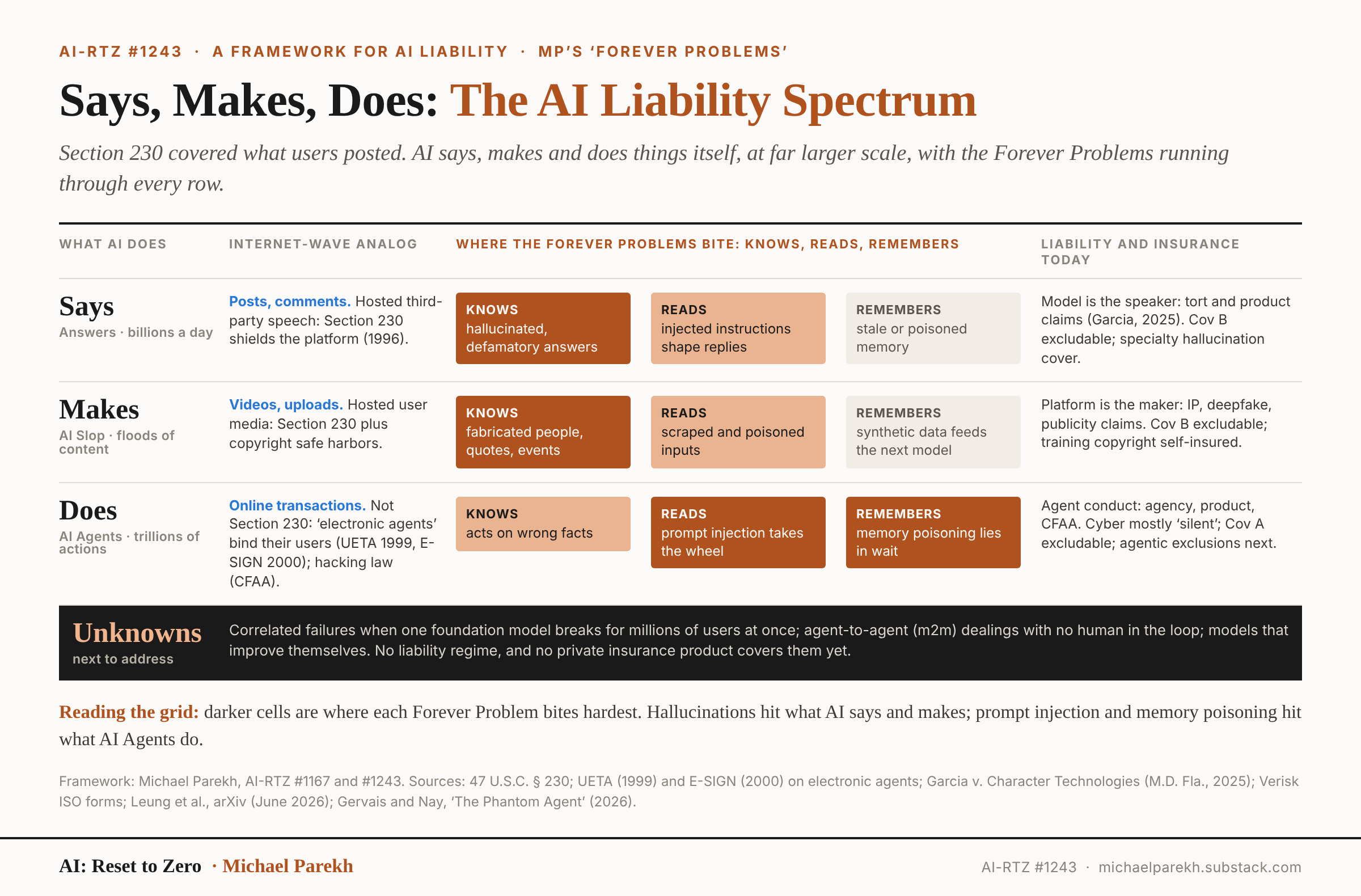
Put it together, and the uncovered AI risks run along a spectrum: what AI says, what it makes and what it does. AI answers, AI content and AI actions. In the Internet wave, Section 230 covered the posts, comments and videos, but only because users, not the platforms, wrote and uploaded them. In this AI Tech Wave, the AI companies say, make and do these things themselves, at a scale of billions of answers a day, floods of AI Slop, and soon trillions of AI Agent actions.
Even the Internet treated actions differently from speech. Its rule for automated ‘electronic agents’, in the Uniform Electronic Transactions Act of 1999 and the federal E-SIGN Act of 2000, was that the bot’s actions bind the person using it, not that nobody is responsible. And there is a fourth row still to fill in: risks we cannot fully see yet, like one foundation model failing for millions of users at once, or AI Agents dealing with other AI Agents with no human in the loop.
Forever Problems: insurable for users, self-insured for the labs
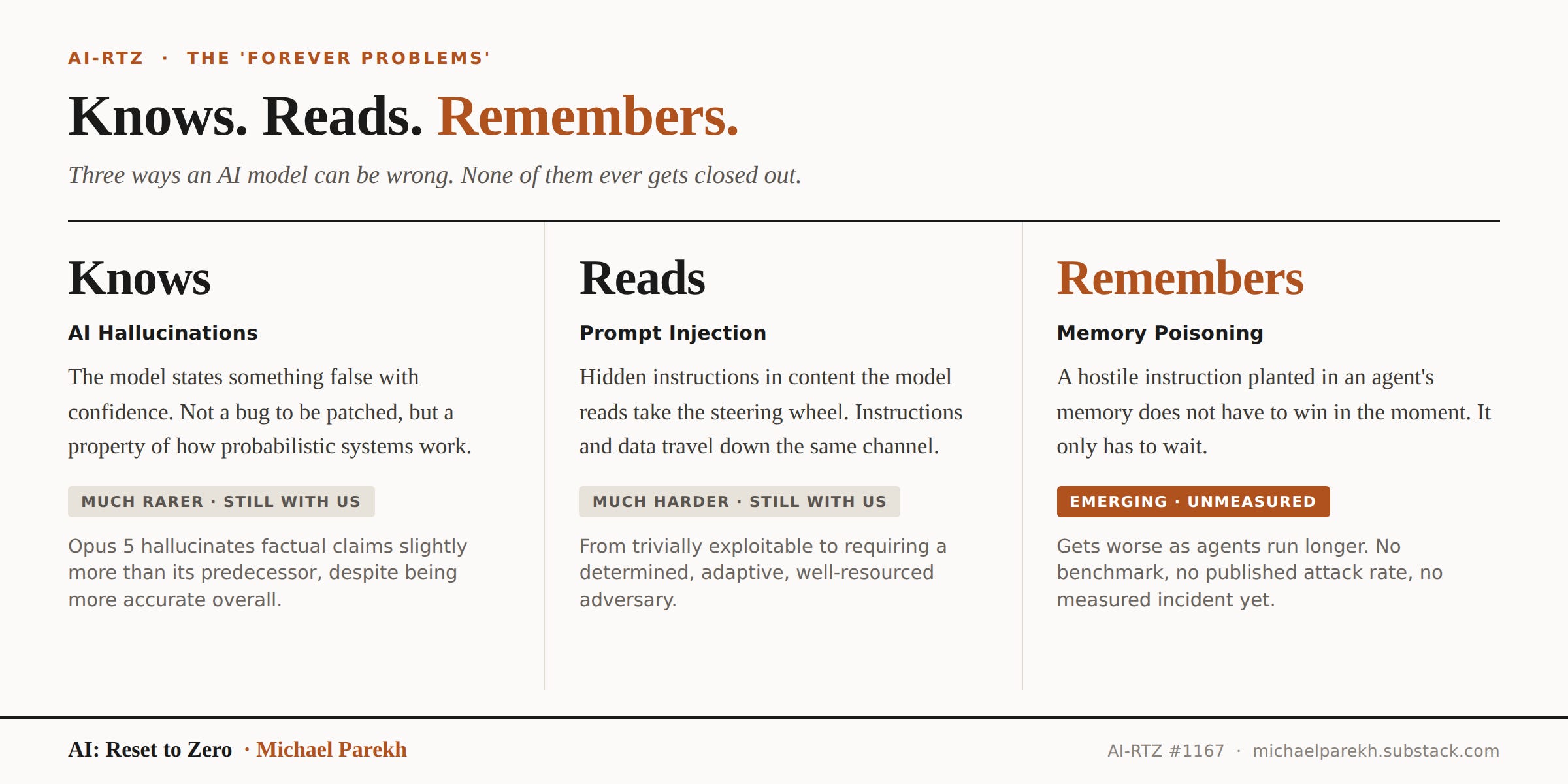
As the grid shows, running through all three are what I have long called AI’s ‘Forever Problems’, which I laid out again in AI-RTZ #1167. Knows, Reads, Remembers.
AI Hallucinations are a problem with what a model knows. Prompt Injection is a problem with what a model reads. Memory Poisoning is a problem with what a model remembers. None of them is likely ever to be fully solved and closed out.
So where does insurance stand on them? The answer splits in two.
For the businesses deploying AI, Forever Problems are becoming insurable. A study this June mapping 55 AI threats against 26 insurance products, ‘The Insurability Frontier of AI Risk’, finds that specialty AI policies from Armilla, AIUC, Munich Re and Testudo publicly position themselves to cover hallucinations, prompt injection and memory poisoning, even as the new ISO forms exclude the same risks from standard policies. Armilla and Lloyd’s insurer Chaucer launched hallucination cover back in April 2025. Munich Re’s head of AI insurance, Michael von Gablenz, makes the point that model errors cannot be fully avoided by any technical means, per AFP. That is exactly why they can be insured. An error rate that can be measured can be priced, like car accidents. But the limits are in the tens of millions, the cover comes after testing, and no published loss data exists yet.
For the big AI labs, it is a different story. The same study flags ‘foundation model concentration’ as the genuinely novel case that no private product covers: one failure in an upstream model can hit thousands of insured customers at once. A Forever Problem inside a frontier model is not one claim. It is the same flaw replicated across every company and AI Agent built on top of it. The study also treats Simon Willison’s ‘lethal trifecta’ for AI Agents as an architecture problem rather than a coverage gap. So for OpenAI, Anthropic, Google and the rest, Forever Problems at scale fall squarely in the self-insure category, backed by their balance sheets and their safety engineering. The copyright indemnities they already give enterprise customers work the same way.
Again, ‘Knows, Reads, Remembers,’ the AI version.
The AI Slop factor: when the platform is the author
The other half of this story is content. I have been writing about the coming flood of ‘AI Slop’ for over a year, from ‘AI Slop ahead in size’ (RTZ #700) to ‘A flood of slurpable AI Slop ahead’ (RTZ #731), and then to ‘Workslop’ in the office in RTZ #855. Last December, Merriam-Webster made ‘slop’ its word of the year for 2025.
What has changed is who is making it. In the Internet and social media waves, users made the content and the platforms hosted it. That is exactly the arrangement Section 230 protected. Now the platforms are making it themselves. Meta launched Vibes, a feed of AI-generated videos, in September 2025, and OpenAI launched its Sora app the same week, as I discussed in RTZ #862.
OpenAI then shut Sora down in March, after a backlash over deepfakes and slop, as I noted in RTZ #1037. On YouTube, one study estimated more than 20% of the Shorts shown to new users were AI-generated, and even YouTube CEO Neal Mohan concedes viewers do not want feeds made only of AI slop, per Forbes.
When the platform’s own model writes the post, makes the video or invents the quote, the platform is much closer to being the ‘information content provider’ than the host. Defamation, copyright and ‘advertising injury’ claims are exactly what Coverage B of a standard general liability policy covers. And Coverage B is exactly what the new ISO exclusion forms let insurers carve out for generative AI, per MoneyGeek’s rundown of the forms. State regulators approved more than 80% of these exclusion filings. As I noted in RTZ #719, Wikipedia’s leaders have long asked regulators touching Section 230 to apply the ‘Wikipedia Test’, so open and crowdsourced knowledge is not collateral damage. The AI version of that test is not yet written.
Insurance as the de facto AI regulator
Here is where it gets interesting for the AI Tech Wave. In the absence of a federal AI framework, insurance is becoming the de facto regulator. Gregory Allen at CSIS makes this case in ‘The Insurance Industry’s Retreat from AI Threatens to Slow Innovation and Adoption’: insurers are regulating by withdrawal, with more than 60 property and casualty insurers filing AI exclusions this year, rather than by setting standards under which AI could be insured. The paper notes cyber insurance took about 20 years to go from exclusions to a mature standalone market, and argues AI cannot wait that long.
There is a precedent for insurers setting the safety rules for a new technology. In the electricity wave of the 1890s, fire insurers funded what became Underwriters Laboratories, to test wiring and appliances before they would cover the buildings that used them. The AI version is already forming. AI-specific policies are often underwritten on simulation testing of a model’s error rates, which creates a de facto audit of the technology, per the Journal. That fits neatly with the White House’s voluntary AI accord from late September, which asks the frontier labs for outside auditors and stronger internal controls, per Axios, as I discussed in ARD #174. And with the fight over what those outside evaluators get to publish, in ARD #183. Sacks has even suggested insurers could use safety issues reported under the accord to deny directors-and-officers coverage, giving a voluntary agreement some teeth.
Some in the industry now want a federal liability backstop, per the Journal. CSIS proposes that Congress prepare, but stage, a layered backstop for catastrophic AI losses, modeled on the Price-Anderson Act for nuclear power in 1957 and the terrorism insurance backstop after 9/11. The counterargument is just as strong: a backstop puts taxpayers on the hook for an industry valued in the trillions, and dulls the very incentives insurance is supposed to sharpen, as one critique puts it in ‘AI Insurance and the Backstop Reflex: A Policy for Every Risk, a Taxpayer for Every Loss’. That debate is just starting.

The mega-AI IPO lens
Now put it in IPO terms. Anthropic is aiming to list as soon as November, and has been showing its numbers to prospective investors, as I discussed in AI-RTZ #1242. OpenAI has pushed its IPO to early next year. Both S-1s will have to describe these liabilities as risk factors, and public investors will have to price them.
The Internet IPOs of 1995 to 1999 came to market with Section 230 already in law. The mega-AI IPOs come to market with open-ended liability, a $1.5 billion copyright settlement already agreed by Anthropic.
Add reported coverage for OpenAI of up to about $300 million, per CSIS, and an insurance market that is excluding more than it is covering. That is a very different risk profile for a public company, at valuations of a trillion dollars and more.
My take
Three things to keep in mind.
First, Section 230 was a one-time gift for a hosting era. AI is an authoring and acting technology, and I would not expect a blanket ‘Section 230 for AI’. The politics run the other way: from Bessent and Sacks on the right to Hawley, Murphy and Durbin across the aisle, the direction is toward more developer responsibility.
The likelier path is a patchwork: product liability, audits and safe harbors tied to standards, and a lot of insurance contracts. As I noted in ARD #101, US AI policy has been ad hoc and on the fly, and this is one more area where it will be decided case by case.
Second, insurance will be the regulator that bites first, well before Congress. Underwriters ask the concrete questions that policymakers have not: what can this agent touch, who monitors it, what is the error rate, and who pays. Expect AI coverage to become a condition of enterprise AI deals, just as cyber coverage became a condition of doing business over the last decade. The companies that can show insurers their homework will deploy AI Agents faster.
Third, the liability gap favors the biggest balance sheets. Google, Microsoft, Meta and Amazon can effectively self-insure from their own cash. Startups, and the businesses deploying AI on top of the models, cannot.
That is one more advantage for the incumbents in this AI Tech Wave, and one more item for the mega-AI IPO investors to weigh. The Forever Problems, Knows, Reads, Remembers, sit squarely on those balance sheets. The AI Slop will keep coming, as I have long said, garbage and treasure alike. The question now is who carries the risk when it goes wrong.
This is still early. Few precedents, fewer statutes, and an insurance market still finding its footing. But how AI gets insured will shape how fast AI Agents scale in the real world, more than most realize.
So the Bigger Picture this Sunday:
The role of Insurance in this AI Tech Wave does not get as much attention as the massive numbers involved in building it. That may need to change sooner than later. Stay tuned.
Sources and further reading
The Wall Street Journal, ‘AI Runs Into Its Next Big Obstacle: Insurance’, October 15, 2026
47 U.S.C. § 230, Protection for private blocking and screening of offensive material
Congressional Research Service, ‘Section 230 Immunity and Generative Artificial Intelligence’
Electronic Frontier Foundation, ‘Generative AI and Section 230’, March 2026
Courthouse News, ‘Florida judge rules AI chatbots not protected by First Amendment’, May 2025
Al Jazeera, ‘Anthropic AI model submits false homicide tip to Philadelphia police’, October 10, 2026
MoneyGeek, ‘Your Business Insurance May Have Dropped AI Coverage in January 2026’
Axios, ‘Trump and top AI leaders agree to voluntary AI standards’, September 29, 2026
Forbes, ‘AI Slop Is Transforming YouTube. Its CEO Wants To Keep It Human’, June 2026
Armilla, ‘AI Gone Wrong? Now There’s Insurance For That’, April 2025
Truth on the Market, ‘AI Insurance and the Backstop Reflex’, October 8, 2026
For longtime readers
RTZ #855: Now AI ‘Workslop’ joins ‘AI Slop’ in new vernacular
AI-RTZ #1167: ‘Forever Problems’ like Prompt Injections still being ‘Solved’
AI-RTZ #1223 to #1225: the ‘Trickle to a Flood’ series on frontier AI incidents
(NOTE: The discussions here are for information purposes only, and not meant as investment advice at any time. Thanks for joining us here.)