
AI-generated fake mantis photo on iNaturalist alarms scientists
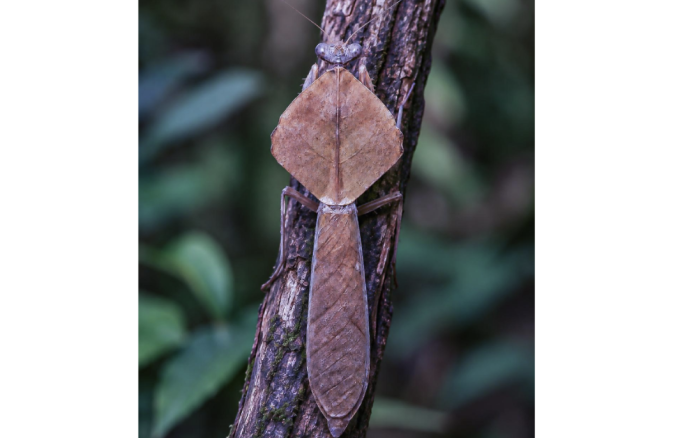
A photo of a mantis camouflaged like a leaf has been confirmed to be a fake created by artificial intelligence (AI). Experts are concerned that sophisticated AI fabrications could contaminate scientific databases.
According to a report by the New York Times on the 16th (local time), a photo of a mantis that looked like a new species was uploaded to the U.S. citizen science platform iNaturalist. Citizen science is a research method in which ordinary citizens participate in the collection, observation, and analysis of scientific data. iNaturalist is a platform where not only scientists but also people around the world can upload information related to plants and animals.
The reason citizen science is important is that it is useful for accumulating massive amounts of data. It is difficult for scientists alone to observe all species across extensive regions.
Most of the wildlife photos uploaded to iNaturalist are of species that are already known. But on rare occasions, photos worthy of publication in academic journals are posted—such as species that have never been observed before or unusual behaviors of known organisms.
Recently, a photo of a mantis with a new appearance was uploaded. It showed a mantis camouflaged as a flat, shield-shaped dead leaf. Through expert analysis, this image was revealed to be a fake created by AI.
The scientific community has long warned that, although AI offers advantages such as shortening research time and reducing costs, it can also become a major source of overwhelming noise. In particular, as the number of poor-quality papers increases, there have been growing calls for mechanisms to keep AI-written papers in check.
ArXiv, a preprint server whose verification procedures are less strict than those of traditional academic journals, recently decided to limit the number of monthly submissions per author as low-quality research produced using AI has surged.
Citizen science platforms like iNaturalist have now reached a point where they must also consider safety measures. eBird, a citizen science platform for recording bird observations run by Cornell University in the United States, has announced that it will introduce a system capable of filtering out AI-generated data.
Citizen science is far from a simple recreational activity. The international nonprofit organization SafeCast uses citizen science to collect radiation and air quality data, while Citizens of the Reef tracks corals through citizen science to assess the health of marine ecosystems.
Because citizen science can exert a powerful influence on both science and society, the reliability of its data is crucial. So far, intentionally fabricated fake images are reported to be relatively rare on citizen science platforms such as iNaturalist and eBird.
It is, however, relatively common for problems to arise when volunteers edit photos with good intentions, only to end up changing an organism’s color or adding patterns that were not originally present. Even without malicious intent, if such images accumulate, they can contaminate scientific databases. This can also cause confusion for AI models used to identify species.
Citizen science has developed on the basis of openness, allowing anyone to participate, but in the AI era it faces the challenge of maintaining this openness while strengthening data verification systems. As fake data becomes so sophisticated that even experts struggle to distinguish it, experts say that ensuring the reliability of scientific data has become more important than ever.