
Researchers create machine learning framework for better long-range forecasts
AUSTIN (KXAN) -- Weather forecasts have historically had a time frame hurdle that most weather models can't accurately predict beyond, but a group of researchers at the Massachusetts Institute of Technology (MIT) say they have a program that could change that.
Weather forecasting
Meteorologists use mathematical physics models to help predict and forecast the weather. These weather models can help predict temperatures, precipitation, and also extreme weather events.
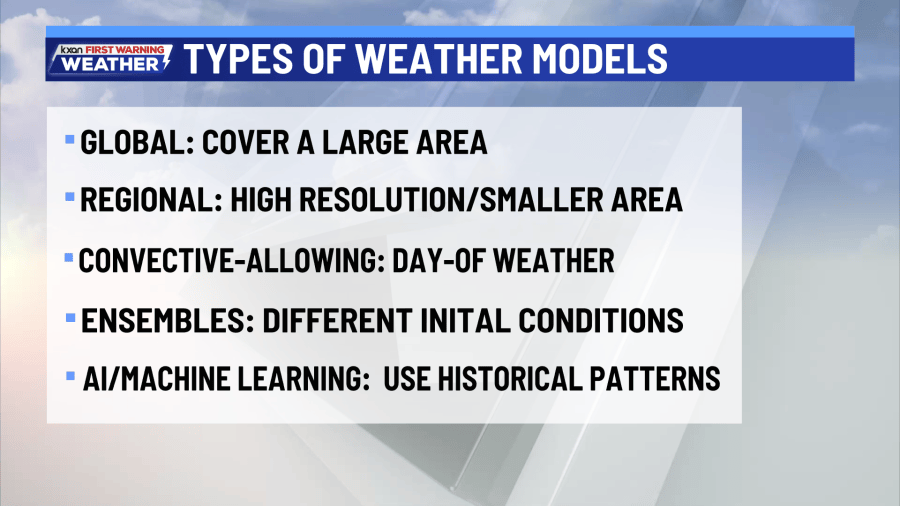
While short- and long-range forecasts have become increasingly accurate in recent years, there is a limit to how far in the future they can forecast.
Forecasts come primarily from "dynamical" models that simulate how the atmosphere and oceans react to atmospheric conditions at a given time. The models' equations build upon themselves based on changes in weather conditions.
But, since weather conditions are constantly changing, the data entered into a model becomes dated almost immediately. Two weeks from a model's initialization, the uncertainty from those changes becomes too high to predict what may happen.
Called "chaos theory," it's why meteorologists frequently update their forecasts and why forecasting beyond two weeks is outside the limits of predictability. This can be detrimental when it comes to extreme weather events like floods, hurricanes or ice storms.
Harnessing AI against chaos
The MIT researchers, in a study published Oct. 14 in Nature, examined how a machine learning framework could be used to decrease uncertainty and provide more time ahead of extreme weather events.
Advertisement
"The 2-week horizon also marks a transition in predictability: beyond this point, even small differences in initial weather conditions can lead to dramatic differences in outcomes and a single deterministic forecast cannot capture this uncertainty," the study says.
Machine learning programs identify patterns in datasets to refine predictions.
According to the study, the research team applied a "probabilistic bias correction" framework to dynamical and AI models from the European Centre for Medium-Range Weather Forecasts (ECMWF).
"The resulting forecasts are designed for operational deployment and, in real-time competition, outperform the best alternative dynamical, AI and hybrid forecasting systems from forecasting centres and competitors around the globe," the study says.
The researchers found an over 90% improvement on their three targets: temperature, pressure, and precipitation.
Their model "MicroDuet," which combined the probabilistic bias corrected ECMWF models, was the top performer in an international competition held by ECMWF in 2025. It was the first time a forecast model had a better prediction than long-term averages in that time frame, according to the study.
The authors suggest dynamical models' built-in error correction tends to revert closer to the mean, while their method allows the model to explore the limits of possibilities.
Copyright 2026 Nexstar Media, Inc. All rights reserved. This material may not be published, broadcast, rewritten, or redistributed.For the latest news, weather, sports, and streaming video, head to KXAN Austin.