
Amplitude (AMPL) Adds OpenAI Executive To Its Board, Is The Stock Fully Valued?
Amplitude (AMPL) got new attention after it appointed Vijaye Raji, the founder of Statsig and current Chief Technology Officer of Applications at OpenAI, to its board. He will serve as a Class III director and a member of the Cybersecurity Committee.
Despite this board change, Amplitude's share price has moved up and down recently. It fell 6.82% in the last day and 5.02% over the past week. However, its share price rose 53.81% over the past 90 days, while its total shareholder return over one year was 48.84%. These figures suggest that the stock has gained momentum over the medium term. However, its total shareholder return over five years is still deeply negative, at 78.61%.
Amplitude has a stronger story and a higher share price. The main question is whether its AI and analytics platform is still attractively priced or whether the market has already included its potential in today's share price.
Most Popular Narrative: 20% Undervalued
According to the most followed view, Amplitude's fair value is $14.77, just above its last closing price of $14.75. This means the focus is on what could change the small difference between these prices, rather than on a large discount.
Amplitude continues to invest in AI-driven analytics and strengthen its leadership in this area. It has also brought in skilled people through several strategic hires and quickly developed new products, including AI agents, Guides, and Surveys. These efforts could help the company meet growing demand from large businesses for automated insights that help them make decisions. This could create opportunities to increase annual contract value (ACV) and charge higher prices, which could eventually improve profit margins and increase earnings.
See why 9 investors see Amplitude as 0% undervalued.
Result: Fair Value of $14.77 (UNDERVALUED)
However, this positive view of Amplitude could be weakened if it takes longer than expected to make money from AI products that are still in closed beta testing. Another risk is that the company depends heavily on a small number of large business customers, which could lead to less predictable contract results.
Find out about the key risks to this Amplitude narrative.
Another View: Market Pricing Looks Full on Sales
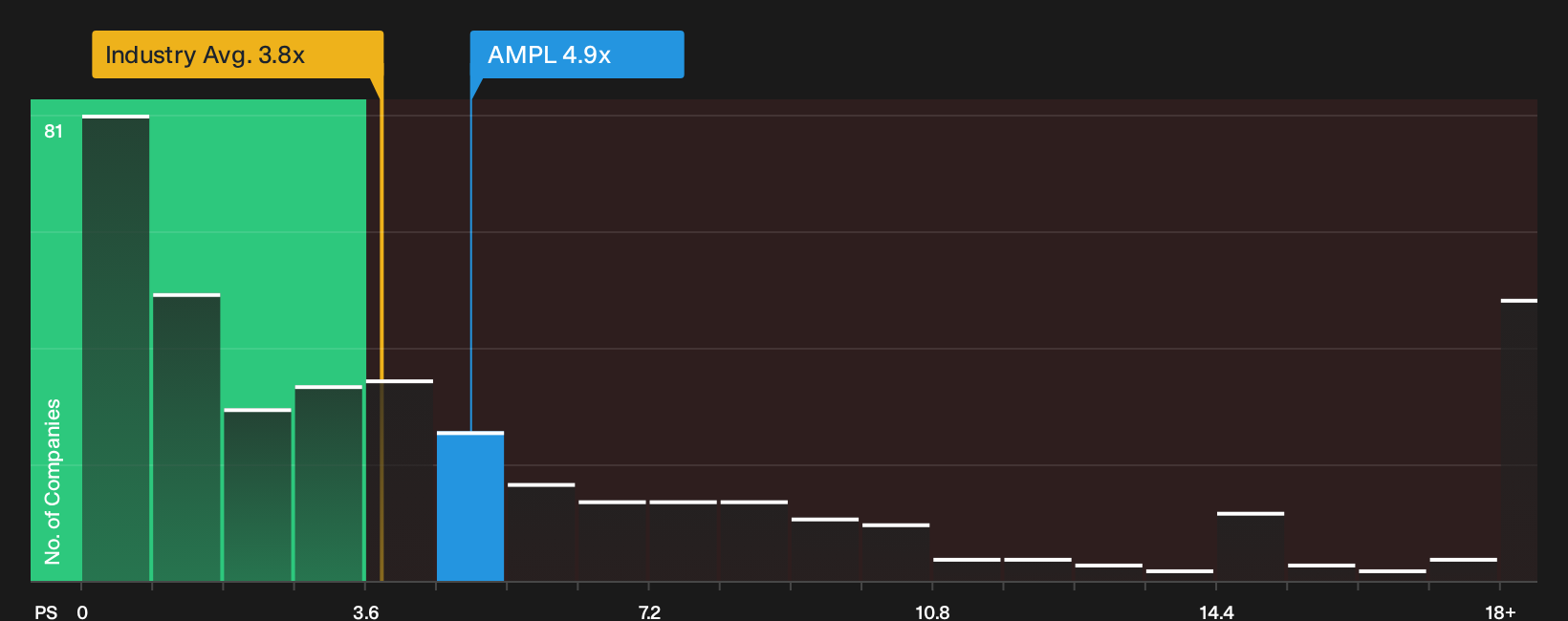
Looking only at the price-to-sales (P/S) ratio, Amplitude trades at 4.9 times its sales. This is higher than the US software industry's ratio of 3.8 times and the 3.5 times ratio of similar companies. The stock's fair P/S ratio is 3.9 times. Investors who use sales-based valuations therefore need to consider whether the current excitement about the company leaves much room for disappointment.
See what the numbers say about this price in our valuation breakdown.
Next Steps
Overall, the case for investing in Amplitude is mixed. If you want to make a decision quickly and base it on actual numbers, consider the 2 key rewards and 1 important warning sign.
Looking for more ideas beyond Amplitude?
You have already researched Amplitude. But looking at a wider range of stocks could help you make a better-informed investment decision.
- Look for stocks that may be priced incorrectly by exploring a selected group of 33 high-quality undervalued stocks.
- Focus on companies that can remain strong over time and handle financial challenges by exploring this list of companies with strong balance sheets and fundamentals (25 results).
- Look for promising companies that the market may have overlooked in this list of 20 high-quality undiscovered gems.
This article by Simply Wall St provides general information. Our analysis is based only on historical data and analyst forecasts, using a method designed to avoid bias. Our articles are not intended to provide financial advice. This article does not recommend buying or selling any stock and does not consider your goals or financial situation. We aim to provide long-term analysis based on companies' basic financial information. Our analysis may not include the latest company announcements that could affect share prices or other important qualitative information. Simply Wall St does not own a position in any of the stocks mentioned.