
This AI startup is betting it can end insurance claim denials
In fifth grade, Bakhtawer Baloch spent 100 Pakistani rupees, less than a dollar, on stickers.
She sold them and went home with 1,000 rupees, ten times what she had spent.
"I came back home, and I think I realised I am going to be doing this all my life," she said in the latest episode of Against The Odds, TheStreet Roundtable's interview show hosted by Tina Das. Each episode features a founder who built a real business despite an unlikely start.
Two decades later, the 31-year-old lives in New York, where she is studying for her second master's degree at NYU and running Clairdoc. The startup is nine months old. It uses AI to predict whether an insurance company will pay a medical claim and, if it will not, explain exactly why.

Bakhtawer Baloch is the founder of Caliredoc, an AI startup that helps doctors reduce their billing denial rate
Through special arrangement/Bakhtawer Baloch
A family that broke the mold
Baloch grew up in Pakistan. Both her parents were business owners. Her father was an engineer who built a real estate business from the ground up. Her mother ran a successful salon that he had helped her start.
Her father had married someone from outside his community. He insisted that all three of his children receive the best education available, whether they were boys or girls.
This was unusual in Baloch families.
For context, the Baloch are one of Pakistan's largest ethnic groups. They are a tribal people whose homeland stretches across Pakistan, Iran and Afghanistan. Their society is among the most conservative in Pakistan. In Balochistan, the province named after them, fewer than one-third of women can read, the lowest rate of female literacy in Pakistan, and nearly half of women marry before age 18. Even in her extended family, Baloch saw women being pushed toward early marriage and away from education.
She chose a different path.
Baloch earned the highest marks in Pakistan's chartered accountancy exams, finishing in three years, and joined Deloitte.
Learning the business of billing
Baloch earned a master's degree from the Isenberg School of Management at UMass Amherst with a 3.9 GPA. She then spent a year working at Deloitte in the United States.
In 2020, she began working as a freelancer and built a profitable U.S. medical billing and consulting business. Over four years, she grew it into a team of 15 to 20 people.
She moved to New York in 2024 to study for a second master's degree at NYU. During this time, she worked on lung cancer research at NYU Langone Health, helping the research team run its computer processes on powerful computers. She later worked in product management at TikTok.

Claire Doc combines machine learning with the rules that govern U.S. billing. Representational image. Source:Getty Images
The idea for Clairdoc came from a hospital room. While Baloch was studying for her first master's degree in data science and AI, her father, who had received a kidney transplant, visited the United States and developed very high blood pressure.
At one of the city's best hospitals, she watched staff write notes by hand. She also saw new nurses arrive without access to her father's medical records.
"Even though America is so far ahead in terms of technology... you walk in, they're writing things down with their pen," she said.
Because she had worked in medical billing, she knew what could happen next. Mistakes in paperwork can lead to rejected insurance claims, and those rejections can leave patients with bills to pay.
Why denials matter
Every time someone visits a doctor in the United States, the doctor sends a claim to the patient's insurance company. If the claim is missing information or uses the wrong billing code, the insurer can reject it. This happens often.
According to a KFF analysis of federal data, insurance companies on HealthCare.gov rejected 19% of in-network claims in 2024. The rate varied from 3% to 36% depending on the insurer. Of about 451 million in-network claims submitted, roughly 85 million were rejected.
KFF found that only 5% of rejections were based on whether the treatment was medically necessary. A quarter were caused by administrative problems, such as paperwork or billing issues. Consumers appealed fewer than 1% of rejected claims, and insurers upheld their original decisions in 66% of those appeals.
Clinics often do not challenge rejected claims either. Research cited by the Medical Group Management Association estimates that reviewing and fixing a rejected claim costs an average of $25.20. Most rejected claims are never reviewed again.
Researchers writing in JAMA estimated that waste caused by billing and coding alone costs the U.S. healthcare system about $248 billion a year. Health Affairs estimates that the wider problem of administrative waste costs up to $570 billion.
The problem is especially serious for the clinics Baloch wants to help. Specialist clinics that treat patients without keeping them overnight, such as those run by gastroenterologists and dermatologists, bring in roughly $1 million to $5 million a year. Yet they may have only one or two people handling billing.
"They have the same billing complexity of a hospital with a small team," she said.
Clinics also lose money when insurers pay less than they should. If a clinic submits a claim for $1,000 but receives only $800, most billing staff move on, she said. They have hundreds of other claims waiting and just 10 to 15 minutes to spend on each one.
When an insurance claim is rejected and the clinic cannot get the decision changed, the patient often has to pay.
"It's a lose-lose situation for both the patient and the doctor," Baloch said, "but it is a win-win situation for the insurance company at all times."
She added that people with lower incomes are hit hardest because they are more likely to visit clinics whose billing teams are already stretched thin.
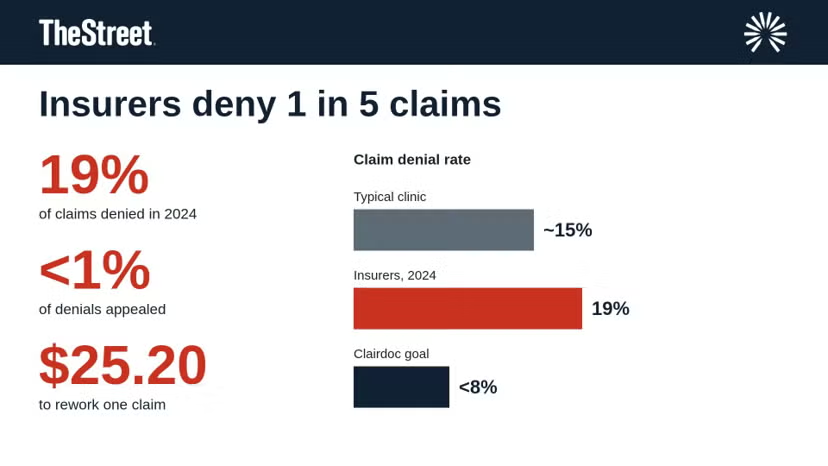
The numbers behind U.S. claim denials, and where Clairdoc wants to take them. Source: TheStreet Roundtable
What Clairdoc actually does
Clairdoc checks insurance claims before they are sent and flags those that are likely to be rejected, explaining the reason. It also checks older claims to find money that insurers may still owe the clinic.
The technology is called neurosymbolic AI. In simple terms, it combines machine learning, which finds patterns in data, with the written rules that govern medical billing in the United States. Baloch said a model that only makes predictions but cannot explain how it reached a decision is not enough.
"And if you don't know how to fix a problem, how are you going to fix it?"
Many claim rejections happen because an insurer decides that a patient's condition was less complicated than the doctor said it was. Baloch said her team published research on patient complexity at ICML, a major machine learning conference. Based on that research, the team built a comorbidity index, a tool that predicts how insurers will judge a patient's case and tells doctors what details they need to include in their notes to get paid.
The goal is to reduce clinics' claim rejection rates from about 15% to below 8%.
"Our goal is to make sure that the doctor gets paid the first time and correctly and the patient can get the best of care," she said.
The company is part of Google for Startups and NVIDIA's Inception program. It also took part in NYU's startup incubator, where Baloch was named a Female Founders Fellow this fall. She has also pitched Clairdoc at NYU's Demo Day.
Health tech is booming
Investment in AI companies that help with medical billing is growing quickly, Fierce Healthcare reported in July. Candid Health raised $120 million in a Series D funding round led by Sixth Street Growth. This brought the company's total funding to more than $219 million. Candid says more than 200 healthcare organizations use its software and that it processes about $7 billion in claims each year.
Adonis, a New York company, raised $40 million in a Series C funding round in March. Mount Sinai is among the organizations that use its software. AKASA has raised more than $200 million. Larger, established companies are also expanding their use of AI. Waystar, which serves about 30,000 clients, completed its purchase of Iodine Software on October 1, 2025. The deal added AI to a platform that handles more than $1.8 trillion in claims each year.
Most of these companies sell their products to hospitals and large healthcare groups. Clairdoc is targeting small specialist clinics instead. The big question is whether larger companies have left an important market open or whether the market is too small to support a successful business.
CB Insights studied 431 startups backed by venture capital that had shut down since 2023, across all industries. It found that 43% blamed a poor fit between their product and the market, meaning they could not find enough customers who wanted what they had built. The typical company shut down 22 months after its last funding round.
Large companies also struggle to make AI work. An MIT study of generative AI projects, reported by Fortune, found that only about 5% of trial programs led to fast revenue growth. The same research found that buying AI tools from specialist companies worked about 67% of the time, which may be a good sign for companies like Clairdoc.
Getting in the door
Before building the product, Baloch completed a startup boot camp through NYU's startup incubator. She then spent months learning what customers needed by interviewing more than 100 doctors and 50 medical billers.
"Building now has become much easier," she said. "The most important thing for founders now is how to sell and what to sell."
Selling the product was the difficult part. Baloch says healthcare is a hard industry for new companies to enter, and connecting a product to electronic health record systems is expensive. So she started by reaching out to people she already knew.
Her first customers were clinics that were already losing money because of rejected claims, she said. One doctor agreed to let her test the tool using his clinic's past claims.
Baloch says Clairdoc now works with more than 12 doctors across more than eight clinics. All of them specialize in dermatology or gastroenterology.