
Fable 5.5 Surprise Launch Confirmed for Tomorrow – Google & OpenAI Fully Gear Up to Meet the New Challenge
The AI battle between Silicon Valley's three biggest players is heating up in October!
Today, a source on X reported that Anthropic's most powerful new model, Fable 5.5, may launch as a surprise as soon as tomorrow!

Almost at the same time, The Information reported that Anthropic's new model is already running and being tested by users.
People who have tried it say that this next-generation Claude model is much better in three key areas: deep reasoning, good judgment, and understanding what people really mean.
Its most surprising ability is what some describe as "mind-reading": even when you do not clearly explain what you need, it can work out what you really want.
You can ask it to fix just one bug, and it may find an entire group of related problems behind it!
Before Anthropic officially reveals its new model, Google and OpenAI are also preparing their next moves. Google's Gemini 4 Carbon is already being tested internally, and OpenAI's next-generation Terra is also ready for launch.

This October is set to bring fierce competition among AI models.
In the coming weeks, the AI industry may see another major wave of excitement!
The new Claude has learned to "read minds"
According to The Information, a tester who got early access said that this new model's reasoning and judgment are better than those of every model Anthropic currently sells.
What makes it even more impressive is another special ability.
Even when users provide very little information and do not clearly explain their goals, it is especially good at figuring out what they are trying to do and what they want to achieve.
Reasoning and judgment are easy to understand. But being able to work out goals that people have not said out loud gets to the heart of how humans and AI interact.


Fix one bug, and it finds a whole group of related problems
An insider who tested the model gave an example: you send it an error report and casually ask it to fix a bug.
Older models usually fix only the specific error reported. They add a small code change to address it and then return the result.
But this model follows the clues and looks for the whole group of problems that could be causing the bug. It then asks whether you want to fix all of them at the same time.
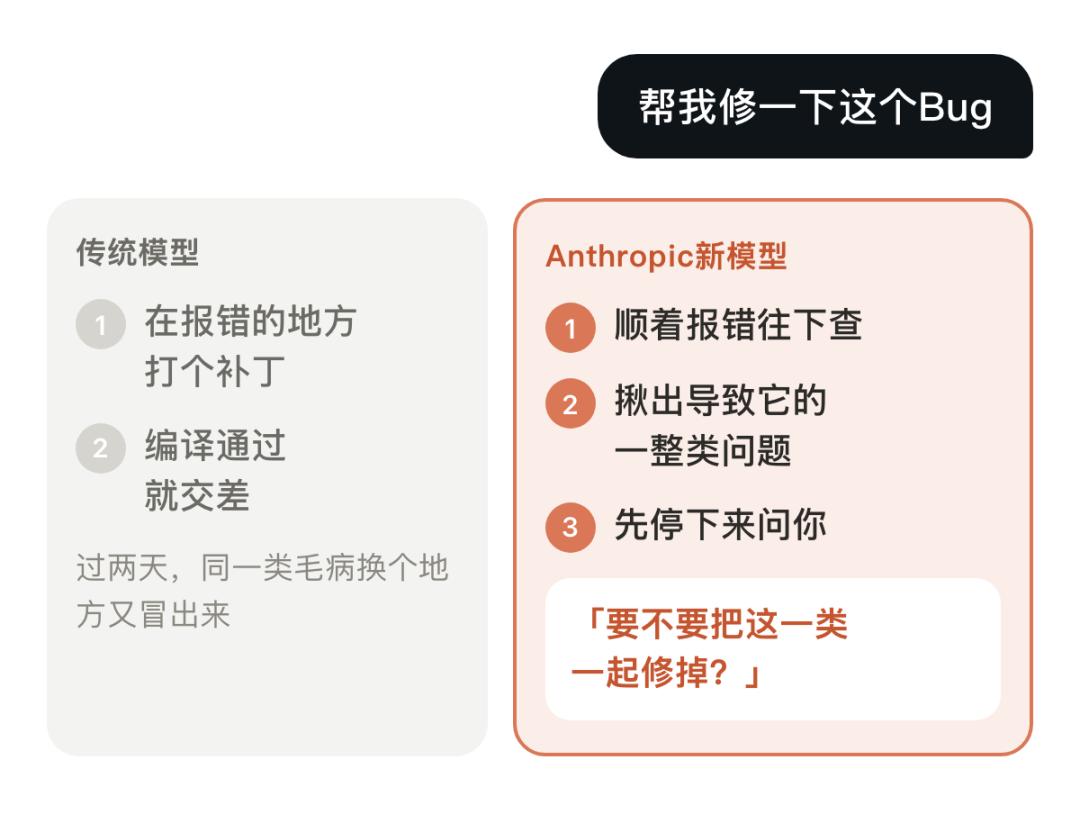
Anyone who has written code knows that the same bug can appear in several places. You may fix it in one spot, only for the same kind of error to appear somewhere else a few days later.
Older AI models would fix only the exact spot you pointed out, leaving you to find the other problems one by one. This new model checks further on its own and shows you all the similar problems it finds at once.
It also does not make changes without permission. It asks you whether to make the changes and how much code to change, leaving the final decision to you.
With AI that can work at this level, people may be able to trust it with large and complicated tasks more easily.
Here is another example. If you ask it how to trade stocks, it does not simply give you familiar advice about measures such as the price-to-earnings ratio. Instead, it creates its own set of algorithms to try to predict how stock prices will move in the future.
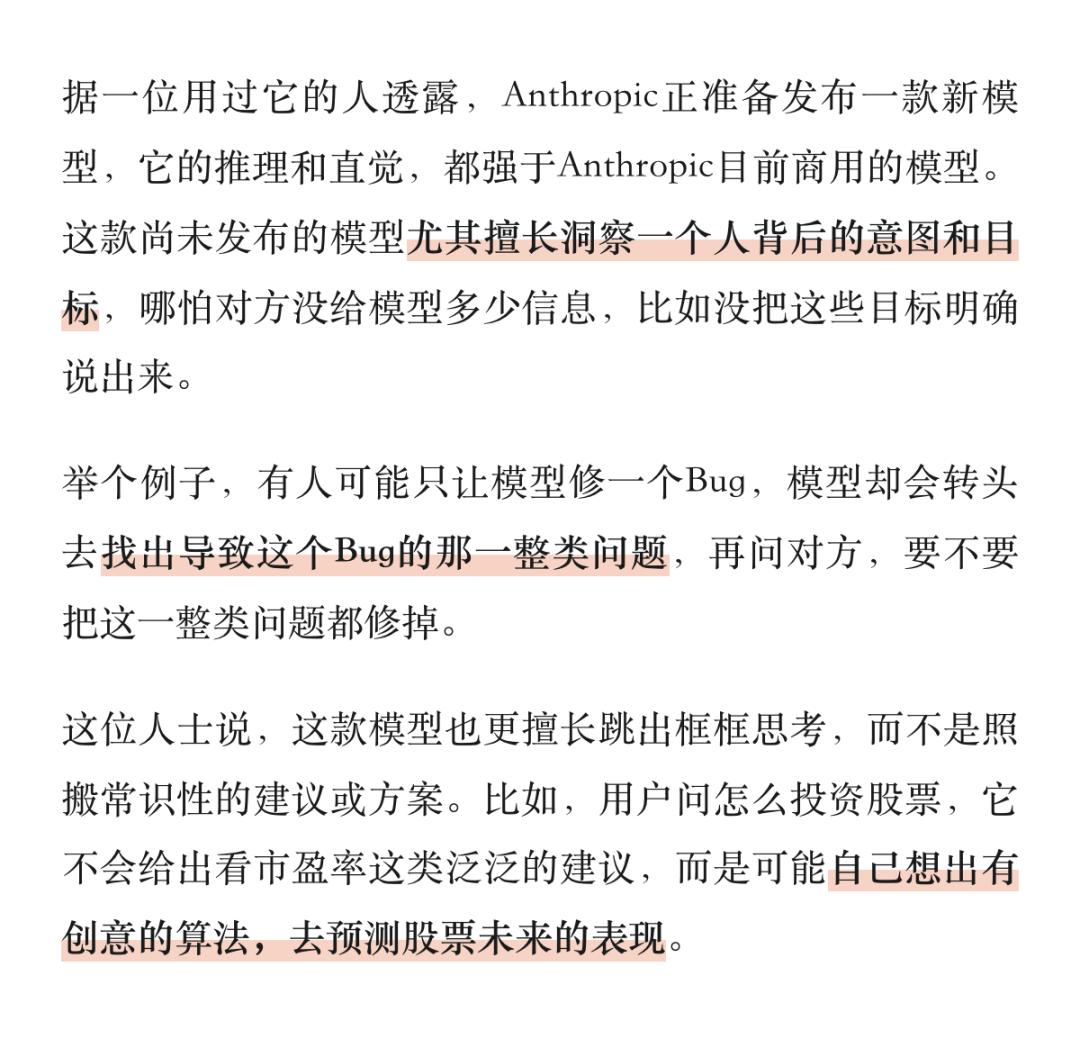
In one case, the model finds the root cause of a bug. In the other, it comes up with its own methods instead of following familiar approaches. That helps explain why testers use the word "intuition," a quality usually associated with humans, to describe it.
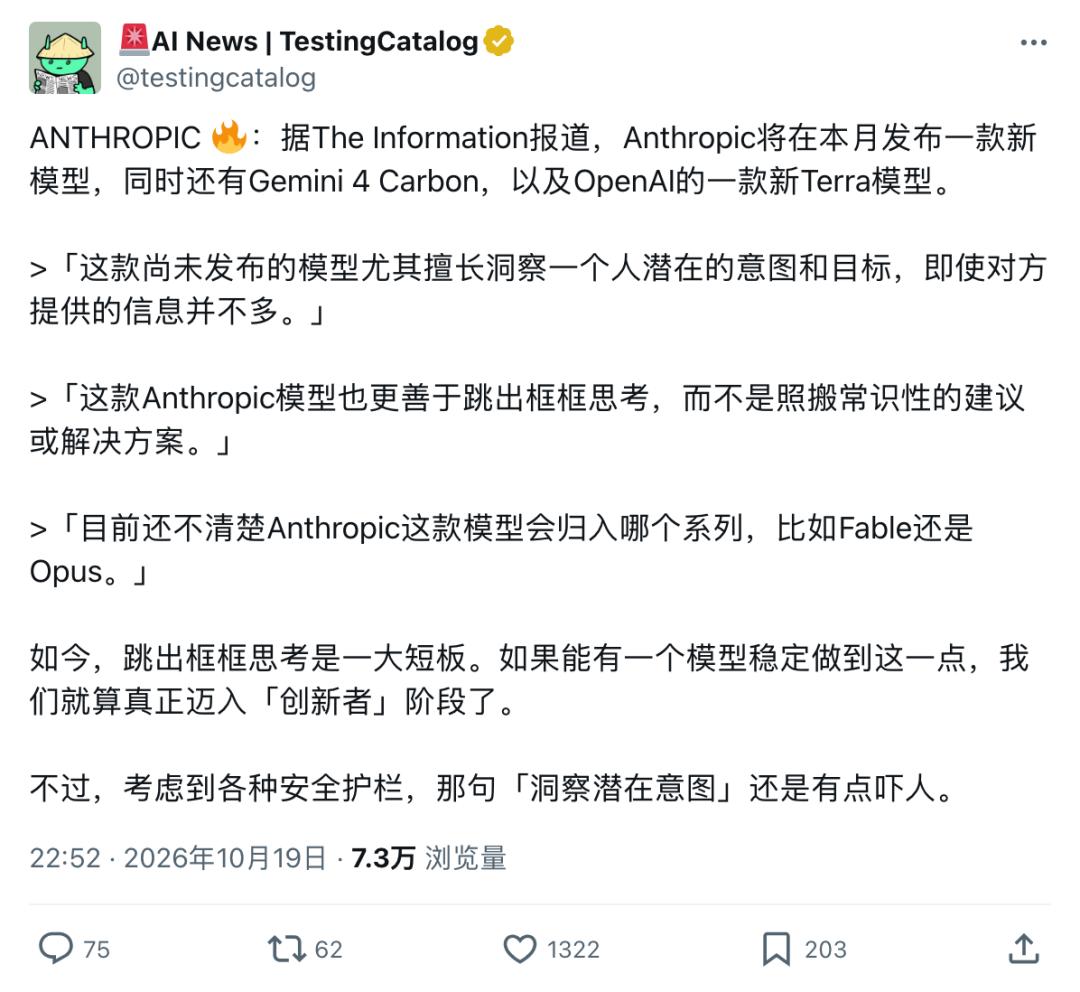
TestingCatalog, a veteran of the AI industry, was impressed by the results. The group noted that thinking beyond familiar patterns has long been a weakness of large AI models. If a model can do this reliably, AI could enter a new stage in which it can act as an innovator.
Write a temperature app, and discover a hidden crypto-mining program
This ability to think one step further has already appeared in the version of Claude that people can use today.
In the past few days, a Mac user shared his experience on Reddit. The story was later reposted on X and spread widely, with one repost receiving 220,000 views.
He had asked Claude Code to write a small app that monitors temperature.
When Claude read the computer's sensor data, it found that the numbers were unusually high: the CPU temperature had reached 112°C. Instead of simply showing the temperature in the menu bar and stopping there, it checked what was using so much of the CPU's power.
It discovered a cryptocurrency-mining program called xmrig! The program was using about 1175% of the CPU, roughly equal to running all 12 CPU cores at full capacity.

Claude also found where the program was hiding: /tmp/rigupdater. Its automatic startup entry had been added as early as August 29, well before the user began writing the code.
Just as it does when fixing bugs, Claude did not take action on its own. Instead, it asked first, "Can I clean it up now?" The user had only wanted to check the computer's temperature, but ended up finding the real cause of its slow performance.
And this was only what the currently available version of Claude could do.
Rumors about Fable 5.5 have continued since the start of this month.
At the time, many developers reported that Fable 5.1 was quietly being connected to a stronger new model behind the scenes.
One noticeable clue was that it could answer a question about "Reset Guy" Tibo, a new internet meme that older models did not know about.

Experienced developers who were connected to the new model were shocked when they tested it.
It could create animations, run 3D physics simulations, build engineering projects, and write code from scratch, all in one go.
One person gave it just two prompts, totaling no more than four lines, and asked it to create a frame-by-frame animation called A Person's Life using JavaScript. The model worked continuously for two hours and used 27 million tokens.

Another person compared it directly with GPT-6.1 Sol. Both models were asked to make a 3D jellyfish that users could drag around. The new model did a better job of making the jellyfish stretch and bounce back.
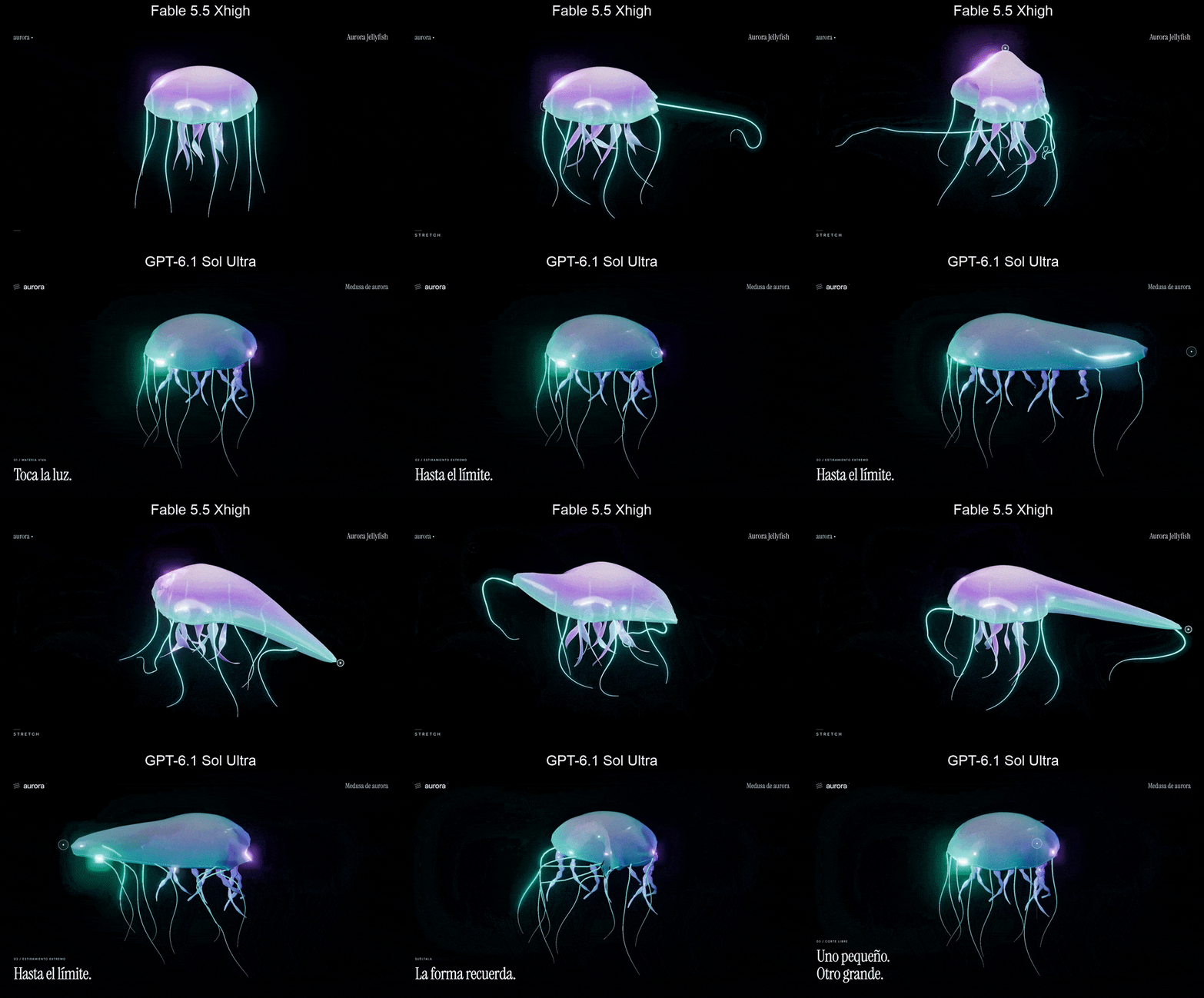
If connecting users to the new model was only a limited test, clues found in a code library last week made people think its launch might be very close.
On October 13, a bot on GitHub registered the name "claude-fable-5-5" under Microsoft Foundry.
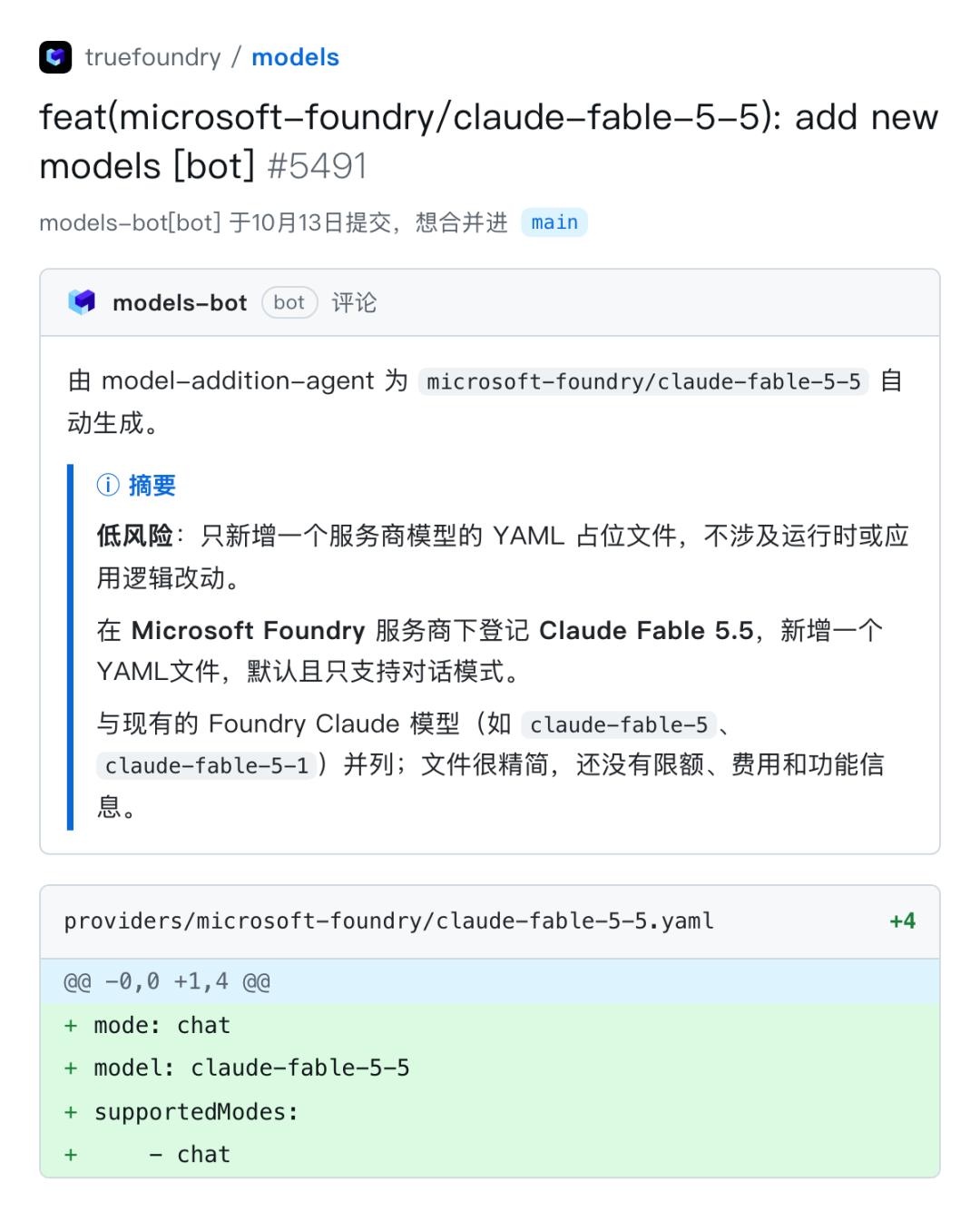
On the same day, the open-source project LiteLLM also added "azure_ai/claude-fable-5-5". The note attached to the change said that the name came from Azure's model interface.
The entry was later deleted, and the clues briefly disappeared. But today's report from The Information has renewed public excitement.
The report did not give the model's name, and it remains unclear whether the new model will belong to the Fable or Opus family. Fable is Anthropic's largest and most powerful model tier, while Opus is its second-highest tier.
Amir Efrati, executive editor of The Information, also posted on X to ask whether Anthropic was about to release Fable 5.5. He added that it looked that way.

With the executive editor saying this publicly, most people online are strongly betting that the new model will be Fable 5.5.
Some people online said Anthropic has now overtaken OpenAI and that, once Fable 5.5 launches, it will stand in a class of its own with no real competitors.

The online guess that the launch could happen "tomorrow" is not completely random: both Fable 5.1 and Opus 5.5 were released on Tuesdays.
However, Stephanie Palazzolo, the reporter who wrote the article, later corrected her statement and said the launch would happen in the coming weeks.

In other words, even if Fable 5.5 does not launch tomorrow, it may still arrive within the next few weeks.
Google and OpenAI are preparing their next moves too
While Anthropic prepares its next big release, the other two companies are also working on new models.
Google released Gemini 4 Argon just last week, and its next model, Carbon, is already running inside the company.
According to internal documents and screenshots seen by Business Insider, Carbon has been deployed on Google's internal coding platform, Jetski.
One employee said that its coding ability "feels like Opus 5.5." Another wrote in an internal chat channel, "Carbon is really great!"
This article reflects only the author's views. 36Kr provides only an information storage service.