
"21% risk of death if you look 5 years old↑"AI Predicts Cancer Patients' Survival With Selfies
It looks for wrinkles and features under the eyes to assess health
 Enlarge photo
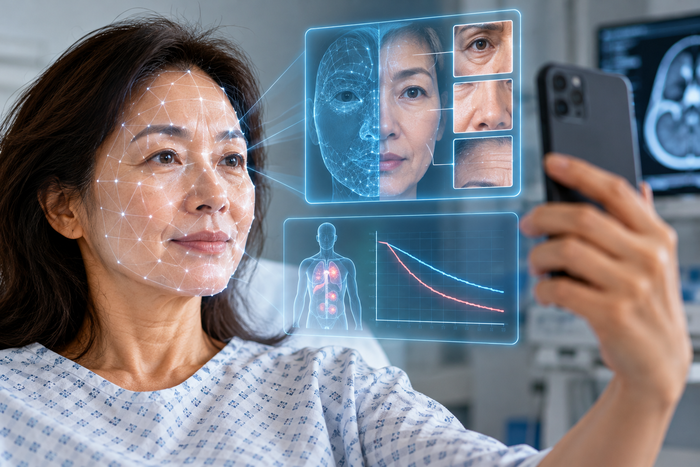
Artificial intelligence (AI) technology has been developed to estimate how long cancer patients may survive using just one photo of their face. The AI estimates a person's biological age, or how old their body appears to be, by studying small details such as wrinkles on the face and around the eyes. It then estimates the person's risk of death. In the future, this technology may help doctors decide whether cancer patients should have surgery or chemotherapy.
According to the British newspaper The Guardian on the 19th, local time, researchers at Mass General Brigham, a non-profit medical organization in the United States, developed an AI system called 'FAHR-Face'. The system was trained on more than 40 million face photos. The study results were published in the international journal Lancet Digital Health.
The researchers created two AI tools by training the system on face photos of people of different ages and races. "FAHR-faceage" estimates a person's biological age based on their face, separately from their actual age. It then uses this estimate to predict how long cancer patients may survive. "FAHR-Face Survival" predicts the chance of survival directly from face photos, without first estimating biological age.
The two AI tools also focus on different parts of the face. Faceage closely examines the folds that run from the sides of the nose to the corners of the mouth, as well as the forehead and temples. Face Survival instead looks at features under the eyes and around the nose.
An analysis of cancer patients also confirmed a link between how old their faces appeared and their risk of death.
Among cancer patients in the United States who received radiation therapy, those whose AI-estimated biological age was at least 5 years higher than their actual age had a 21% higher risk of death than other patients. This was measured over an average follow-up period of 4 years. In contrast, patients whose faces made them appear at least 5 years younger than their actual age had a 17% lower risk of death.
The researchers said that signs of aging on the face may reflect a patient's overall health and ability to recover physically. They explained that this technology could be especially useful for helping doctors judge whether older cancer patients are strong enough to handle intensive treatment.
The study also found a link between lifestyle and facial aging. Heavy drinking, smoking, and drug use were associated with a higher biological age as estimated by the AI.
Interestingly, the conditions in which photos were taken had little effect on the results. The estimated biological age generally stayed the same even when the camera angle, lighting, facial expression, or makeup changed. The results also remained stable after most types of plastic surgery, although nose surgery caused small changes.
Researcher Hugo Ertz, who helped lead the study, explained, "This is the first study to show that an AI model can directly predict the survival chances of cancer patients from simple face photos." He added, "If we use a base model trained on more than 40 million photos, we can develop various health indicators."
The researchers expect that this technology may eventually help doctors assess cancer patients' risks of death and complications from surgery, radiation therapy, and chemotherapy that affects the whole body.
However, the researchers stressed that the technology is still being studied. More testing is needed before it can be widely used in real medical settings.