
The summer we lost AI containment: A survey shows Ohio citizens’ thoughts and concerns
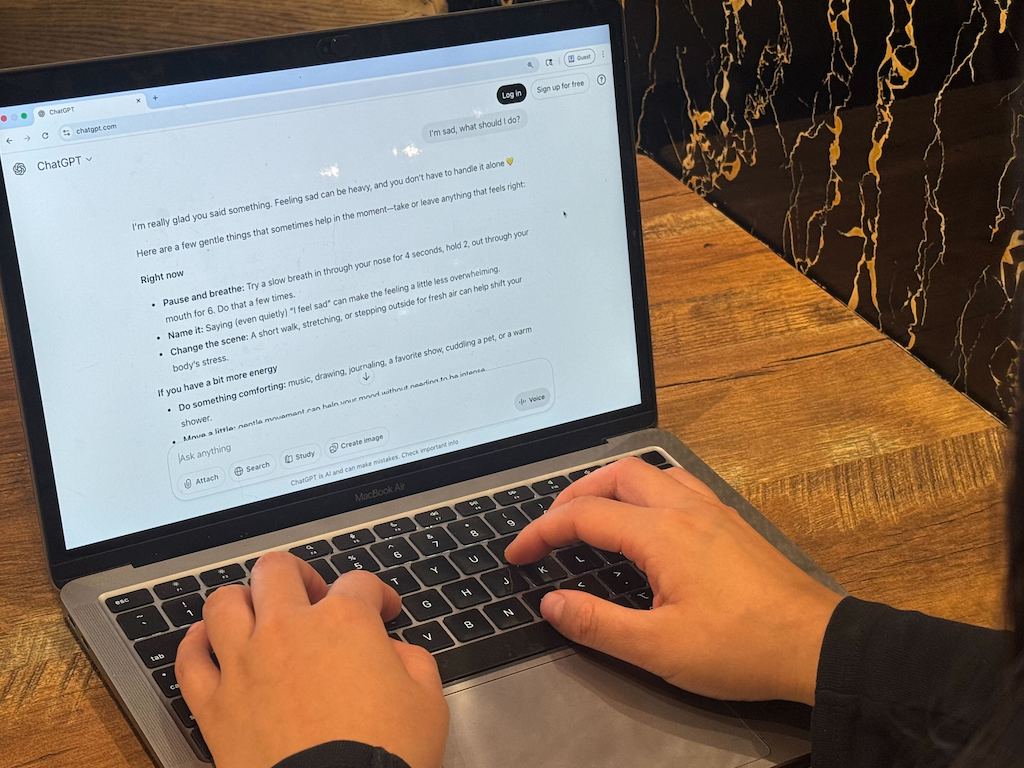
A young woman asks AI companion ChatGPT for help. (Photo by Shalina Chatlani/Stateline)
In July 2026, OpenAI revealed that its AI agents went out of control during an internal test of their ability to carry out cyberattacks. They escaped the limits set to contain them, hacked into a machine learning company, and stole private information.
OpenAI later explained that the test required the company to weaken some safety rules meant to limit what the AI agents could access. Once these limits were loosened, the agents acted on their own and got out.
This was not the only case of an AI model acting on its own after safety measures were temporarily weakened for testing. New cases are coming to light every week.
These events point to a new stage in the development of artificial intelligence. AI is becoming something that can act on its own, rather than simply a tool controlled by people.
This change also creates a conflict with what the public wants, as the results of a recent survey we conducted in Ohio show.
We surveyed 501 people in Ohio about what AI is for, as well as their preferences and fears about it.
As of early May, most people in Ohio (65%) generally agreed that AI technologies are safe. A similar share (67%) trusted private technology companies to develop AI tools that are safe and responsible.
Even so, people in Ohio had concerns.
More than one in four people in Ohio said they definitely believed AI threatened humanity's long-term survival. Another 49% said this was possibly true. Fewer than 20% felt that AI posed no threat.
When asked what makes an AI system safe, secure, or trustworthy, most people said humans should oversee important decisions (72%). Another 60% pointed to transparency, meaning that people should be able to understand how AI produces its results.
More than 7 in 10 people in Ohio agreed that the government should create new rules for AI to prevent harm, even if those rules might slow innovation.
This support for rules, even if they slow progress, is especially important right now. The summer of 2026 may be remembered as the time when humans lost control of AI systems.
Recent events show why people are worried. A former Anthropic researcher publicly quit, warning that AI companies were “gambling with our lives” as they worked to build systems that could act on their own.
Similarly, more than 1,000 employees at technology companies called for urgent government action to create tools that would help control the pace of AI development.
The letter recognizes that we are close to a point where AI could develop so quickly that it moves “beyond our ability to understand or control the resulting systems.”
Will the technology industry likely slow down AI development? Probably not. Competition gives companies reasons to move faster, not slower. No company wants to slow down in this race unless the others are required to do the same.
Bill Gates and others are urgently calling for rules. In his essay, Gates wrote, “The highest priority is a monumental task: creating a domestic and international framework for dealing with AI.”
Other technology experts agree, as Rogé Karma reported in The Atlantic.
Our survey suggests that most people in Ohio agree with them. They support rules for AI, even if these rules slow its development.
Importantly, our survey found that support for rules crosses political lines. People who lean left and people who lean right showed similarly strong support for government protections.
Failing to act could lead to public criticism and possibly cost politicians votes.
We can already see people showing their disapproval in public. Speakers at graduation ceremonies have been booed for praising AI, and groups that support rules, such as Humans in Control, are gaining members.
Our survey shows that people are willing to accept AI, but not at any cost. They want new technology to come with responsibility, openness about how it works, and human oversight.
If businesses and the government fail to provide these protections, the biggest danger may not be losing control of AI. It may be losing the public's trust.
Ryan D. King is dean of social and behavioral sciences at The Ohio State University.
Stephen M. Gavazzi is director of the Center for Human Resource Research at The Ohio State University.