
AI Could ‘Absolutely’ Replace Human Actors, CEO of Generative AI Startup Runway Says at Italy’s View Conference: ‘It’s Already Happening in a Way’
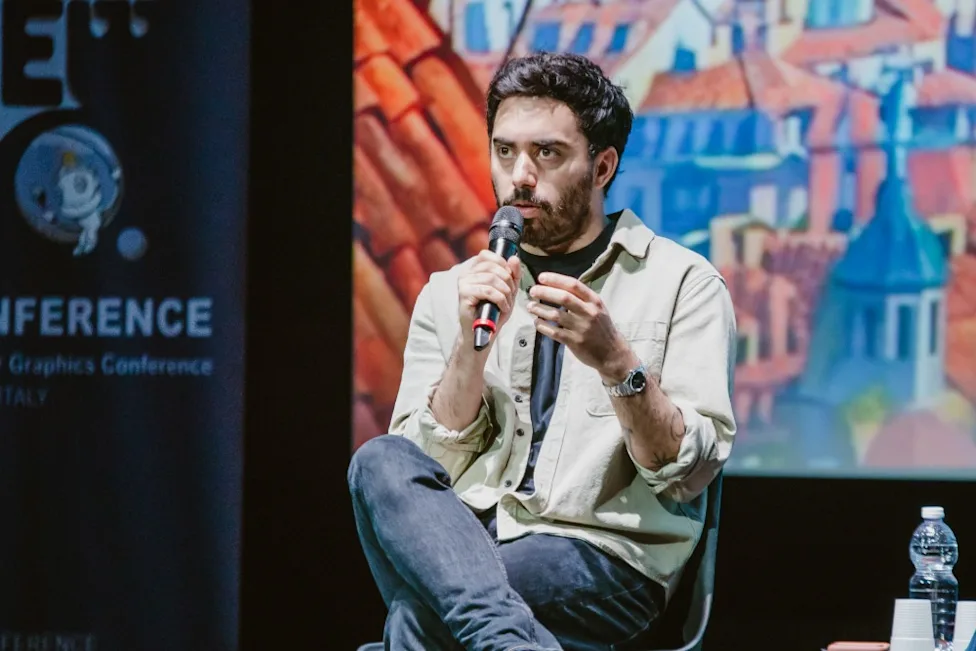
During a discussion called "Every Pixel Will Be Generated" at the View Conference in Turin, Italy, someone in the audience asked Cristóbal Valenzuela, co-CEO of the generative AI startup Runway, whether AI might eventually replace human actors.
"Yes, absolutely. I think it's already happening in some ways," he replied. He went on to describe AI as "a new medium of expression" and "a new medium of storytelling."
His fellow speaker, Richard Kerris of Nvidia, was more supportive of keeping traditional filmmaking practices. Earlier in the discussion, he recalled a director's argument that the natural, unexpected moments between a director and an actor could never be created just by giving instructions to a computer. One example was Marlon Brando improvising with a cat while filming "The Godfather."
"That craft is something to behold, and I just think that's something we'll never lose," said Kerris, Nvidia's vice president of developer relations and general manager of media and entertainment.
"Not now, but I think AI models will probably reach a point where you can direct them in a very similar way," Valenzuela replied.
Kerris had also stressed that making a film still requires an understanding of characters, how shots are arranged, and how stories work. There is no "make movie button."
"I wish," Valenzuela joked.
Valenzuela explained his view more clearly in an essay called "It's All About the Pixel Economy." In it, he predicts that "the value of creating pixels is trending towards zero." He also writes that, eventually, the number of "seconds consumed" will come together with the number of "seconds generated."
Today, making a film often requires hundreds of people, while millions of people may each spend two hours watching it. Valenzuela imagines a future in which viewers create entertainment tailored to their own tastes as quickly as they watch it.
In another essay, "The Cost of a Frame," Valenzuela describes the history of media by looking at how much it costs to create one convincing frame of an image. He focuses on high-quality productions, the kind of work done in Hollywood and by many of the professionals attending the conference.
"This is the last expensive layer," he writes. He argues that AI is making the cost of creating this kind of content fall sharply.
During the discussion at the View Conference, Kerris often described people's concerns about AI as similar to fears caused by earlier advances in technology, including the arrival of computer-generated imagery, or CGI.
"The fears and the rush to judge these things are so similar to what I've seen in the past," he said.
Jeff Kember, Nvidia's chief technical evangelist for media, shared a similarly positive view in his presentation, "Creative Control in the Age of AI Agents." He said that many people are already using generative AI.
"There's a whole bunch of people talking about how they're using generative AI, and there's also a bunch of people who aren't talking about it, mainly because their legal team won't let them talk about it," he said. "But people on both sides of this divide are using generative AI. I don't know anyone who isn't."
Between sessions, several visual effects artists, leaders of game studios, and animation directors spoke less about fear and more about anger. Their concerns focused on something unusual about generative AI: the material used to train these models in the first place.
When Variety asked Valenzuela about the data used to train the models, he said one of the "core misbeliefs" about AI was that "people thought AI was some sort of a database."
"They're not databases," he said. "They're learning from representation."
Legal cases are likely to play a major role in deciding these questions. In July, a federal judge approved a $1.5 billion settlement by Anthropic with authors whose books had been downloaded from pirate libraries. An earlier ruling had found that using copyrighted works to train AI models could count as fair use. However, it treated that question separately from the company's actions in obtaining and keeping pirated copies of those books. Meanwhile, several lawsuits against major AI companies are still moving through the courts. One proposed class-action lawsuit, brought by visual artists against Stability AI, Midjourney, DeviantArt, and Runway, claims that their copyrighted work was used to develop generative AI models without their permission or payment.
Together, the talks by companies pushing AI forward at the View Conference showed a vision of the future in which creating moving images could cost almost nothing and the traditional way films and other productions are made could change completely.