
Anthropic IPO draft shows nearly 15-fold revenue jump and $600 billion in compute deals
Summary
- Anthropic’s draft IPO prospectus shows that revenue in the first half of the year reached about $16 billion, up from $1.1 billion a year earlier. The company also reported a net loss of more than $80 billion, mostly because of accounting charges, according to the Wall Street Journal. Its commitments to computing infrastructure exceed $600 billion, and more deals are being discussed.

The deals described in the filing give Anthropic’s suppliers a clearer idea of how much money they may earn over several years. Google, Amazon Web Services, Microsoft and Broadcom are all linked to contracts worth tens or hundreds of billions of dollars. Many of these contracts cannot be cancelled. This supports the idea that demand for AI computing equipment and services is backed by signed agreements, rather than just hopes for future sales. But it also creates a risk: these suppliers depend on one company that is losing money. People thinking about investing in the IPO will likely focus on whether Anthropic can keep growing revenue faster than its computing costs, and on its dependence on a small number of customers. Two customers brought in about one-fifth of its sales in the first half of the year. A possible value of up to $2 trillion would leave little room for growth to slow or costs to rise faster than expected.
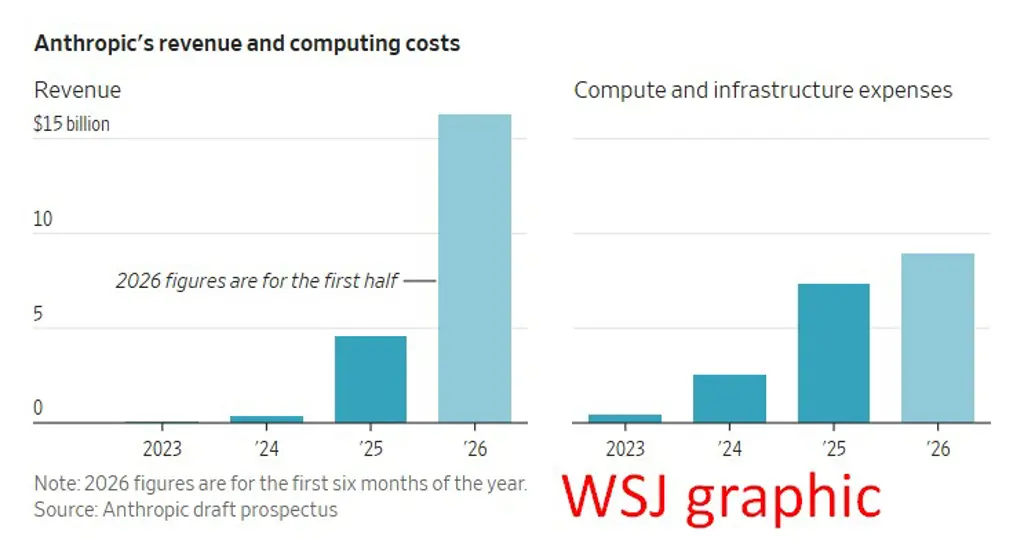
Anthropic’s draft prospectus shows a company whose revenue is growing very quickly, but whose costs are also rising sharply. It has promised to spend so much on computing infrastructure that its suppliers, customers and regulators all matter to the decision about whether to invest in the company.
Summary:
- Revenue in the first half of 2026 was about $16.3 billion, up from about $1.1 billion in the same period a year earlier, according to a draft prospectus reviewed by the Wall Street Journal (subscription required).
- Anthropic lost about $81 billion in the first half of the year. Roughly $72 billion of this came from accounting charges linked to convertible notes and other ways of raising money. The company lost about $13 billion in the first half of the previous year.
- The company spent nearly $9 billion on computing power and infrastructure in the first half of the year, more than it spent during all of 2025.
- Its commitments to infrastructure exceed $600 billion. More deals are being discussed, and these could add up to another $150 billion.
- About one-fifth of its revenue in the first half came from two customers.
- Risks include harm caused by AI systems, legal responsibility for damage, serious events that insurance might not cover, limited access to computing power, and organised opposition to data centres.
Anthropic’s revenue grew almost fifteenfold in the first half of 2026, while the company committed to spending more than $600 billion on future computing infrastructure. This information comes from a draft document for its planned initial public offering (IPO), which the Wall Street Journal reviewed. Anthropic declined to comment on the report.
The artificial intelligence company made about $16.3 billion in revenue in the six months ending 30 June, compared with about $1.1 billion in the same period a year earlier, the Journal reported. This amount is already much higher than the roughly $4.6 billion it made during all of 2025. Spending on computing power and infrastructure rose to nearly $9 billion in the first half, up from about $2.3 billion a year earlier. It was also higher than the roughly $7.3 billion the company spent on these items during all of 2025.
The company’s reported loss was much larger. Anthropic lost about $81 billion in the first half of the year, compared with roughly $13 billion in the same period a year earlier and about $42 billion during all of 2025. Around $72 billion of the latest loss came from accounting charges linked to changes in the value of convertible notes and other financial tools used to raise money. These charges were not ordinary costs of running the business.
The size of Anthropic’s infrastructure commitments is one of the most striking parts of the filing. According to the Journal, the company has agreed to pay around $450 billion under cloud computing contracts over the next seven to 10 years. Most of these agreements cannot be cancelled. They include about $111 billion with Google, $110 billion with Amazon Web Services and $31 billion with Microsoft. Anthropic has also agreed to spend up to $86 billion on Nvidia computing chips supplied by Nscale and Lambda. A separate commitment to lease Google chips through Broadcom is worth more than $160 billion. Together, these commitments bring the total above $600 billion. Deals still being discussed could add as much as another $150 billion.
Even with these agreements, Anthropic said its main cloud computing partners had not provided as much computing capacity as it wanted. The company also said these partners increasingly see Anthropic as a competitor. To get more capacity, Anthropic is also renting data centres and using outside companies to run them. Some of these operators, it said, have not been in business for very long.
Anthropic also depends heavily on a small number of customers. Two customers accounted for about one-fifth of its sales in the first half of the year. The company expects a large share of its future revenue to continue coming from a small group of clients.
The Journal reported that risks take up about one-third of the filing. These include the chance that AI systems could act in ways that do not match human intentions and cause harm. They also include legal responsibility for damage, such as stolen data, and serious incidents that insurance companies might refuse to cover. Anthropic also warned that political opposition to data centre construction is becoming more organised. Because the company is well known, projects connected to it could receive more public attention.
The filing comes as Anthropic prepares to sell shares to the public. The company could be valued at as much as $2 trillion. A public listing would bring much closer attention to how quickly its revenue is growing, how much it costs to operate and how much it depends on a small number of customers.