
Anthropic Took In About $1.80 per Compute Dollar in H1
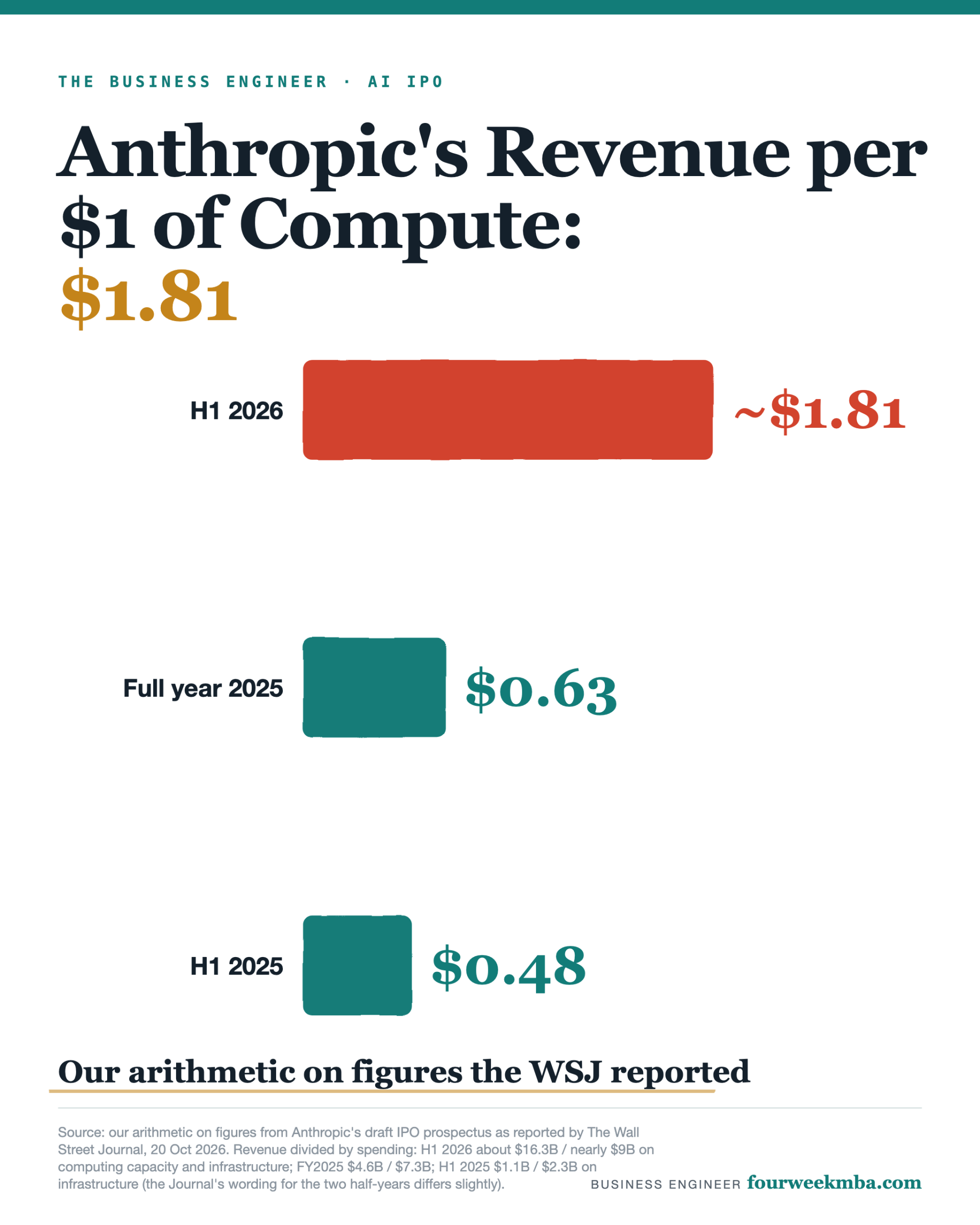
Anthropic made about $16.3 billion in revenue during the six months ending 30 June 2026. It spent nearly $9 billion on computing power and infrastructure during the same period. These figures come from a draft document for Anthropic's planned stock market listing, which The Wall Street Journal saw and reported on 20 October 2026. Using these figures, we calculate that Anthropic made about $1.81 in revenue for every dollar it spent on computing. The actual figure is slightly higher because the Journal said spending was nearly $9 billion, not exactly $9 billion. Anthropic declined to comment to the Journal.
Using the earlier figures reported by the Journal, we calculate that Anthropic made about $0.48 in revenue for every dollar spent on infrastructure during the first half of 2025, and about $0.63 for the whole of 2025. Below, we explain how we calculated these figures, what they measure, and what they leave out.
The key insight: Based on our calculations using the Journal's figures, Anthropic's revenue in the first half of 2026 covered its computing costs about 1.8 times over. In the same period a year earlier, revenue covered those costs only about 0.48 times. However, the computing agreements reported by the Journal commit Anthropic to spending money for years beyond these periods.
The Ratio, Period by Period
We calculated all three ratios using figures reported by the Journal. Each ratio is revenue divided by spending on computing during the same period.
First half of 2026: Anthropic made about $16.3 billion in revenue and spent nearly $9 billion on computing power and infrastructure. This works out to about $1.81 in revenue for every dollar spent.
Full year 2025: Anthropic made $4.6 billion in revenue and spent $7.3 billion on computing power. This works out to about $0.63 for every dollar spent. A Financial Times report, summarized on Yahoo Finance, gave the same approximate figure for 2025. We covered that report on 15 October.
First half of 2025: Anthropic made $1.1 billion in revenue and spent $2.3 billion, giving a ratio of about $0.48. The Journal describes the spending in the first half of 2025 as spending “on infrastructure,” while it describes the 2026 figure as spending on “computing capacity and infrastructure.” This means the two half-year figures may not measure exactly the same things.
Based on these figures, we calculate that revenue grew about 15 times between the two half-year periods, while spending on computing grew about four times.
What the Ratio Measures
Revenue per dollar spent on computing is a simple way to check whether an AI company earns enough money to cover the cost of the chips and data centers that run its models. If the ratio is below $1, the company spends more than one dollar on computing for each dollar it earns in revenue. If the ratio is above $1, its revenue covers its computing costs, with some money left over.
This ratio does not measure profit. It does not include salaries, research costs, sales costs, or the accounting expenses listed in the draft prospectus. The Journal reported that Anthropic had a net loss of $80.7 billion in the first half of the year. Of that amount, $72 billion came from accounting expenses linked to changes in the value of convertible notes and other financial instruments.
The ratio also measures what the company spent during a particular period, not what it has promised to spend in the future. The Journal reported that Anthropic is committed to around $450 billion in cloud computing agreements over the next seven to ten years. Most of these agreements cannot be canceled. The Journal also reported that Anthropic's future infrastructure costs exceed $600 billion when a chip lease with Broadcom is included.
A Second Measure, From Investors
A different figure came from a presentation Anthropic gave to potential investors. The Financial Times reported, in an article summarized by BeInCrypto and published on Yahoo Finance, that Anthropic told investors it earned $1.70 in revenue for every $1 it spent on computing power in the third quarter. We reported this figure on 15 October.
The $1.70 figure is Anthropic's own ratio for one quarter, as reported by news outlets. The $1.81 figure is our calculation using half-year figures from the draft prospectus. The two figures may use different definitions of computing costs, so we do not treat the difference between them as evidence of a trend.
Connecting the Coverage
Earlier today, we covered the Journal's first report on the draft prospectus. That report focused on the $80.7 billion loss and its accounting expenses. On 29 September, we covered Reuters' report on Anthropic's 2025 figures, which showed $7.33 billion in computing and infrastructure spending against $4.59 billion in revenue.
On 19 October, we covered OpenAI's $30 billion funding round at a valuation of more than $1.4 trillion. Reuters said OpenAI was racing to secure the funding before Anthropic's expected stock market debut. Today, we also covered executives who expect only 7 to 10 neocloud companies to survive a shakeout. Earlier this month, we reported on record costs to insure the debt of Meta and Nvidia. These stories offer two ways to look at who pays the cost of computing for AI.
The Structural Read
Our calculation shows that the ratio rose from about $0.48 to about $1.81 because revenue grew about 15 times while computing costs grew about four times between the two half-year periods reported by the Journal.
The ratio covers only a specific period. It does not include the future spending covered by the roughly $450 billion in mostly noncancelable cloud computing agreements reported by the Journal.
The two figures being discussed, the Financial Times' $1.70 for the third quarter and our $1.81 for the first half of the year, may use different definitions of computing costs. For this reason, we do not treat them as evidence of a trend.
Anthropic's draft prospectus, as reported by The Wall Street Journal, 20 October 2026
“limited number of customers for the foreseeable future”
Three Implications
ABOUT $1.81 PER COMPUTE DOLLAR Our calculation shows that around $16.3 billion in first-half revenue divided by nearly $9 billion in computing costs equals about $1.81, or slightly more, for every dollar spent.
ABOUT $0.48 A YEAR EARLIER Our calculation shows that $1.1 billion in revenue divided by $2.3 billion spent on infrastructure in the first half of 2025 equals about $0.48.
AROUND $450B COMMITTED The Journal reported that Anthropic is committed to around $450 billion in cloud computing agreements over the next seven to ten years. Most of these agreements cannot be canceled.
The Business Engineer Lens
This story connects to the Business Engineer framework called The State of The Inference Economy.
The framework explains the economics this way: “Training was a cost center: it happened at certain times, was concentrated among roughly twenty leading AI model labs, and its costs could be spread across trillions of tokens. Inference is a way to earn revenue: it happens continuously across millions of applications and AI agents, and each query adds another cost.”
Our reading is that revenue per dollar spent on computing is a simple way to track this idea at an individual company. Based on our calculations using the Journal's figures, Anthropic's ratio rose from below $1 to about $1.81 between the first halves of 2025 and 2026. The framework was published in March 2026 and does not discuss Anthropic's draft prospectus.
What Is Not Established
We have read the Journal's article, not the draft prospectus itself. As far as we could check, the draft was not publicly available through the SEC's EDGAR system. The ratios are our own calculations. The Journal did not publish these ratios, and its report does not show that the draft prospectus defines a measure of revenue per dollar spent on computing. The draft could also change before the final document is filed.
The Bottom Line
Based on our calculations using figures that The Wall Street Journal reported from Anthropic's draft prospectus, Anthropic earned about $1.81 in revenue for every dollar it spent on computing in the first half of 2026. That compares with about $0.48 a year earlier and about $0.63 for all of 2025. Our reading is that revenue covered the computing bill during the first half of 2026, but the long-term spending commitments listed by the Journal are not included in this ratio.
A note on sources: This article is based on The Wall Street Journal's report of 20 October 2026 about Anthropic's draft prospectus for its planned stock market listing. We read the full report but have not seen the draft itself. The revenue-per-computing-dollar ratios are our own calculations using figures from the Journal. Earlier figures come from our own articles that cited Reuters and the Financial Times. The chart also shows our calculations using figures reported by the Journal. Nothing in this article is financial or investment advice.