
A PIN reset wipes ChatGPT's new locked chats
- OpenAI added locked chats to ChatGPT on Tuesday. Users can hide conversations behind a four-digit PIN, Face ID, or Touch ID.
- Resetting a forgotten PIN permanently deletes all locked chats. OpenAI Support cannot recover them.
- Locking chats does not add end-to-end encryption or change how long OpenAI keeps the chats.
OpenAI added locked chats to ChatGPT today. Users can protect private conversations with a four-digit PIN.
If users reset a forgotten PIN, all their locked chats, files, and saved memories are erased permanently and cannot be recovered.
OpenAI Support and workspace admins cannot restore deleted content
OpenAI's help page says that simply forgetting a PIN does not delete anything. Resetting the PIN does.
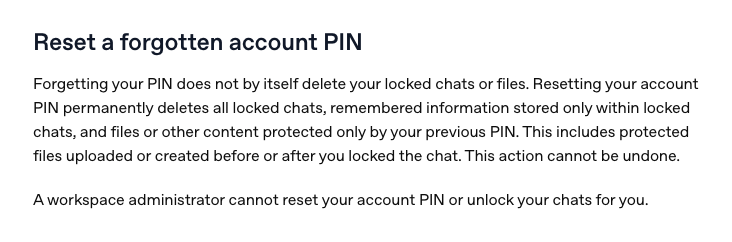
OpenAI says that resetting a PIN “permanently deletes all locked chats.” It also deletes saved memories and any files protected only by the old PIN. Users cannot undo this action, and OpenAI Support cannot recover the deleted information.
There is no backup that an administrator can use to restore the content. Workspace administrators cannot change a user's PIN or open a locked chat for them.
In the OpenAI Compliance Platform for ChatGPT Enterprise and Edu workspaces, locked chats can still appear in message logs. The PIN is linked to an OpenAI account, not a workspace. This means that someone with two accounts will have two separate PINs.
Changing a PIN is different from resetting a forgotten one. Anyone who knows the old PIN can use it to set a new PIN without losing their conversations.
Users must enter their current PIN to change it, even if their device uses Face ID or Touch ID. If someone enters the wrong PIN too many times, ChatGPT will block further attempts until the waiting period ends.
Hidden conversations do not have end-to-end encryption
Users can find their conversations in a section called “Locked chats” under “Projects.”
To open these hidden conversations, users need their PIN or, on supported phones, Face ID, Touch ID, or the device's usual unlock method. OpenAI suggested using this feature when planning a surprise or when letting a family member or friend use a phone.
Temporary chats do not appear in chat history, but locked chats are saved. Once users prove their identity, they can open their locked chats again at any time.
Locked chats have a separate memory. New messages in a locked chat can update a memory that is shared only among locked chats.
This keeps new information from being added to regular conversations.
OpenAI said that locking a conversation does not provide end-to-end encryption or create a separate, encrypted storage space.
Locking a chat does not change the “Improve the model for everyone” setting. OpenAI also keeps the chat for the same length of time as before.
Locking a chat does not delete anything ChatGPT had already saved in memory before the chat was locked.
OpenAI says locked chats may also show ads to users whose accounts receive ads. Cryptopolitan has already reported that OpenAI plans to test display ads this month while ChatGPT images are being created.
Locked chats are available on ChatGPT Free, Go, Plus, Pro, Business, Enterprise, and Edu plans. ChatGPT for Healthcare does not include this feature.
Users cannot lock temporary, archived, or group chats. They also cannot lock chats opened through shared links, chats for scheduled tasks, chats containing meeting recordings, or Codex conversations.
OpenAI is making the feature available gradually, so the option to lock a chat may not yet appear on every account.
FAQs
What happens if I forget my ChatGPT locked-chats PIN?
Forgetting the PIN does not delete anything. But resetting it permanently deletes all locked chats, and OpenAI Support cannot recover them.
Which ChatGPT plans support locked chats?
Free, Go, Plus, Pro, Business, Enterprise, and Edu support locked chats. ChatGPT for Healthcare does not.
Does locking a chat encrypt it?
No. OpenAI says locking a chat does not add end-to-end encryption or create a separate encrypted storage space.
Disclaimer. The information provided is not trading advice. Cryptopolitan.com is not responsible for investments made based on the information on this page. We strongly recommend doing your own research and/or speaking with a qualified professional before making any investment decisions.

Randa Moses
Randa Moses is an editor and reporter at Cryptopolitan. She covers technology, AI, robotics, cryptocurrency, scams, and hacks. She has worked in the cryptocurrency industry since 2017. She has held positions at Forward Protocol, AmaZix, and Cryptosomniac. Randa has a degree in Electrical and Electronics Engineering from the University of Bradford.