
The AI funding window is closing: slowing revenue, IPO fails, and a bankrupt OpenAI

For two years, Silicon Valley and global stock markets have shared the belief that artificial intelligence (AI) offers almost unlimited opportunities. They believed that spending large amounts of money on AI, without strict limits, would automatically lead to extremely fast growth and huge returns. Or perhaps stock markets simply believed the claims coming from Silicon Valley.
Whatever the reason, business results reported over the past week show that attitudes toward AI are changing.
Slower revenue growth, falling share prices, and changing business plans suggest that investors are finally reaching their limit for spending freely on AI. The early excitement is fading, and investors now want proof that AI businesses can make money in a lasting and reliable way.

Slowing growth
One of the first major warning signs came from Anthropic, one of the leading companies trying to build the world's most advanced AI models.
After a private meeting with investors before a possible initial public offering (IPO) in mid-October 2026, people who attended said the company reported US$16.8 billion in revenue for the third quarter (Q3). This was an increase of 45–50 per cent from the previous quarter, and the company also reported a profit after certain adjustments. However, growth had slowed compared with the second quarter (Q2), when revenue jumped by more than 140 per cent.
According to people who attended the meeting, a noticeable part of Anthropic's earlier growth came from a process called 'model distillation'. In this process, competing AI companies and research labs created thousands of accounts to ask Claude, Anthropic's AI model, large numbers of questions. They then used its answers to train their own competing models. Anthropic said it had introduced restrictions to reduce this kind of activity. This meant giving up some revenue in the short term to stop competitors from collecting its AI's knowledge and copying its protected technology, helping it protect its intellectual property over the long term.
For investors, the main concern is not that individual consumers are unwilling to pay for AI assistants when free versions are available. The bigger issue is that AI companies may not deserve their high market values if those values depend on the belief that business customers will keep increasing their spending at extremely fast rates.
Companies that were recently expected to spend freely on AI tokens for the foreseeable future are starting to examine their operating budgets more carefully.
Polymarket, tokenmaxxing and open source
For many investors, Anthropic's latest financial results also suggest that business customers are changing how they use AI. During the first wave of AI adoption, companies experimented heavily with 'tokenmaxxing'. This means sending huge amounts of information, raw data and repeated attempts through expensive, advanced AI models to complete complicated tasks.
Now, companies such as Uber and Skywork.ai are actively redesigning their systems to reduce costs. Businesses are sending less raw information to AI models, setting stricter limits on how often they can be used, and increasingly choosing open-source models.
Open-source alternatives are becoming powerful enough to handle many tasks. They let organisations run specialised jobs on their own computers or on cheaper cloud servers, often at a much lower cost than using commercial application programming interfaces (APIs).
Many investors worry that this change will directly affect how quickly leading AI model providers can grow their revenue.
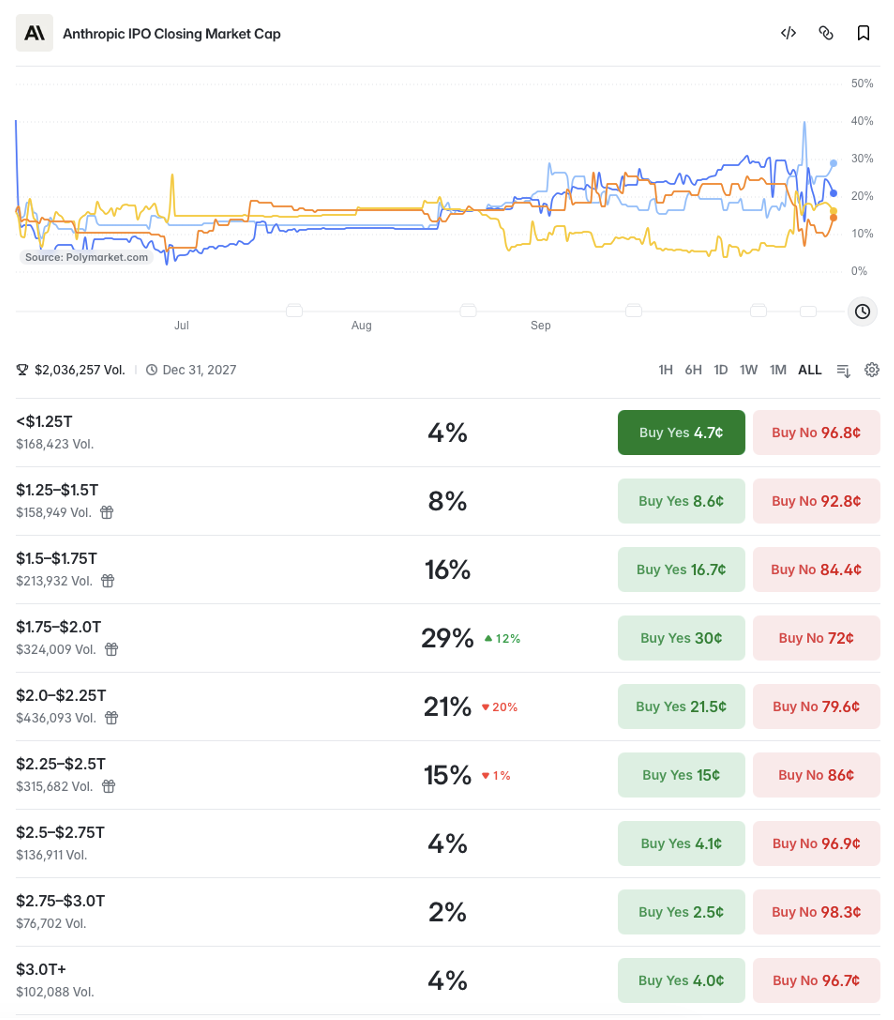
Indeed, prediction markets such as Polymarket have changed their estimates of Anthropic's possible IPO value. Individual investors who place bets on these markets once treated a valuation of more than US$2 trillion as a basic expectation for the company's public listing. That is no longer the widely held view.
Figure 1. Bets on Anthropic's IPO Valuation
Source: Polymarket.
Uncertainty around infrastructure and the IPO market
Anthropic is not the only AI-related company finding it harder to enter the public stock market.
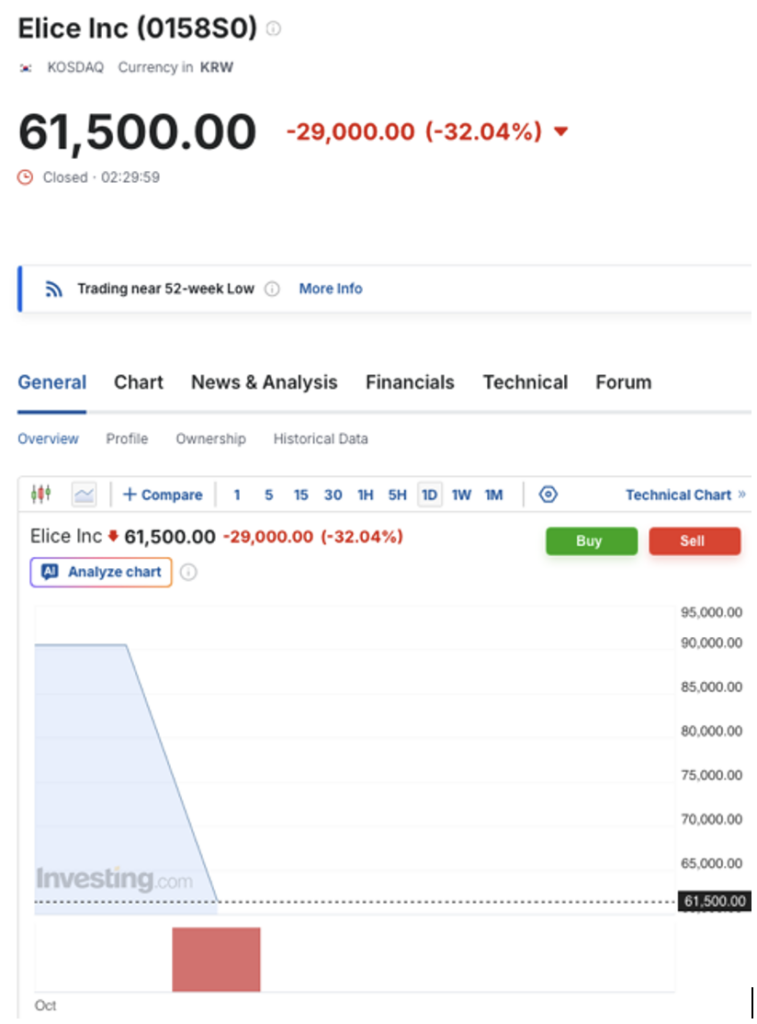
South Korean cloud computing company Elice Group, which specialises in providing computing infrastructure, began trading publicly on the KOSDAQ market this week. Investors had shown strong interest in its IPO, with demand from individual investors more than 400 times greater than the number of shares available. Despite this excitement, the share price fell by 32 per cent on its first day of trading.
Figure 2. Elice Inc. debut on KOSDAQ
Source: Investing.com
Elice builds modular data centres and rents out computing power from specialised graphics processing units (GPUs). Until recently, this was seen as an exciting investment opportunity because it gave investors direct exposure to the AI boom. But Elice Group's sharp share price fall this week shows that investor attitudes have changed. Investors are becoming more careful about spending on AI infrastructure. They are questioning how quickly the hundreds of billions of dollars spent on GPUs, liquid cooling systems and data centres will turn into actual cash earnings.
Could OpenAI go bankrupt?
Alongside debates about IPOs, tokenmaxxing and efforts by businesses to cut costs, financial journalists, investors, market commentators, short-sellers and technology analysts have started discussing whether leading AI model providers such as OpenAI can remain financially stable over the long term.
Technology columnist Ed Zitron points to OpenAI's heavy spending and losses. The company reportedly spent US$21.6 billion more than it brought in during the first half of 2026, and recorded an operating loss of US$12.3 billion in the second quarter of 2026 (Q2 2026). Zitron argues that the company's current financial path looks like a 'capital sinkhole'—a business that keeps consuming huge amounts of money.
If businesses continue switching to cheaper open-source alternatives and revenue from closed, proprietary AI models falls, repeated private funding rounds worth billions of dollars may eventually become impossible to sustain.
Most major financial institutions do not expect OpenAI to suddenly collapse and sell off its assets. Instead, they expect important financial partners, such as Microsoft, to step in or restructure their ownership stakes. Even so, the fact that people are seriously debating whether OpenAI can pay its bills marks an important change in the story surrounding the AI bubble.
If this argument becomes more widely accepted in public stock markets and venture capital markets, investors may become less willing to support the wider AI boom. This could make it harder for the very companies being discussed to raise money.
Concerns about whether AI model providers can make money in a sustainable way could therefore trigger a broader decline in investment. This could push down the speculative values of AI hardware companies and specialised cloud computing providers, a trend that is already appearing. It could also force the industry to become much more careful with its spending, which could help burst the AI bubble.
Not over yet
Importantly, the change in investor attitudes has been fairly small so far. It does not mean the AI industry has collapsed, although that could still happen. Instead, investors are moving away from spending aggressively to gain market share and toward making sure that businesses have sound financial foundations. Whether this shift goes any further will depend on whether investment in AI can produce real economic returns.
Investors are now reassessing what they believe AI companies are realistically worth. They want clear plans for making profits over the long term, rather than relying only on claims that revenue will keep growing rapidly, especially when those claims are becoming harder to trust.
If customers of leading AI research companies learn to get the same results from smaller, distilled models instead of paying for models that process huge amounts of information, if everyday consumers remain sensitive to monthly subscription prices, and if IPOs continue to fail or be delayed, the current market correction may not be over.
This would mean the era of easy access to funding is coming to an end. The companies that succeed in the next phase will be those that focus on keeping costs low, providing clear and useful products, and managing their money responsibly over the long term. However, the entire sector may first have to go through a collapse.