
Backlash Wipes A$140M Off NextDC Guidance as Anthropic Warns
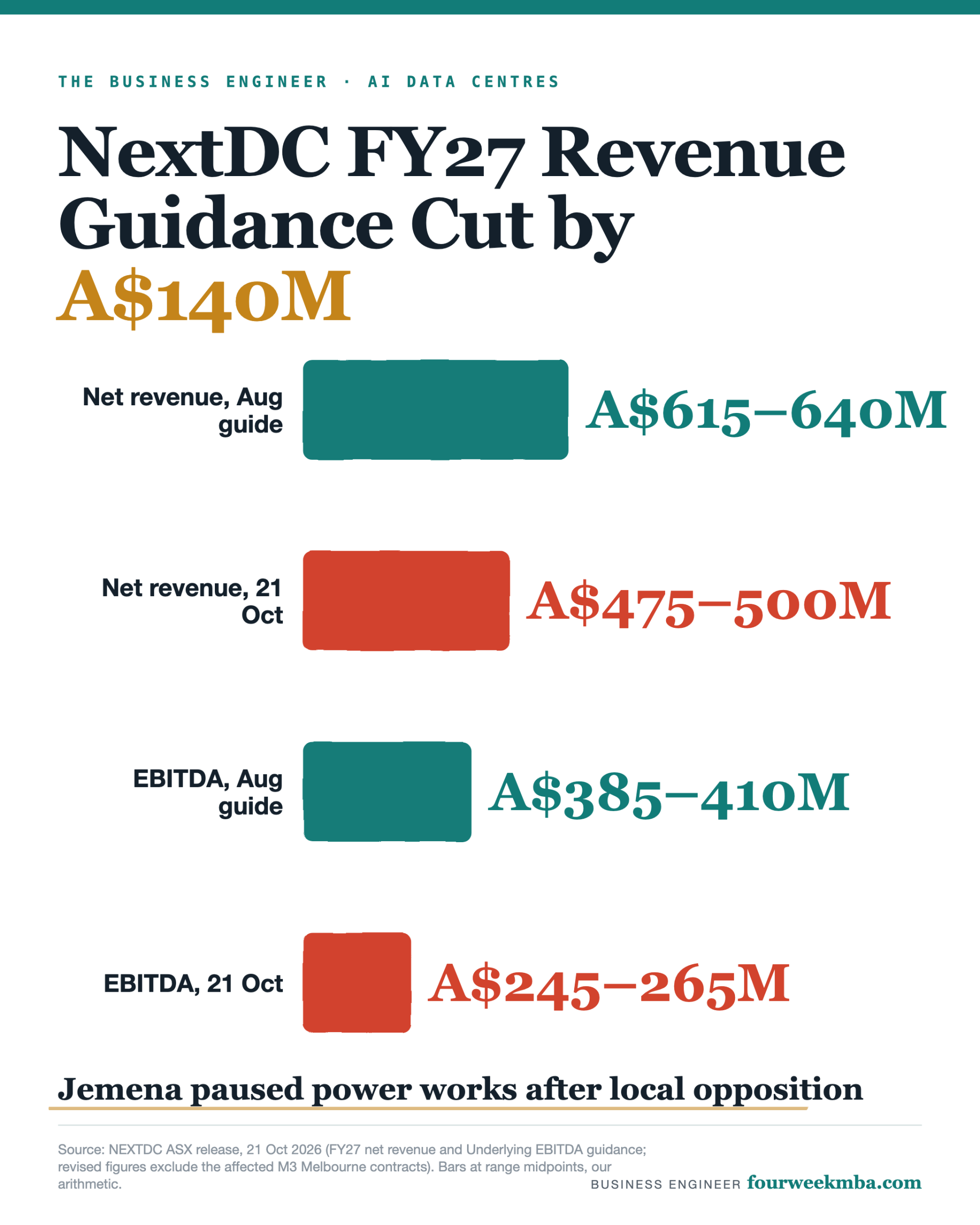
NEXTDC, a data centre company listed on the Australian stock market (ASX), removed about A$140 million from each of its net revenue and Underlying EBITDA forecasts for the 2027 financial year on 21 October 2026. This followed the suspension of power works by electricity distributor Jemena for NEXTDC's M3 data centre in Melbourne. According to NEXTDC's announcement, Jemena said it had stopped the work because local residents and other groups opposed it and the local council had not given its approval.
NEXTDC shares traded at A$5.28 on the morning of 21 October, compared with A$9.18 before trading was paused. That is a fall of about 42%, based on our calculation. Bloomberg's headline reported a 44% drop. In the same week, Anthropic's draft document for a planned initial public offering (IPO) warned that political opposition to data centres had “become more organized and coordinated across jurisdictions”, the Wall Street Journal reported.
What NEXTDC Disclosed
NEXTDC now expects net revenue of A$475 million to A$500 million for the 2027 financial year, down from its earlier forecast of A$615 million to A$640 million. It now expects Underlying EBITDA, a measure of operating earnings, of A$245 million to A$265 million, down from A$385 million to A$410 million. The new forecasts leave out the affected M3 contracts. In its August forecast, NEXTDC had expected these contracts to contribute about A$140 million to each figure.
The company said Jemena suspended parts of its work on a 66-kilovolt power line in September 2026. Jemena does not expect to restart the work before February 2027. NEXTDC now expects the next increase in the power supply to M3 during the 2028 financial year.
Chief executive Craig Scroggie said: “With M3 revenue deferred, we have paused projects not backed by customer contracts and put that capital behind the capacity our customers have already contracted.”
- Capital spending. NEXTDC lowered its forecast for spending on buildings and equipment in the 2027 financial year to A$4,500 million to A$5,000 million, from A$5,250 million to A$5,750 million. All new development projects and land purchases are on hold.
- Contracts. The affected contracts allow customers to receive service credits if the promised capacity is late. In some situations, customers also have the right to end their contracts, the company said.
- Financial position. NEXTDC reported A$8,675 million in available cash and other financial resources at 30 September 2026. It said it was meeting its financial covenant requirements, which are rules it must follow under its borrowing agreements.
The Cost of Opposition
NEXTDC is not the only example this week of local opposition to AI infrastructure becoming a financial cost, a business risk or an insurance product. This is how we understand the reports and announcements:
- A risk for an IPO. Anthropic's draft IPO document warned about growing political opposition to data centres, according to the Wall Street Journal.
- An insurance product. Arbol launched a product it calls Data Center Regulatory Moratorium Cover. Artemis reported that it pays a set amount if a covered government action remains in place beyond a waiting period. Arbol chief executive Sid Jha said: “A moratorium or construction hold can strand hundreds of millions in committed capital, and standard policies do not respond.”
- A court decision. A federal court in Mississippi rejected the US Justice Department's request to dismiss a lawsuit brought by the NAACP under the Clean Air Act. The case concerns xAI and a gas-fired power plant that supports its Colossus 2 data centre. Earthjustice, which represents the people bringing the case, reported the decision.
- A student protest. A few dozen students at San Diego State University urged the California State University system to end its contract with OpenAI, KPBS reported. Their signs raised concerns about the environmental damage caused by data centres.
Update, 21 October: Australia's Government Sets a Condition on Power
Australia welcomes data centres if they “contribute to the energy grid,” Treasurer Chalmers said, according to the headline of a CNBC video interview. We could read the headline but not a full transcript of the interview.
Reuters also reported in a headline that NEXTDC shares “shed 44% on revenue delay.” This was the same percentage reported in the Bloomberg headline mentioned above. We read the Reuters headline but not the full article.
How These Reports Connect
When NEXTDC paused trading in its shares because of the M3 delay, our earlier article about the limits of AI development reported that Citigroup analysts believed up to A$25 million of NEXTDC's operating earnings for the 2027 financial year could be at risk, according to Bloomberg. The amount now removed from the company's forecast is larger: about A$140 million in Underlying EBITDA. However, NEXTDC says the capacity is still covered by customer contracts, subject to customers' rights under those contracts. The company's actual results for the 2027 financial year will include earnings from the affected contracts.
We see a similar pattern in Microsoft's decision to leave Nscale's Loughton site. The Telegraph reported that electricity network leaders do not expect power to be available there until the 2030s. On the financial side, our article about Anthropic's draft IPO document explained the company's commitments to pay for computing capacity. Our article about possible changes in the neocloud market covered financial pressure on companies that build and rent out computing capacity.
In our view, the common problem is the gap between signing a customer contract and having a building with power. If approvals or power supplies are delayed, the revenue expected from the contract can be delayed too.
What the Bigger Picture Shows
We read the cut to NEXTDC's forecast as being about timing as well as demand. The company says the affected capacity is still covered by customer contracts, subject to customers' rights, and that construction of the data halls is continuing.
We also see a link between local approval and access to funding. NEXTDC says its ability to borrow the remaining money available under its senior debt agreements depends on its expected billing patterns. Delays to the power supply at M3 could change those expectations.
In our view, the other events reported this week show the same risk in different ways: Anthropic listed political opposition as a risk in its draft IPO document, according to the Wall Street Journal, while Arbol introduced insurance to cover certain government-ordered pauses, according to Artemis.
Craig Scroggie, NEXTDC chief executive, ASX announcement of 21 October 2026
“We have taken the affected M3 contracts out of FY27 guidance until we can reliably estimate their contribution.”
Three Main Effects
FORECASTS NEXTDC removed about A$140 million from each of its net revenue and Underlying EBITDA forecasts for the 2027 financial year.
SPENDING The company's capital spending forecast fell to A$4,500 million to A$5,000 million. New development projects and land purchases are on hold.
POWER Jemena does not expect to restart the suspended work before February 2027. NEXTDC expects the next increase in power supply to M3 during the 2028 financial year.
The Business Engineer View
This story relates to the Business Engineer framework called The State of AI Data Centers.
The framework puts the idea simply: “The structural bottleneck isn’t computing, it’s electrons.”
In our view, the reported facts about M3 fit this idea. The data halls are being built, but the next increase in power supply depends on work that Jemena has suspended. The framework was published in December 2025 and does not discuss NEXTDC.
What We Do Not Know
NEXTDC says it cannot yet reliably estimate how much the affected contracts will contribute during the 2027 financial year. It also says service credits for late delivery could cause Underlying EBITDA to fall below the updated forecast. The company has not named the customer. The reports do not say whether the customer will use any right to end its contract, how many projects Arbol's insurance will cover, or how the xAI court case will end. We have grouped these events together in our analysis. The share prices and percentage changes come from market data checked on the morning of 21 October, not from the closing price.
The Bottom Line
On 21 October 2026, NEXTDC removed about A$140 million from each of its net revenue and Underlying EBITDA forecasts for the 2027 financial year. The decision followed the suspension of power works for its M3 data centre in Melbourne amid opposition from local residents and other groups. In our view, local approval has become a measurable business issue, appearing in company forecasts, IPO risk disclosures and insurance products.