
Anthropic and OpenAI Face Commodification Threats. Here’s What to Watch For
Leading AI companies face three main challenges.
We believe leading AI model companies, such as Anthropic and OpenAI, are building strong advantages that could help them stand out over the long term. However, there is a real chance that large language models (LLMs) could become commodities. This means most models might become very similar and easy to replace with one another.
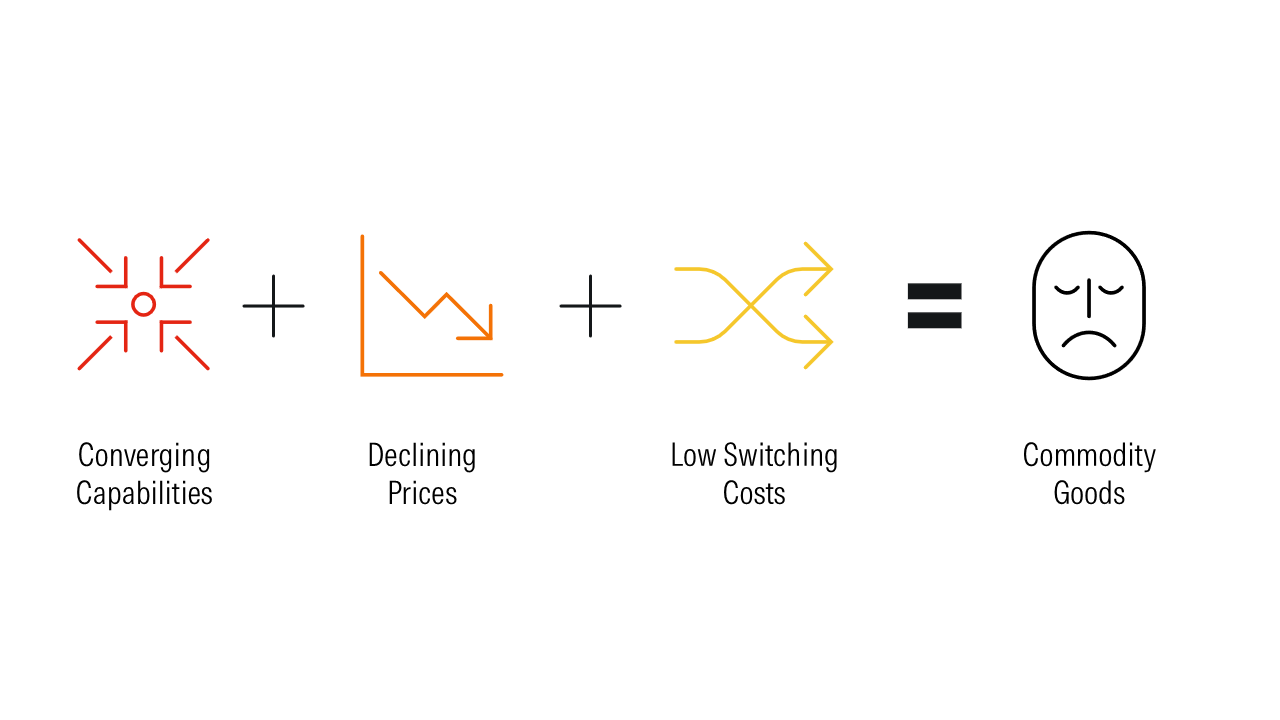
Critics say that the abilities of competing LLMs, including models from leading companies such as Anthropic and OpenAI, are already becoming more alike. Open models from China are a clear competitive threat. At the same time, the price per token is falling, and users can switch between models easily.
If all three problems continue over the long term, AI models could become interchangeable products. The power to set prices would then shift away from model makers and toward companies that control scarce resources, such as chips, electricity, cloud computing infrastructure, and ways to reach customers. Strong competitive advantages and clear differences between models could help companies avoid this outcome.
The Bear Case: LLMs Could Become Like Ordinary Commodities
Bear Case Part One: Models Are Becoming More Similar, and Chinese Open Models Pose a Risk
Data shows that the performance gap between LLMs is getting smaller. The rankings of the best models also change often. Unless an AI lab finds a way for its models to learn from their own work and improve themselves quickly, we expect this trend toward similar abilities to continue.
Leading AI Models Are Becoming More Similar in What They Can Do
Another challenge is the rapid growth of Chinese open-weight models. Over the past year, these models have made clear progress compared with US models. Cheaper, openly available versions of leading AI models can appear just months after a new top model is released. This supports the argument that it is difficult for AI companies to protect the features that make their models better than others.
Investors are clearly concerned about competition from Chinese open models. We saw this when investors worried about leading AI model companies after DeepSeek released its R1 model in January 2025 and Moonshot released its Kimi K3 model in July 2026.
We believe Chinese models will continue to trail leading US models for structural reasons. First, Chinese AI labs face hardware limits because they cannot access the newest AI chips. Second, Chinese labs have used outputs from Claude models, along with the reasoning steps Claude provides, to improve their own models. This process is called distillation. If Chinese model development depends at least partly on using leading US models to make improvements, then Chinese labs cannot meaningfully outperform US labs by definition.
Also, as open models become able to handle simple, low-value tasks, demand will grow for systems that coordinate these models and for leading models that manage them efficiently. Finally, we think it is very unlikely that US businesses and government agencies will build their standard work processes around Chinese open models. Reasons include national security concerns and costs.
Performance of Leading US and Chinese Models on the Arena
Bear Case Part Two: Falling Prices
When we group models by intelligence level and track their prices over time, we see large price drops. In late 2024, a level of intelligence that cost $17 per million tokens could be bought for $0.50 per million tokens in 2026. That is a 97% drop.
We see a similar pattern in the months after new leading models are released. Models that score above 40 on the Intelligence Index have seen their prices fall from about $5.00 to around $0.25 per million tokens within just a few quarters of release.
It may be tempting to look at these falling prices and conclude that AI models are becoming interchangeable commodities. But we urge readers not to rush to that conclusion. When the amount of usage grows rapidly, lower prices per unit can still lead to strong sales growth. Anthropic has already seen extremely rapid sales growth. Even if the price per token falls by 90%, total spending on tokens can still rise, as long as token use continues to grow at its recent rate.
AI labs have also become much more efficient at running their models over the past few years. This means they can keep their profit margins steady even as the price per token falls for some models in their product ranges.
Language Model Running Costs by Intelligence Index Group
Bear Case Part Three: Switching Models Is Easy
On cloud platforms such as Microsoft Azure and AWS Bedrock, or coding tools such as Antigravity and Cursor, users can choose a different model from a drop-down menu. This setup makes sense, especially for large cloud providers such as Microsoft (MSFT) and Amazon (AMZN), because these companies benefit when models are easy to replace and compete with one another.
We agree that switching from one model to another through a service such as Cursor costs almost nothing. But switching an AI system used across an entire business is not so easy. Companies invest in writing prompts, building systems to test model quality, fine-tuning models, and creating the supporting tools needed for AI agents to work. They often design these systems around a particular model or provider. If they suddenly switched models across the whole organization, they could face many quality problems because the processes they built would not necessarily work with the new model.
Competition between model providers will increase, but companies will offer models with different levels of intelligence and speed at different prices. Customers who need the cheapest model for a simple, repetitive task will have that option. Those who need something more capable will have other choices. Each model company can offer a full range of options.
This also points to a deeper conflict between AI model companies and software companies. Much of the value outside the model itself, including supporting tools, company-specific information, workflows, and connections to other systems, is the kind of value that software companies have traditionally tried to provide and capture.
We see two possible long-term outcomes. Software companies could become the main way customers access and connect AI models, while the models themselves become an input that customers pay to use. Or AI model companies could expand into these areas and effectively become software companies themselves. The same conflict exists between AI labs and public cloud providers. Large cloud providers benefit when models can easily be replaced, while model companies are trying to make customers more dependent on their own products and systems.
A Broader Bear Case: Public Opinion Could Slow AI Companies' Growth
AI has a serious public opinion problem. Surveys suggest that the general public views AI less favorably than Congress. This matters because local governments and councils have significant power over whether data centers can be built. If public opposition causes data center construction in the US to slow significantly, we believe AI labs will grow more slowly, but they will not lose their profits.
The extra profit earned from running AI models should remain, no matter how much new computing capacity is added in a given year. In fact, if supply is limited while demand remains high, prices could rise and profits per unit could improve for a while. However, these limits would also slow the growth that investors are counting on when valuing these companies.
The author or authors do not own shares in any securities mentioned in this article. Find out about Morningstar's editorial policies.