
How does a 235-year-old watchmaker thrive in the age of artificial intelligence?
The more artificial intelligence takes over our lives, the more valuable work done by human hands becomes. This is Marc Michel-Amadry’s view, and it fits Girard-Perregaux, a watchmaker with 235 years of history that is working to stay relevant today.
Michel-Amadry, the managing director of the Swiss watchmaking company, believes the future of watchmaking lies, in a surprising way, in looking back. He wants to protect the human skills and mechanical creativity that are becoming rarer in a world of mass production and artificial intelligence.
“The more crazy we go with technology and AI running our lives, the more important this connection to heritage, to human craftsmanship becomes,” he says.
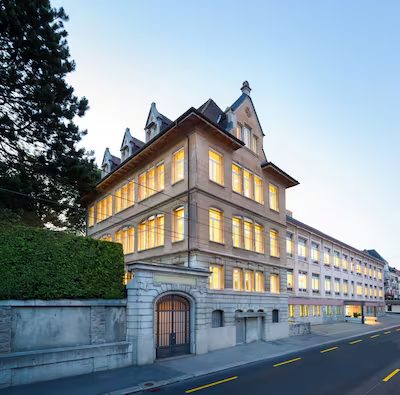
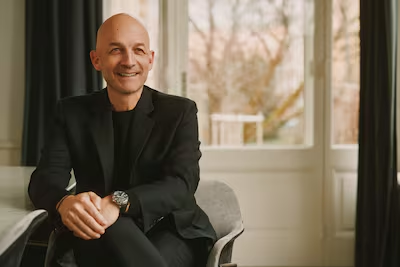
Michel-Amadry joined Girard-Perregaux in February 2025, after holding senior jobs in the watch industry and at Sotheby’s. His task is not to remake the company, but to help it gain the recognition he believes its history deserves.
“I have only one ambition: to reveal Girard-Perregaux for what it is and for the values that have always nourished it,” he says. These values go back to Jean-François Bautte, who brought watchmakers, engravers, goldsmiths, jewellers and enamel artists together under one roof in Geneva in the late 1700s. Instead of relying on separate specialist workshops, Bautte understood that people could produce better work by working together. This idea remains central to Michel-Amadry’s plans. “We have been a manufacturer since 1791, and are deeply rooted yet free.”
This difference matters. Girard-Perregaux is an independent company. It can design and develop its own watch movements, cases and designs without being held back by its history or having to answer to a parent company. Its only sister brand is Ulysse Nardin. Michel-Amadry believes this independence is becoming more important to collectors who want to discover brands beyond the best-known names.
“The beauty of our maison is that it has 235 years of history,” he says. “We are at the same level of legacy as Vacheron Constantin and Patek Philippe, but we have this freedom and this independent position.”
The Middle East is an important part of this plan because it has a knowledgeable and demanding community of watch collectors. But Michel-Amadry says the region should not be seen on its own. “Today, the impact of watchmaking, and horology in particular, is everywhere,” he says. “Wherever you are, in China, Dubai or New York, the level of knowledge, the level of sophistication collectors share and know about our industry is fascinating. Sometimes they know more than me,” he adds with a laugh.
He is especially interested in how technology and traditional skills relate to each other. As artificial intelligence and computer algorithms become part of everyday life, he believes people will value handmade objects even more. “Girard-Perregaux believes very much in AI, but as artisanal intelligence,” he says.
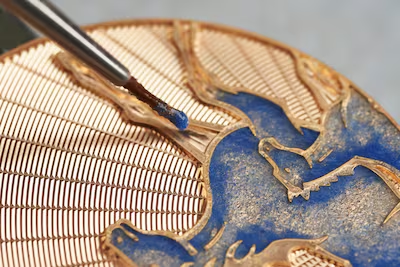
This means keeping skills in the company that many modern watchmakers might hire outside specialists to do. For example, Girard-Perregaux still makes its enamel work in-house. It also supports an engraving school in La Chaux-de-Fonds to help protect a demanding craft that fewer and fewer people practise.
“Hand-engraving is a magnificent skill, but there are very few people who do it,” he says. “We cannot afford to let this knowledge disappear.” The result is work that shows the human touch instead of the exact sameness of a machine. “People are craving artistry,” he adds. “It is perfect, but it’s not machine-perfect. And that is what makes it beautiful.”
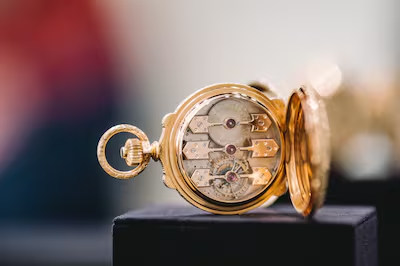
One of the best examples of this idea is Girard-Perregaux’s La Esmeralda tourbillon. This modern watch is inspired by an older pocket watch with the same name, which won a gold medal at the 1889 Paris Universal Exhibition. Its detailed enamel work and finishing required great patience and care. The modern version is also put together through a slow and careful process.
The same approach guides the company’s watch movements. Each of its most complex movements carries the signature of the master watchmaker who made it. Michel-Amadry sees this as a way to show who created the work, as well as the skill involved. “We want that level of hand-finishing in our movements, in our cases, everything. We don’t compromise on this,” he says.
This focus on quality shapes Michel-Amadry’s plans for the company. He has said before that Girard-Perregaux should be “not bigger, but better known”. He believes its customers value all the work that goes into each watch, “from the design to the development to the finishing.”
“We want to bring a different status to the people who embark into Girard-Perregaux. “It is not about saying: ‘I’m rich. I’m powerful.’ It’s more about: ‘I know how this watch has been made and it has been made uncompromisingly.’”
This approach also shapes how Girard-Perregaux welcomes collectors. At its headquarters, visitors can meet watchmakers face to face instead of watching them work through glass. The company’s villa is part museum, part private home and part place to visit. Guests eat food prepared by an in-house chef, walk through the workshops and see beehives in the gardens. They are given jars of honey when they leave. This is a more personal welcome than most luxury brands offer.
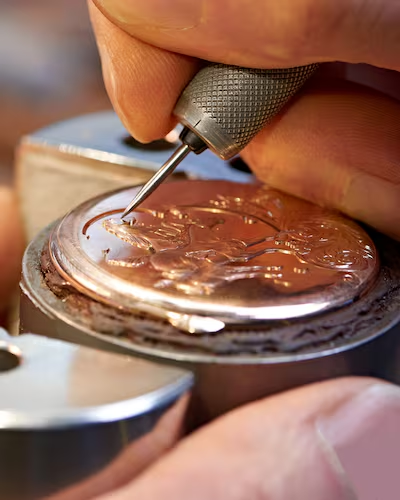
“It is a place where you will not only meet a brand, an idea and a field of horology, but you will also meet people,” Michel-Amadry says. Even the company’s new Geneva shop was designed in-house by its chief marketing officer, who has a background in architecture. “Who else can best incarnate what we want to stand for than us?” Michel-Amadry notes.
This way of thinking is part of Girard-Perregaux’s history. A good example is the Laureato, which recently marked its 50th anniversary. First introduced in 1975, this sports watch is known for its eight-sided bezel, designed by the company itself. Michel-Amadry believes it has lasted because the design can change over time without losing its identity. A Laureato from the 1980s still looks right beside one made today.
“It’s not about having the latest Laureato versus a beautiful Laureato from 1985 or 1992,” he says. “They are all relevant, and we are seriously proud of that.”
The watch is important for more than its design. The Laureato was created at a time when the watch industry was dealing with the arrival of quartz technology. Girard-Perregaux embraced this new technology and developed the Calibre 350 in 1971. It helped establish the frequency of 32,768Hz, which is now widely used in quartz watches. When the Laureato appeared four years later, it used a later version of this movement, the Calibre 705.
For Michel-Amadry, this shows that heritage and new ideas cannot be separated at Girard-Perregaux. The company’s history is not just a collection of old watches to look back at. It also tells the story of experiments and new ideas in watchmaking.
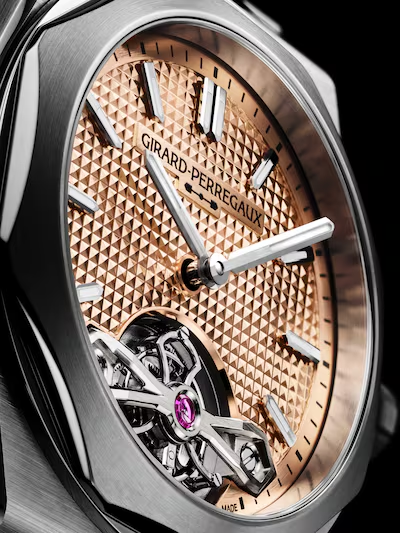
One of the clearest examples of this thinking is the Three Bridges. Constant Girard first came up with the design in 1867. It changed the usual watch movement by placing its parts beneath three bridges with a distinctive shape. Instead of hiding the mechanism under the watch face, Girard made it visible.
“It was more than skeletonisation,” Michel-Amadry says. “It was to change the whole view on how you create a movement: to show, to make the invisible visible, and to reveal the beauty within.” The design was patented in 1884 and remains one of the company’s main features. It was given a new form in the Laureato 50th Anniversary Three Gold Bridges. Only 50 of these watches will be made. The design brings together two important parts of Girard-Perregaux’s style in a single watch.
Michel-Amadry’s goal for the company may also come from his personal connection to it. He was born in La Chaux-de-Fonds and was interested in Girard-Perregaux long before he joined the company.
For his 40th birthday, he bought himself a Girard-Perregaux WW.TC chronograph. “This was my celebration,” he says about the milestone. “I felt the watch was absolutely exceptional.” It is hard to imagine someone more personally committed to the watchmaker’s future.