
A Once-in-a-Generation Opportunity: 1 Artificial Intelligence (AI) Stock to Buy Before it Soars 1,233%, According to Cathie Wood
Tesla (TSLA +3.57%) has always been a stock that people disagree about. Supporters believe in Elon Musk's plan to build a future with self-driving technology, while critics question whether his goals are too ambitious and depend too much on excitement and hype.
For years, one of Tesla's strongest supporters has been Cathie Wood, CEO of Ark Invest. Ark has just released an updated model predicting that Tesla shares could reach $5,000 by 2031 in its most optimistic scenario. With Tesla stock currently trading at around $375, that would mean a gain of about 1,233%. Such a gain could turn even a fairly small investment into wealth that lasts for generations.
Let's look at what would need to happen for Tesla to deliver these returns. Then, I'll decide whether Tesla stock could multiply in value several times over or whether it offers an opportunity that comes with major risks.
Image source: Getty Images.
Tesla could become a $20 trillion company
First, investors should understand that Ark's forecast is very different from the price targets set by most Wall Street analysts. Even in its worst-case scenario, Wood predicts that Tesla stock could reach $3,300 per share. This shows just how optimistic Ark's expectations are.
In its best-case scenario, Ark estimates that Tesla could reach a market value of $20.4 trillion. To reach this value, the company would need to earn $1.62 trillion in yearly revenue and achieve a 65% margin for earnings before interest, taxes, depreciation, and amortization (EBITDA). This margin measures how much of its revenue remains before these costs are taken into account.
For comparison, Tesla earned $95 billion in revenue in 2025 and had an adjusted EBITDA margin of 15.4%. To meet Ark's forecast, the company's yearly sales would need to grow to about 17 times their current level in just five years.
Interestingly, selling electric vehicles (EVs) is not the main reason Ark expects Tesla to grow so much over the next decade. Instead, Wood's forecast depends heavily on Tesla successfully bringing self-driving transportation, known as Robotaxi, and humanoid robots, called Optimus, to the market.
How big can Robotaxi and Optimus become?
Ark estimates that Tesla's Robotaxi business will make up 80% of the company's total business value by 2031. Tesla launched its Robotaxi service in Austin, Texas, in June 2025 and has since expanded into other cities. Ark's bigger idea is that Tesla could use its self-driving technology, Cybercab vehicles, and manufacturing skills to run a worldwide transportation network.
In its most optimistic scenario, Ark's model assumes that 10 million Robotaxis will be operating by 2031 and will bring in a total of $900 billion in yearly ride-hailing revenue. The firm also expects 1.2 million Optimus robots sold to outside customers to generate $254 billion in revenue.
The idea is that Tesla could offer robots as a service. Instead of buying robots outright, businesses could pay to use them for work. This could give Tesla a steady stream of income with high profit margins as businesses use humanoid robots in factories, warehouses, stores, and other places.
Ark also predicts that Tesla could earn $193 billion from energy storage sales, while continuing to sell traditional vehicles. Its most optimistic scenario assumes Tesla will sell 11.7 million vehicles each year.
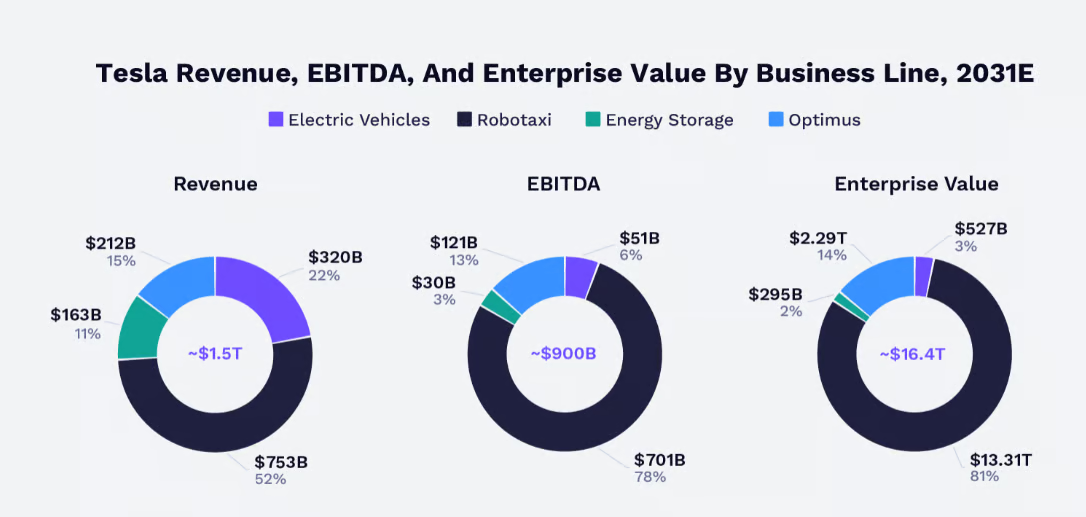
Image source: Ark Invest. Base case scenario.
Reaching these goals would require huge investments in infrastructure. Ark estimates that Tesla's total spending on AI-related capital investments could reach $225 billion by 2031. This money would help pay for the computing power needed to develop self-driving vehicles and robots.
Interestingly, Ark's analysis does not include possible contributions from Tesla Semi, additional opportunities to license its Full Self-Driving (FSD) technology to other companies, or a possible merger between Tesla and Space Exploration Technologies. However, leaving these possibilities out does not mean Ark's forecast is cautious.
Should you buy Tesla stock now?
In reality, Tesla's Robotaxi business is still small compared with the huge fleet Ark expects it to have. Meanwhile, Optimus is still an uncertain technology. Its commercial success depends heavily on improvements in reliability, safety, and the cost of making and operating each robot.
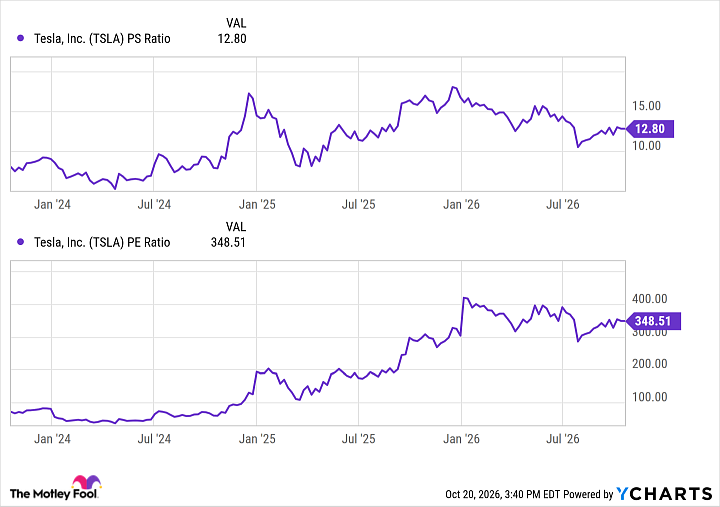
Of course, Tesla stock already has a high valuation compared with its competitors and the company's current business, whether measured by its price-to-earnings (P/E) ratio or its price-to-sales (P/S) ratio. In other words, investors are already paying extra for opportunities that could take years to become successful or might never work out at all.
TSLA PS Ratio data by YCharts
Cathie Wood's new Tesla price target shows how large the potential opportunity could be. But it also depends on very optimistic assumptions about how quickly customers will adopt these technologies, how profitable they will become, and whether Tesla's management can deliver on its plans. Given these risks, I see Tesla stock as a speculative long-term investment for people who share Wood's confidence in self-driving technology and Elon Musk's vision of building an AI-powered business based on cars, robots, and energy.
I would not buy Tesla stock just because one analyst predicts gains of more than 1,200%. For most investors, it may be better to wait on the sidelines until there is stronger evidence that Robotaxis and Optimus robots can operate successfully at a large scale.