
‘The Fix Is In’ in AI. Musk, Nvidia, OpenAI & AI Agents. ARD #189
How the biggest players in AI are fixing their weak points: a possible Tesla-SpaceX merger, Nvidia's plans for saving water and power, OpenAI's move to Google Cloud, and the race to build AI agents.
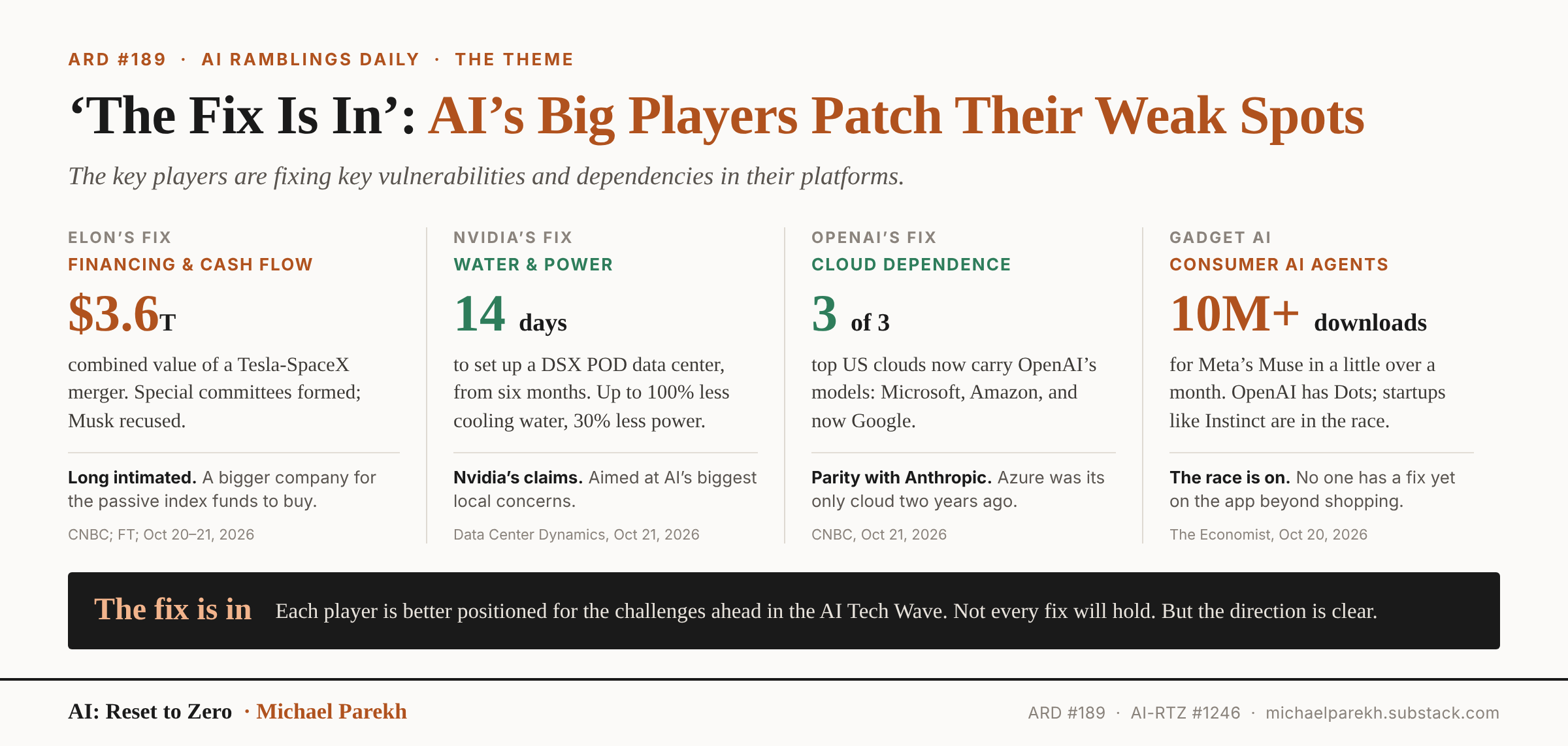
It is Wednesday, and today's theme is 'The Fix Is In' for some important AI issues. The developments are big, even if they are not surprising. In this AI Tech Wave, the biggest players are working to fix their main weaknesses and reduce their dependence on other companies and resources.
There are three big developments today. Elon Musk says Tesla and SpaceX are discussing a merger. Nvidia is trying to address water and power shortages that slow the building of AI data centers. And OpenAI is bringing its models to Google Cloud, catching up with Anthropic by making its models available across all three major US cloud providers. Then, in Gadget AI, we look at the race to secure the best positions in the consumer AI agent market.
(1) Stop the presses. Tesla and SpaceX may merge.
Elon Musk says Tesla and SpaceX have formed special committees to discuss a possible merger, according to CNBC in 'Musk says Tesla and SpaceX formed special committees to discuss merger'. He made the announcement during SpaceX's first earnings call since its huge AI IPO in June. The committees consist of independent directors. Musk said he has a conflict of interest and must stay out of the discussions. Still, he called a merger 'a good idea'. At Tesla, a deal would need the support of a majority of all shares, not just a majority of the shares voted. Musk himself described this as a high hurdle.
The combined company would be worth about $3.6 trillion, making it one of the world's five most valuable companies, according to the Financial Times in 'Rockets, robots and risk: Elon Musk's $3.6tn gamble to merge Tesla and SpaceX'. Musk controls about 84 percent of SpaceX's votes through shares with extra voting power, compared with about 20 percent of Tesla's votes. Analysts expect the combined company to use at least $54 billion more cash than it generates from its operations this year. The deal would face challenges from shareholders and regulators in the United States, Europe and China. China matters because Tesla earns about one-fifth of its revenue there. The financial results behind this news were also strong: SpaceX revenue rose 161 percent to $14.6 billion, while revenue from its AI business, now called Super Intelligence, grew ninefold to $7.6 billion, according to The Information in 'SpaceX's Musk Lauds Its Soaring Cloud Business and Possible Tesla Merger'. Most analysts expect SpaceX to be the company that buys the other, according to The Verge in 'Tesla and SpaceX are discussing a possible merger, Musk says'.
MP Take: Yes, this is a surprise, even if it was expected. I have written and spoken about this possibility for a long time, as many readers know, and I was not the only one. In March 2025, when Elon merged xAI and X, I said Tesla was the next likely company to join the group in RTZ #675. I made the point again in February, when xAI became part of SpaceX, in RTZ #987. The recent demonstration of a flying Roadster using SpaceX thrusters was another strong sign that he plans to combine his space and car businesses. There are many regulatory issues and differences in voting power to deal with, but that seems to be the direction. The timing is important, too, with Anthropic's huge AI IPO coming up and OpenAI's IPO expected sometime between now and 2027.
Most importantly, the merger could help the company attract more money from the hundreds of billions of dollars held in passive index funds. SpaceX went public on Nasdaq, and a change to Nasdaq's rules allowed it to join the Nasdaq-100 in just weeks instead of waiting a year, as I explained in AI-RTZ #1115. A larger Tesla-SpaceX company would increase the share of this business that you and I own through our index funds. Remember, I have argued, along with others, that if Tesla were valued only as a car company, its core business might be worth around half a trillion dollars. That is a generous estimate, given that Toyota, the world's largest car company, is worth less than $300 billion. The rest of Tesla's value depends on robotics and fully self-driving robotaxis.
I was head of internet research at Goldman Sachs and a partner there in the 1990s. One major question for me is how investors would value the different parts of a large group like this. Starlink is a telecommunications business. SpaceX has a rocket-launch business, with its own uncertainties about reusable rockets. Tesla has its own set of uncertainties. Car analysts, robotics analysts, and aerospace and defense analysts would all have to work out how to cover the combined company. Their views would help determine how the stock trades after the businesses are brought together. When Elon focuses intensely on a plan, he often gets it done. Elon is working to fix the pieces.
Sources: CNBC, 'Musk says Tesla and SpaceX formed special committees to discuss merger' · FT, 'Rockets, robots and risk: Elon Musk's $3.6tn gamble to merge Tesla and SpaceX' · The Information, 'SpaceX's Musk Lauds Its Soaring Cloud Business and Possible Tesla Merger' · The Verge, 'Tesla and SpaceX are discussing a possible merger, Musk says'.
For longtime readers: RTZ #675, 'AI: Elon merges xAI and X/Twitter as first step to AI platform' · RTZ #987, 'AI: Following playbook, Elon Musk merges xAI under SpaceX shell' · AI-RTZ #1066, 'AI: SpaceX/xAI IPO filing outlines Elon's boundless AI Ambitions' · AI-RTZ #1115, 'AI: Nasdaq to force-feed SpaceX/xAI IPO into Passive Index Funds'.
(2) Nvidia fixes for water and power.
Nvidia says its new data center design will use much less water and electricity, according to Data Center Dynamics in 'Nvidia launches DSX POD, claims the Vera-Rubin reference architecture will make AI data centers more water and energy efficient'. Nvidia shared the design at its GTC conference in Berlin. The company says its DSX plan can reduce water used for cooling by up to 100 percent. It does this by cooling chips with liquid in a closed system and using outdoor dry coolers, so no water evaporates. At a site that uses 2 gigawatts of power, Nvidia says this could save 54 million liters of water each day. Very hot places may still need extra cooling. Nvidia's software can also produce the same AI results using up to 30 percent less electricity. It can adjust a data center's power use up or down when the electricity grid needs it.
Nvidia has also introduced the DSX POD, a ready-made data center built around its newest Vera Rubin chips. The units arrive in containers that have already been assembled and tested. Nvidia says this can cut setup time from six months to just 14 days. Seventeen partners are involved, including Dell, Foxconn and Schneider Electric. Deliveries are due to begin early next year.
MP Take: This is a good fix. Nvidia is making steady improvements to how efficiently its data centers use water and electricity. The changes could save millions of liters of water each day. Remember, water use is one of the main public concerns about AI data centers. There is also growing opposition to building more data centers ahead of the midterm elections, as I noted just yesterday in ARD #188. A design like this could help ease some of those concerns. Cutting setup time from six months to 14 days also addresses a major problem for companies building the most advanced AI models and the large cloud providers.
Nvidia is continuing to improve its platforms one step at a time, as I described after its major conference in March in RTZ #1031. Instead of focusing mainly on big questions about artificial general intelligence, or AGI, and AI safety, the company is making its systems work better. It is improving water and energy use, which are limited resources needed to power AI computing and AI data centers.
For longtime readers: RTZ #1031, 'AI: Nvidia's dense announcements at GTC 2026 worth a trillion+ by 2027' · ARD #188, 'One Step Forward, Two Steps Back'. OpenAI, DeepSeek & Idealab.
(3) OpenAI befriends Google Cloud.
OpenAI will make its AI models available to developers through Google's cloud service, after years of competition between the two companies, according to CNBC in 'OpenAI to bring AI models to Google's cloud, in further expansion beyond Microsoft'. OpenAI's GPT models will appear in Google Cloud's model library and coding tool in the coming weeks. This means OpenAI will be available on all three leading US cloud platforms. Microsoft's exclusive license to OpenAI's technology ended in April. Amazon announced the very next day that it would host OpenAI's models. Google Cloud has also been growing quickly. Its growth reached about 82 percent last quarter, compared with 37 percent for Amazon and 42 percent for Microsoft. All three companies are due to report earnings next week.
MP Take: This matters because OpenAI is continuing to reduce its dependence on Microsoft Azure, which was its only cloud partner a little over two years ago. I wrote about Microsoft's plans for a future beyond OpenAI a year ago in RTZ #898. By adding Google Cloud, OpenAI now matches its main rival Anthropic, whose models are available across all three major large-scale cloud providers. This is an important step in reducing dependence on a single partner, and it can help all the companies involved, even though they compete with one another. Remember, each has its own chip designs and preferred AI models. Amazon has its Trainium chips, and its relationship with Anthropic is changing, as I explained in June in AI-RTZ #1133. OpenAI is continuing to reduce its dependence on Microsoft. This is an important development.
Sources: CNBC, 'OpenAI to bring AI models to Google's cloud, in further expansion beyond Microsoft'.
For longtime readers: RTZ #898, 'AI: Microsoft outlines its 'Post-OpenAI' path for AI' · AI-RTZ #1133, 'AI: Amazon-Anthropic relationship evolving' · RTZ #754, 'AI: OpenAI & Microsoft almost at an impasse'.
My overall take
MP Take: The biggest players are fixing weaknesses in their platforms, reducing their dependence on key partners and making better use of important opportunities. Elon is addressing financing and cash flow across his two major public companies. Nvidia is improving the efficiency of AI factories and computing systems, which are at the heart of an AI construction boom that could reach $10 trillion by 2030, as I wrote on Monday in AI-RTZ #1244. OpenAI is reducing its dependence on the cloud services it uses by adding Google Cloud. All these changes matter in this AI Tech Wave.
Gadget AI: The race to secure the best positions in consumer AI agents.
The Economist has a useful overview of the race to build AI agents for consumers in 'AI-powered personal assistants could reshape the digital economy'. Unlike older assistants such as Siri, these new agents can take action on their own instead of waiting for someone to ask them to do something. Meta's Muse, led by Mark Zuckerberg and his AI chief Alexandr Wang, has passed 10 million app downloads in just over a month. ChatGPT's app had 3.7 million downloads over the same period after its launch. The startup Instinct works through text messages. It can check users in for flights, find concert tickets and arrange dinners. Its number of users has been growing by about 10 percent a day. OpenAI has its own Dots platform, while Google, Amazon and Apple are also competing in this market. The main challenges are trust and safety, because an agent needs access to personal information such as your calendar and credit card to be useful. Businesses are another challenge. Shopify, Walmart, Instacart and Expedia are working with these agents, while Amazon is keeping them out for now. I wrote about the state of the market a week ago in AI-RTZ #1238.
MP Take: I have written a lot about this topic, and I use Instinct every day myself. Many companies are focused on AI agents and online shopping. But we are still at the very beginning. We have not yet seen AI agents become widely used for everyday tasks on a large scale. As I wrote two years ago in RTZ #494, there is still a long road ahead. Companies are trying many different ideas, while early users experiment and work out how to use these tools. We should have a much clearer picture in about six months.
Sources: The Economist, 'AI-powered personal assistants could reshape the digital economy'.
For longtime readers: AI-RTZ #1238, 'AI: Meta's 'Wonder Full' Muse Joins the AI Frontier' · RTZ #494, 'AI: Long road ahead for AI Agents for enterprises and consumers'.
Q&A
What number am I watching for in consumer AI agents?
The first agent to reach more than 100 million daily users. As I mentioned, Meta's Muse AI agents have around 10 million downloads, complete with their cheerful mascot. OpenAI probably has a few million users, and Google is increasing the reach of Gemini. It will probably take six to 12 months to see how things develop and whether any of them reach this target.
What is the main event to watch for in consumer AI agents?
It is the arrival of a widely used AI agent application that does something other than shopping. Everyone is focused on shopping, and a lot of work is happening in this area. Amazon has blocked some of these agents while it negotiates with them. Companies are trying to discover what people will find genuinely useful. The business market is further along, with Microsoft's Copilot and many other tools. For consumers, it is still early. To fit our theme, no company has yet found a clear winning formula for a consumer AI agent that does something other than shopping. We will see how the market develops.
Clips from today
Nvidia's Fix for Water & Power
Nvidia's new DSX POD design for AI data centers aims to save millions of liters of water each day and reduce setup time from six months to 14 days.
MP Take: Water use is one of the main public concerns about AI data centers. A design like this could help address some of those concerns.
Tesla and SpaceX May Merge
Elon Musk says Tesla and SpaceX have formed special committees to discuss a merger. Together, the companies would be worth more than $3.5 trillion.
MP Take: This possibility has been suggested for a long time, by me and others. The deal would face regulatory challenges and differences in voting power, but that appears to be the direction.
The Race for Consumer AI Agents
Meta's Muse has passed 10 million app downloads in just over a month. OpenAI has Dots, and startups such as Instinct are also competing.
MP Take: The race to secure the best position in the consumer AI agent market is underway.
AI Agents: Just the Beginning
Consumer AI agents are still at the very beginning of their development.
MP Take: The number to watch is the first agent to reach more than 100 million daily users. Another key sign will be an AI agent app that does something other than shopping and becomes part of people's daily lives.
Today's AI-RTZ #1246, 'Anthropic's $750 Billion Compute Bill, SpaceX's AI Profit' covers new details from Anthropic's draft S-1 filing, reported by the Wall Street Journal and others ahead of its huge AI IPO. The report points to a $750 billion computing bill, putting Anthropic in the same league as OpenAI. It also covers SpaceX's first AI profit. Please take a look.
AI Ramblings Daily on AI-RTZ is a place to think through AI and reset, together.
Tomorrow, it is ARD 190 and AI-RTZ #1247.
Thanks for joining us, AI Curious Folk. Stay tuned.
Full Source Reading
Tesla and SpaceX
FT, 'Rockets, robots and risk: Elon Musk's $3.6tn gamble to merge Tesla and SpaceX', Oct 21, 2026
The Verge, 'Tesla and SpaceX are discussing a possible merger, Musk says', Oct 20, 2026
Nvidia, water and power
OpenAI and the clouds
Gadget AI
The back catalogue
AI-RTZ #1246, 'Anthropic's $750 Billion Compute Bill, SpaceX's AI Profit'
AI-RTZ #1238, 'AI: Meta's 'Wonder Full' Muse Joins the AI Frontier'
AI-RTZ #1115, 'AI: Nasdaq to force-feed SpaceX/xAI IPO into Passive Index Funds'
AI-RTZ #1066, 'AI: SpaceX/xAI IPO filing outlines Elon's boundless AI Ambitions'
RTZ #1031, 'AI: Nvidia's dense announcements at GTC 2026 worth a trillion+ by 2027'
RTZ #987, 'AI: Following playbook, Elon Musk merges xAI under SpaceX shell'
RTZ #898, 'AI: Microsoft outlines its 'Post-OpenAI' path for AI'
RTZ #675, 'AI: Elon merges xAI and X/Twitter as first step to AI platform'
RTZ #494, 'AI: Long road ahead for AI Agents for enterprises and consumers'
ARD #188, 'One Step Forward, Two Steps Back'. OpenAI, DeepSeek & Idealab

(NOTE: These discussions are for information only and are not investment advice at any time. Thank you for joining us.)