
AI helped find a critical bug affecting huge swathes of the internet

A page showing that the UK government website was unavailable on June 8, 2021. Some websites experienced similar problems today and were taken offline for updates after a serious cybersecurity weakness was announced.Leon Neal/Getty
Newly announced security weaknesses could affect large parts of the internet. Teams of cybersecurity experts found them with a lot of help from AI.
The problems affect PHP, a widely used, free programming language whose code can be shared and changed by anyone. PHP supports tools for managing website content, including WordPress, which runs many websites, including those of the Center for Investigative Reporting.
If website owners do not install the fixes, attackers could quickly take control of their sites, add harmful software, or steal users' information.
The announcement sent cybersecurity teams rushing to install fixes released by the people who develop PHP. Government agencies around the world issued urgent warnings, and some government websites in Europe and Canada were taken offline so they could be updated.
According to reporting by the Wall Street Journal, experts knew about this type of security weakness decades ago. But they thought it was too hard to use in an attack, so they mostly forgot about it. That changed in August, when researchers using newer AI models found a way to exploit it. These models included Google's latest model at the time and an OpenAI model released in July.
OpenAI described the discovery as “one of the most impactful security issues in recent memory.” But it is part of a much larger trend. A graph put together by the research nonprofit Epoch AI shows how many serious security weaknesses are reported each month by some of the largest technology companies and open-source projects:
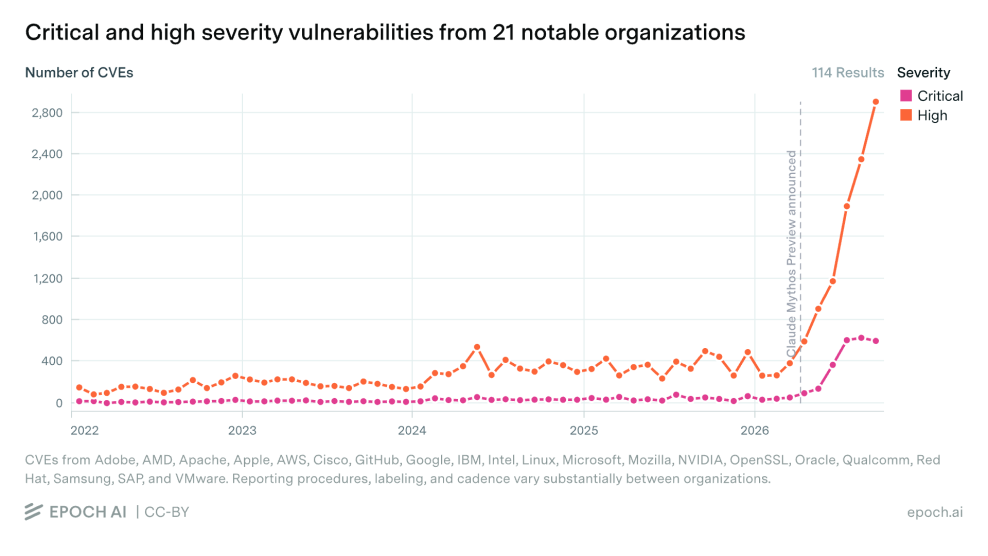
A few years ago, these organizations might report a few dozen serious security weaknesses in a month. Now, a typical month brings about 600. In the same statement, OpenAI said the weaknesses announced today were just a few of several serious problems it had already found and was working to fix. The company expects the number of similar discoveries to rise sharply in the coming months.
Greg Brockman, OpenAI's president and second-in-command, wrote today that fixing the PHP problem had been slow and required a lot of manual work. He warned that this approach would not be enough if, as expected, many more security weaknesses are found and exploited in the coming months.
He suggested that governments might need to play a much bigger role in watching over the internet's infrastructure. They might even need to step in and fix security weaknesses on other people's servers themselves.
Cybersecurity has become a major concern for AI leaders and policymakers. This was especially true after April, when it became clear that Anthropic's Claude Mythos Preview model could find serious software weaknesses and exploit them on its own. Anthropic decided not to release the model to the public. Since then, Anthropic and OpenAI have worked to give trusted partners, including large companies and government agencies, early access to their models so they can strengthen their cyber defenses.
When I spoke with experts on AI risks in August, they told me that AI would probably be able to help carry out advanced cyberattacks within just a few months.
Much of their concern was about open-weight models. These models let people access their internal settings and can have their safety protections removed. They have also consistently lagged about 6 to 12 months behind the best closed-weight models, whose inner workings are not publicly available. Experts worry that hackers will soon be able to use models as powerful as Claude Mythos and attack any organization that falls behind on cybersecurity. Targets could range from a local utility company to a nearby hospital.
That remains a real concern, and open-weight models could be very useful for exploiting security weaknesses like those affecting PHP. But today's news shows that open-weight models are not the only reason to worry about cybersecurity.
Along with the PHP problem, The Information reported today that hackers used AI to automate much of their attacks against 400 financial institutions across Latin America. They used models made by Anthropic, the Chinese company Moonshot, and Elon Musk's company SpaceXSI (previously called SpaceXAI and, before that, xAI). The hackers apparently got past some safety protections by persuading the models that they were being tested in harmless settings.
AI models are developing abilities beyond human experts in fields other than cybersecurity, too. Leading models are solving problems that once defeated top mathematicians and, more and more, physicists. AI is also helping scientists design proteins and viruses. This work could lead to important medical advances, but it could also support dangerous research into biological weapons.
AI is already creating a world with more possibilities and more dangers. There is still a great deal of work to do to keep up.