
Surprise Debut of Claude Personal Intelligent Agents: Proactive Briefing Outreach and Unexpected Raid on Muse and Dot
Zhidongxi reported on October 22 that, early this morning, Anthropic launched a new personal AI agent app called Claude Duet. It focuses on handling work tasks before users ask for help. It can connect to users' email, calendars, bank accounts, and business systems. It can find tasks that need attention without waiting for instructions and keep working on them.
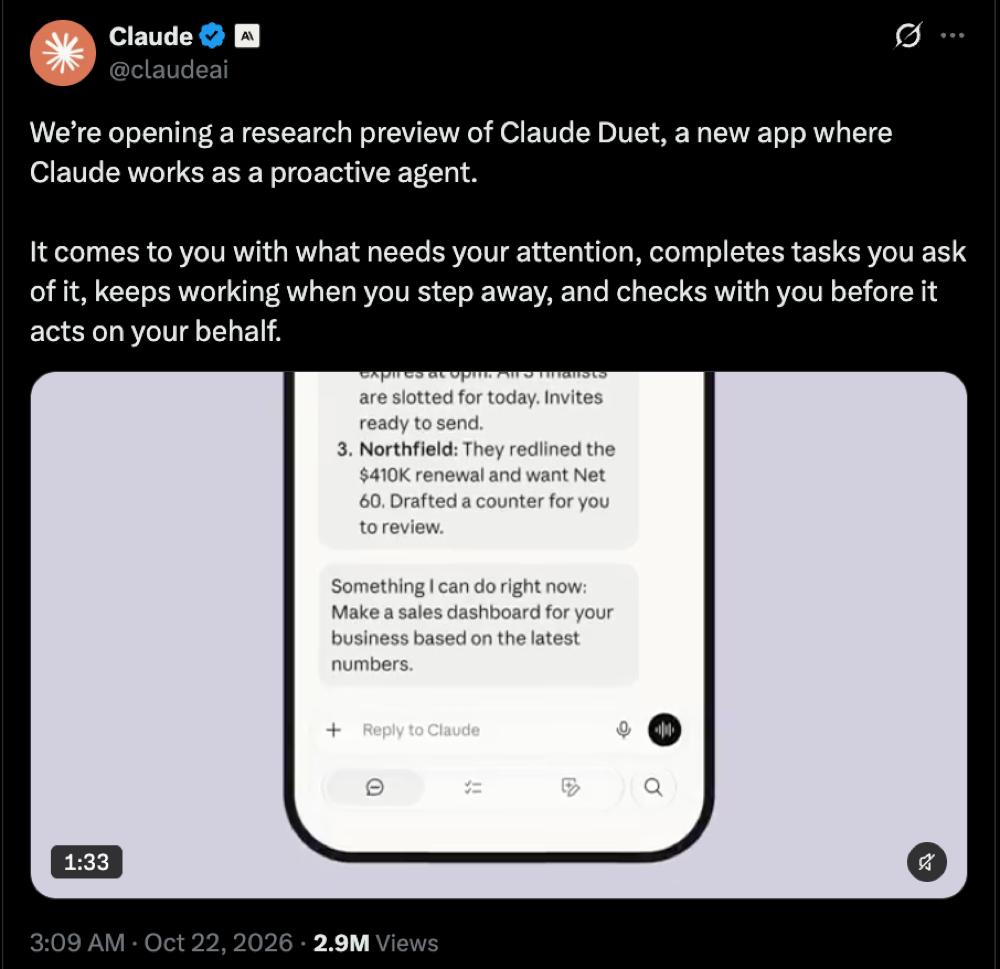
Claude Duet is built on the Claude Opus 5.5 model. It can use more than 6,000 connectors and plugins in the Claude Marketplace to handle tasks such as financial analysis, hiring, customer communication, and payroll. Even when users turn off their computers or phones, Claude Duet can keep working inside its own virtual machine.
Claude Duet is now available as a separate app for iOS, Android, and the web. Applications for the first research preview are open to Pro and Max subscribers in the United States, but the product is not yet available to everyone.
Claude Duet's launch has also started discussions in the international AI community.
Thibault Sottiaux, known online as Tibo, leads ChatGPT and Codex at OpenAI. Developers jokingly call him "the God of Reset." He joked in the comments: "Dot, meet Duet. Duet, meet Dot. You two should get along well."

One person online said, "Duet has already won. It uses the Opus model, which says it all." The person also called out to Tibo, saying, "Hope you still have some tricks up your sleeve, especially on the model side."

Other users shared the famous meme of two Spider-Man characters pointing at each other. The caption read: "Muse, Dots, Grok, and now Duet comes along."

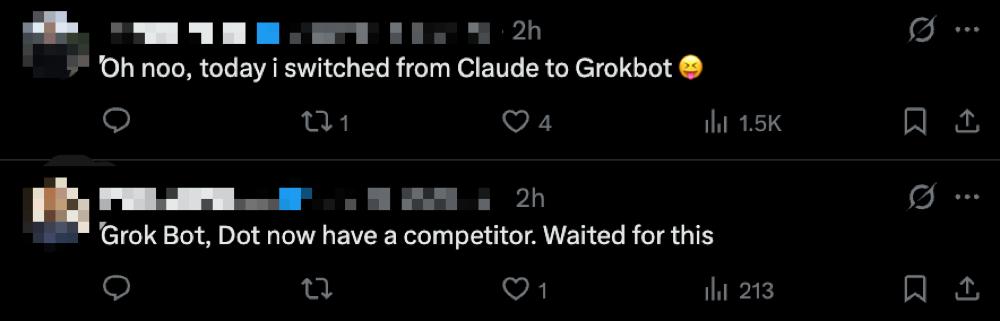
Some users also said, "Oh no, I just switched from Claude to Grok Bot today." Another user said, "Grok Bot and Dot now have competitors. I've been waiting for this for a long time."
In September, Meta and OpenAI launched their personal AI agents, Muse and Dots. With Anthropic now joining them, another competitor has entered the race to build personal AI assistants.
01.
Daily Updates on Tasks That Need Attention
Can Handle Hiring and Financial Work
A key feature of Claude Duet is that it can find work that needs attention ahead of time, without waiting for users to ask questions.
In a demo video released by Anthropic, Claude Duet sends users a work briefing every morning. It gathers information from connected apps to explain the day's important tasks and which decisions need to be made soon. The video follows Nicole, who runs a coffee company, as she uses Claude Duet throughout a day. In the morning, Claude Duet sends Nicole a briefing that lists three key tasks.
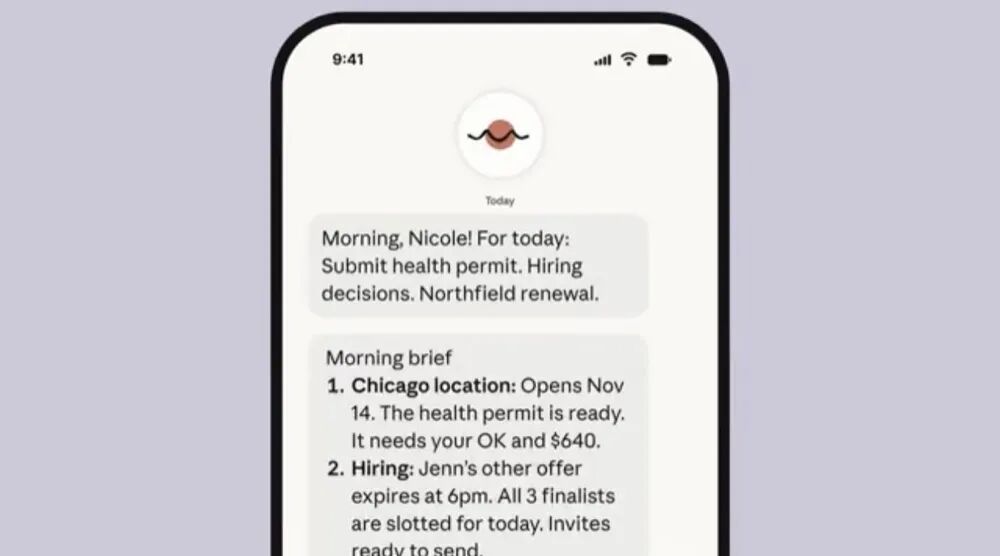
Claude Duet does more than list tasks. It also prepares the materials needed to handle them in advance, such as permit application documents, hiring plans, and draft counteroffers for contracts.
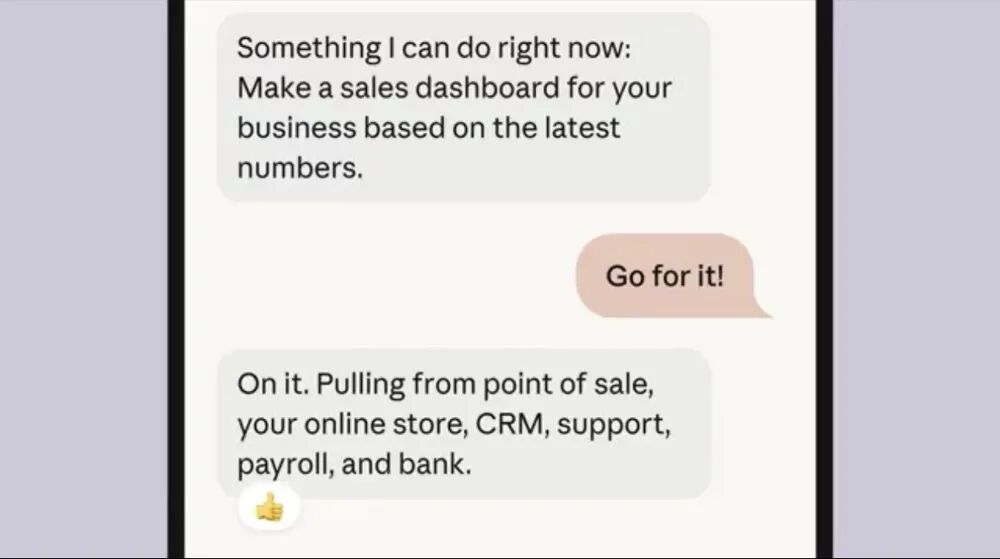
Along with the morning briefing, it offers to build a sales dashboard using the company's latest business data. When Nicole replies, "Go for it!", Claude Duet says it will gather data from checkout systems, online stores, customer relationship management (CRM) systems, customer service tools, payroll systems, and bank accounts. Users do not need to open each service, download its data, and organize everything themselves. Claude Duet can use the relevant tools to do the work.
Claude Duet can also send reminders before problems arise. For example, it reminds Nicole that the Chicago store will open in 26 days, but the health permit application has not yet been submitted. It has already prepared a draft application and asks Nicole to review it before paying.

Claude Duet also changes task priorities as work progresses. For example, if the Northfield renewal does not need immediate attention, it tells the user that the task can wait until the following Monday.
The hiring example shows how Claude Duet can work on a task that continues for several hours.
In the demo, Claude Duet first tells the user that the interview panel is meeting three candidates. It says it will organize the interview records after all the interviews are finished.
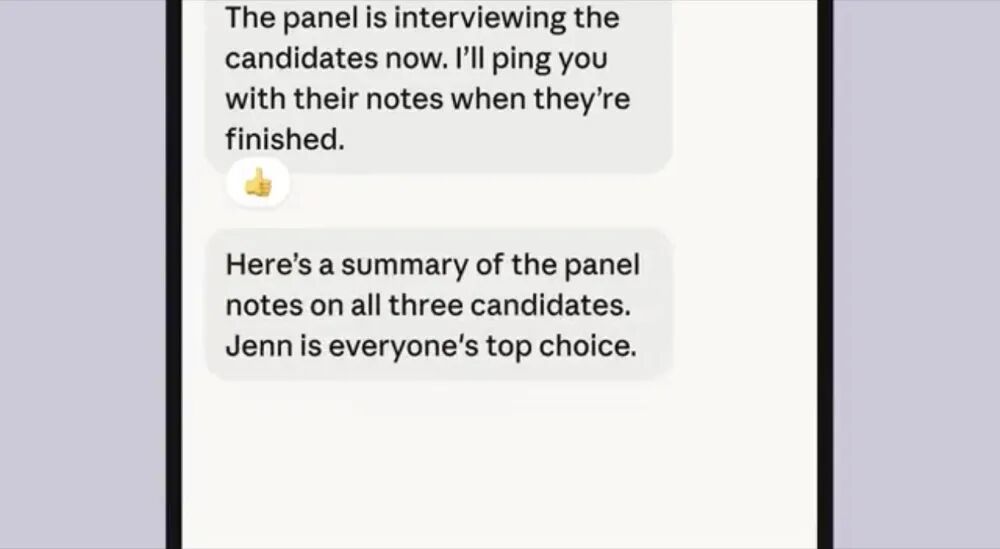
It then creates a summary from the interviewers' feedback. The summary says that all interviewers consider Jenn the strongest candidate. It also reminds the user that Jenn has received another job offer.
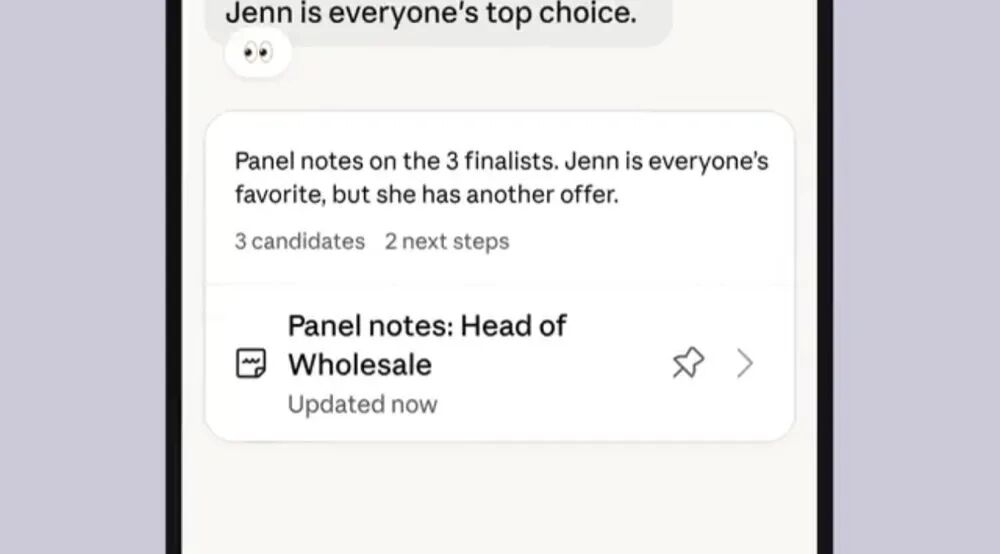
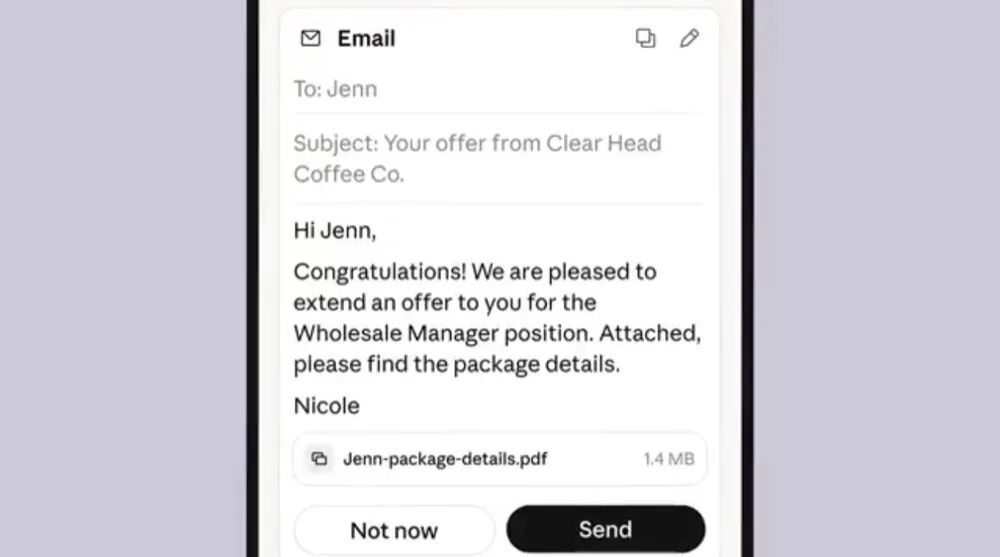
After Nicole confirms that Jenn is also her first choice, she asks Claude Duet to find the pay package in the human resources folder and draft an offer email. Claude Duet quickly prepares the email, attaches a PDF containing Jenn's pay package, and asks Nicole to approve it before sending.
02.
Connected to More Than 6,000 Tools
Can Keep Working When Users Step Away
Claude Duet can use the memories, skills, and connected apps from a user's existing Claude account, reducing the amount of setup needed at the start.
Users can interact with Claude Duet through text or voice. They can assign tasks, check progress, and add new requests at any time in the same ongoing conversation.
Unlike traditional automation tools that require users to keep their devices online, Claude Duet has its own virtual machine and browser. After receiving a task, it can decide which apps to use and what actions to take, then continue working in the background. The task will not stop if the user leaves their computer or turns off their phone. Claude Duet sends a notification when the task is finished or needs the user's review.
However, users cannot currently see the steps Claude Duet takes while operating its browser.
Claude Duet can connect to more than 6,000 tools and plugins in the Claude Marketplace, giving it access to software commonly used in everyday business operations.
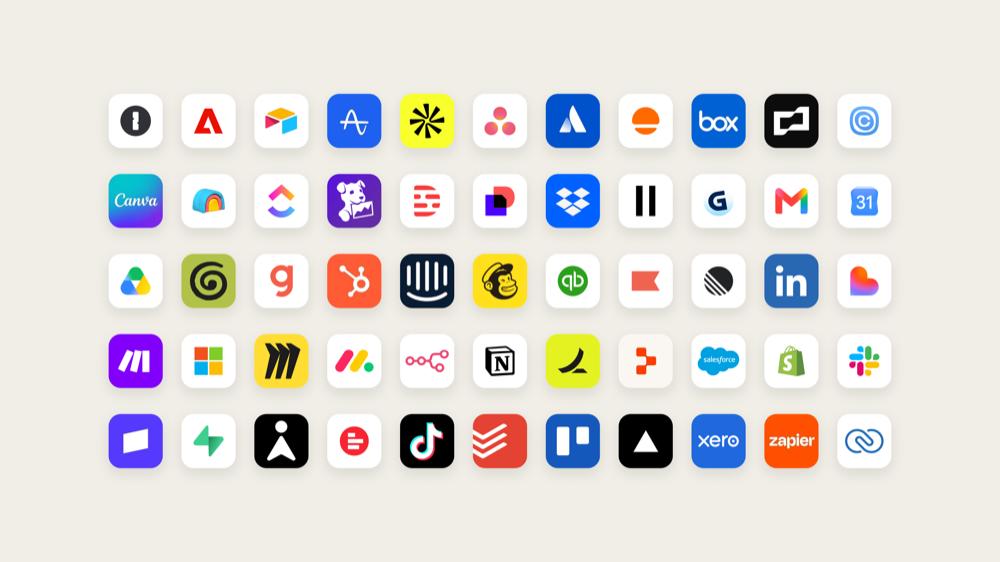
For example, it can find important messages that users missed in Gmail and Slack and draft replies. It can check for unpaid invoices in QuickBooks or Stripe and prepare payment reminders. It can also enter working hours, bonuses, and expense reimbursement details in Gusto to prepare payroll payments.
For hiring and sales, it can draft job listings and publish them on LinkedIn after the user reviews them. It can write follow-up emails using customer contact details and sales history in HubSpot, prepare contracts and send them for signatures through DocuSign, and use Canva to turn product launch plans into social media marketing campaigns.
For businesses that sell products online, Claude Duet can connect to Shopify to help design and manage online stores. Anthropic says it plans to launch a more complete visual editor in the future, so users can preview store designs before making their stores available to the public.
For payments, Claude Duet supports buying business supplies through Link, Stripe's digital wallet. After the user confirms the items, Link asks for payment approval again and uses a virtual card to complete the purchase. This means the user's real bank card number does not need to be given directly to the seller.
Claude Duet also supports completing online purchases through Shopify's Shop Pay. In the future, Anthropic plans to let Claude Duet access websites using login details stored in 1Password, after the user gives permission.
03.
Payments and Emails Need User Approval
Background Checks Also Use Up Usage Quota
Because Claude Duet needs to connect to email, bank accounts, and other business apps, Anthropic has placed special emphasis on security in its product introduction.
First, when handling account credentials, Claude Duet follows the relevant design used by Claude Managed Agents. It does not directly access users' passwords or login tokens.
Second, Claude Duet can read information, draft documents, and prepare actions on its own. But before it sends messages to others, makes payments, signs documents, or deletes content, it must show the user what it plans to do and wait for approval.
Some actions are not allowed even when the user approves them. These include trading securities and transferring money between accounts.
To reduce the risk of sensitive information being leaked, Anthropic has added a special classifier and security instructions to Claude Duet to check messages and block the sharing of sensitive information.
For highly sensitive information, such as credit card numbers and government-issued ID numbers, the system will reject requests to share it. Other sensitive information, such as health details and personal financial information, can only be sent when the user clearly instructs it to do so.
Anthropic says internal security teams and outside security companies have tested Claude Duet by trying to find ways to break into it. The product has also been added to the company's public bug bounty program.
Claude Duet does not constantly monitor every connected account to look for new information.
It currently checks connected apps every few hours. One main reason is that checking continuously would use up the user's plan allowance more quickly. Users can also choose which notifications they want and how often they receive them. Claude Duet's proactive alerts and ability to work in the background both use up the available allowance.
Claude Duet shares the usage allowance of the Pro and Max plans with the main Claude product. Regular background checks use some of this allowance. Complex tasks, such as building financial models and presentations, require more rounds of AI processing and therefore use more of it.
Anthropic also clearly states that Claude Duet is still at an early stage. It may misunderstand conversations or make mistakes when judging which tasks are urgent.
Because the current product is mainly designed for work, it is not yet good enough at handling personal tasks, such as booking tickets.
This preview is currently open only to Pro and Max users in the United States who apply to join the waitlist. Users must wait for an official email to learn whether they can access it. Claude Duet is a separate app and has not yet been added to the main Claude app.
04.
Conclusion: Competition in the Personal AI Agent Market
Is Growing More Intense
With Claude Duet entering the market, there is another new product competing in the personal AI agent field.
On September 8, Meta launched Muse, a personal AI agent developed by its Superintelligence Lab. On September 30, OpenAI launched Dots, a personal agent designed to work throughout the day. On October 22, Anthropic officially announced Claude Duet.
All these products focus on providing help proactively, without waiting for users to ask.