
Could thoughtful 'AI art' counter the rise of 'AI slop'? Why creatives today face a paradox
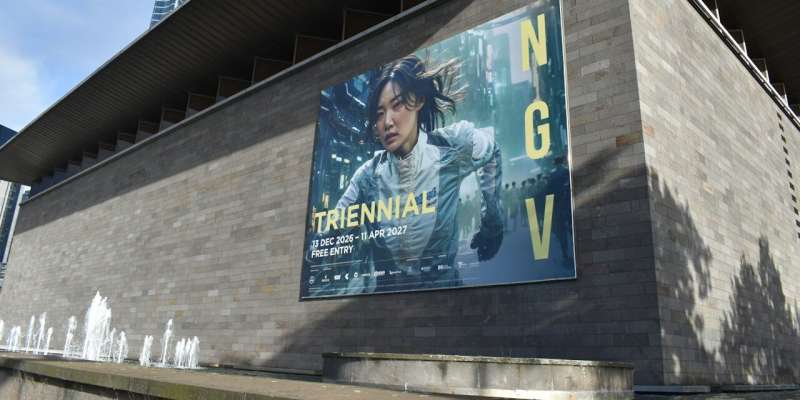
A discussion on Reddit includes a photo of a poster advertising the National Gallery of Victoria's upcoming triennial art exhibition. The poster shows an image from Ayoung Kim's video installation, Delivery Dancer's Arc: Inverse (2024), which uses several video screens.
The image shows a Korean woman running through a crowded, futuristic city. She wears a riding suit and gloves. The image comes from a video about women who work as delivery drivers for gig-economy companies in a dark future version of Seoul. An artificial intelligence system pushes the women to compete against each other, watches their work and changes how they experience time.
The artwork combines AI, computer-generated images (CGI), video game engines and live-action footage.
People commenting on Reddit criticize the use of generative AI. They do not distinguish between art made with generative AI and AI that replaces the artist completely. They question why the gallery chose to promote an artwork that uses AI as an artistic tool.
There is an irony here. The commenters are against a world in which AI takes over people's jobs. But Kim's artwork also explores this very problem.
The disagreement seems to center on her choice to use generative AI as a tool for making art.
AI everywhere
AI systems now shape our everyday lives. They are used in warfare, control what appears in our social media feeds, study our facial expressions and take the data we upload. A small number of technology companies collect and use this data to make money through what is known as cloud capital.
Our data becomes part of the collections of information used by commercial generative AI platforms. These platforms fill the internet with large amounts of low-quality, AI-generated content, often called "AI slop." It seems we cannot avoid it.
It is no surprise that Reddit commenters are upset to see art made with generative AI. If AI also replaces artists and creative work, what parts of our social lives will remain untouched by its growing influence?
However, their criticism treats two different things as if they were the same: AI replacing an artist and an artist choosing to use the technology.
So, does an artist's purpose matter?
Media theorist Joanna Zylinska is careful to distinguish between two kinds of art made with generative AI.
She compares popular AI art to a mindless game of Candy Crush. In this kind of art, the artist uses generative AI only for what it can do, showing off its ability to turn data into impressive-looking images.
Critical AI art, on the other hand, tries to show what the technology means and how it affects us. This includes how the technology is built and supported, how it affects workers and even what it means to be human.
The role of the gallery
Art institutions around the world are paying more attention to how AI affects art and creativity.
Some of these artworks strongly criticize the way AI systems take and use data and other resources.
But art institutions depend on company sponsorship, visitor numbers and media attention to get funding. As a result, an artist's political criticism can also become a marketing tool, a symbol or a main image used to promote an exhibition.
Kim's poster, which uses generative AI, shows this problem when it is taken out of the context of her artwork.
Theorist Victor Burgin questions whether art galleries can effectively criticize AI. He argues that to understand art that criticizes AI, people need background information that cannot be communicated simply by looking at the artwork.
Burgin believes that art can resist harmful ideas in other ways, such as challenging stereotypes, overused ideas and beliefs built into popular visual culture.
Understanding AI through art
People are becoming more worried about AI replacing artists and other creative workers. As AI spreads into many parts of the creative industries, it is important to discuss what artists can learn by experimenting with AI.
As a researcher who studies creativity, I am interested in how my experiences with technology shape what I can learn and understand about it. As a photographer, I think about how generative AI developed from collections of photographs taken around the world. This also means that generative AI inherits ways of seeing and remembering the world that come from photography.
Generative AI taps into people's desire to create images of almost anything, from nude pictures and Hollywood stars to images that make it seem as though dead people are alive again.
When text-to-image platforms appeared in 2021–22, people could turn this desire into images by writing a short description, known as a prompt.
That is the promise made in the technology's advertising. It inspired me to create an artwork about something that was impossible to see: my mother before she became my mother.
I wanted to find out whether the billions of images taken and used without permission could produce even one image of my mother.
The experiment was designed to fail because of the prompt I used. I did not want to solve this problem. Instead, I wanted to use it to explore the links between the language we use to describe images and the labels attached to images inside AI systems.
Since creating that artwork, I have struggled with the ethical questions involved in using generative AI as an artist. The flood of low-quality AI content is one reason I hesitate. The political questions around whether we can choose not to use AI are another. I keep asking myself whether artistic practice can help us understand and think critically about AI systems.
Using generative AI creatively begins with finding new ways to use its systems and working against what they are designed to do. It means accepting what AI cannot capture and challenging the way it works. For example, artists can write prompts about parts of social life that are difficult to measure or combine into data, such as feelings, emotions and physical sensations.
In this way, experimenting with art may be one of the few opportunities we have to experience and understand the limits of AI as it increasingly affects our lives.