
OpenAI Models Land on Google Cloud: Frontier Distribution Goes Multi-Cloud While the Watts Stay Exclusive
Analysis
GPT-6 Astra, Sol, and Luna are now available in Google Cloud’s Model Garden. Google is the third major cloud provider to sell OpenAI’s most advanced models since its exclusive deal with Azure ended. More businesses can now access these models through different cloud providers, but control over the computing power needed to run them has not spread in the same way.
OpenAI’s most advanced models are coming to Google Cloud. The deal was announced on October 21. It adds GPT-6 Astra, GPT-6.1 Sol, and GPT-6 Luna to Google Cloud’s Model Garden. Codex, OpenAI’s system for AI agents that can carry out tasks, will also connect with Google’s Gemini platform to run AI models. Businesses can buy these services through Google Cloud Marketplace. They get one bill, can use existing spending commitments to pay for their purchases, and can count their spending toward Flexible Savings Plans that cover different model providers. In the joint announcement, Greg Brockman, OpenAI’s president and co-founder, said: “This partnership is an important step in making our most capable models and Codex available where customers are already building, giving them even more choice in how they use frontier AI as we grow the agentic ecosystem together.” Google Cloud CEO Thomas Kurian added in SiliconANGLE’s report published the same day: “We are focused on giving customers a broad selection of models, including those from OpenAI, so they can choose the right model for any given job, helping to deliver optimal quality and lower costs.” Google Cloud is now the third major cloud provider to sell OpenAI’s models since the exclusive distribution deal with Azure ended in April. Amazon Bedrock added the models on April 28, followed by Oracle Cloud on June 10. OpenAI’s models are now sold through several major cloud providers. But the computing power needed to run them is still controlled by a small group of companies.
The first thing to examine is the price and other business terms, because most of these details have not been made public. As of the announcement date, neither Google Cloud nor OpenAI had published the price per token for any of the three models offered through Model Garden. Access is limited to selected business customers in a private preview. General access was expected to begin in the coming weeks, but no exact date was given. Google’s public Model Garden documentation did not list any OpenAI models. Customers had to sign in to the console to see model IDs, supported regions, usage limits, and prices. This is not a marketplace listing that anyone can freely access. Instead, it is a business deal where customers negotiate private terms. It uses the same approach as the $20 million licensing deals covered in this publication, but applies it to distributing models rather than licensing them.
There is one important detail about billing. Google’s Flexible Savings Plans let businesses use their spending commitments across different model providers. However, Google’s own Flexible Savings Plans (FSP) documentation states: “Third-party products don’t get any discounts from the FSP.” Spending on third-party models under an FSP counts toward a company’s enterprise spending commitment. This is subject to the usual Cloud Marketplace rules and the limits set in the company’s enterprise contract. A chief information officer who expects to save money by paying for GPT-6 Astra through an FSP is relying on terms that Google has not made public.
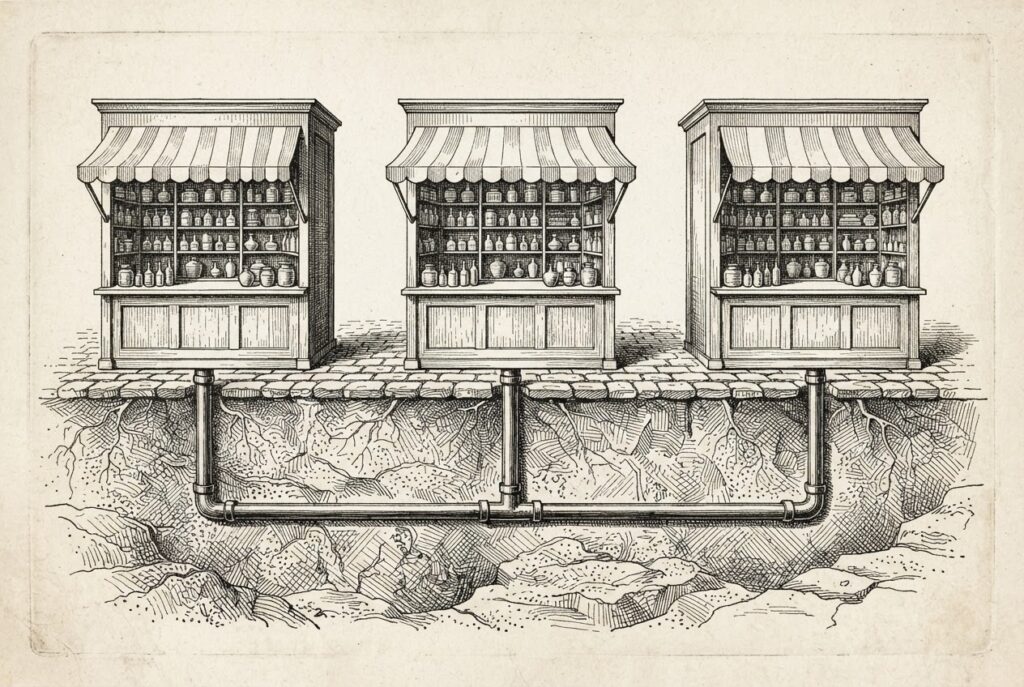
The competition follows the pattern described in Model Moats: value is moving away from the AI models themselves and toward the systems and computing power needed to run them. When a model is free and the systems used to run it are widely available, the software may no longer be the most profitable part of the business. OpenAI’s exclusive distribution deal with Microsoft Azure ended in April 2026. In six months, OpenAI expanded to Amazon Bedrock, Oracle Cloud, and now Google Cloud. Each major cloud provider sells access to the same models through its own billing system, spending commitments, and rules for meeting security and legal requirements. The model is the product on every shelf. Control of the shelf is what gives the provider its advantage.
What remains exclusive is clear and can be measured. The model weights, the internal values that help determine how the models work, remain closed. GPT-6 Astra, Sol, and Luna are available through APIs, which let customers send requests to use them, but customers cannot download the models themselves. The computing systems that run them are inside data centers owned by a small group of major cloud providers, along with OpenAI’s own growing network of computing facilities. Prices have not been published. Access is restricted and requires a preview request. Google Cloud says it is “the only hyperscale cloud provider offering access to all three leading closed source LLMs.” This claim is about the range of models customers can access through Google Cloud, not how much computing power the company has. The same companies that controlled the limited supply of computing power last week still control it now.
There is also an important detail about open-weight models. OpenAI’s gpt-oss 120B and gpt-oss 20B were already available on Google’s platform before this announcement. These models are the more openly available option. The GPT-6 models arriving now are closed models. Google’s platform now offers both types side by side. Buyers must choose between a model they can run in different places and a model they can only rent access to from three companies.
For developers and businesses that use AI, the practical benefit is real but limited. A business that already uses Google Cloud can now test OpenAI’s most advanced models without setting up a separate contract with another provider. The charges also appear on the same bill as its Gemini spending. This makes buying and managing the services easier, but it does not change how the market works. Four major cloud providers now sell roughly the same advanced AI models. None publicly competes on the price of the computing power needed to run them, and the model weights themselves are not available for customers to download. More providers can now sell access to the models, but the limited supply of computing power remains a problem. More ways to buy the models do not mean more computing power is available.