
Chart Of The Week: The Most Staggering Number In The AI Boom
Yesterday, I explained why Elon Musk might be getting ready to combine Tesla and SpaceX into one huge technology company.
Artificial intelligence is a major reason this merger might happen.
By bringing their AI technology together, Musk could build a company that makes its own computer chips, trains its own AI models, and uses this technology in everything from robots to rockets.
SpaceX (SPCX) has already completed the largest initial public offering (IPO) in history. This shows that investors are willing to pay huge amounts of money for this vision.
But Musk is not the only one making big moves.
Two of his biggest competitors in AI, OpenAI and Anthropic, are also getting ready to sell shares to the public. The values they might reach are enormous.
In fact, adding the values of all three companies gives us a number that is hard to believe.
This week's chart helps show just how big that number is.
Three Companies Worth More Than 45 Years of Tech IPOs
This week's chart compares the combined values of SpaceX, OpenAI, and Anthropic with the value of thousands of technology companies when they first sold shares to the public.
The difference is surprising.
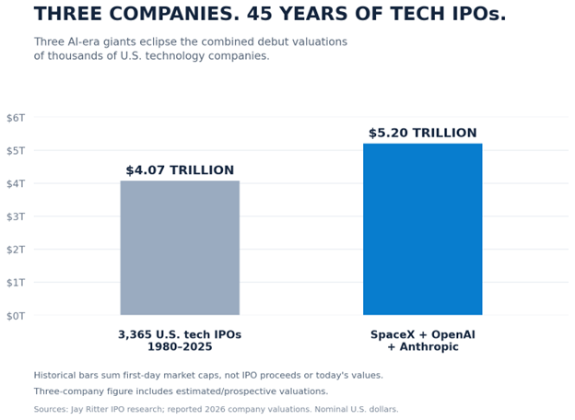
According to data collected by Jay Ritter, a finance professor at the University of Florida, 3,365 U.S. technology companies went public between 1980 and 2025.
If we add up the market value of each company on its first day of trading, the total comes to about $4.07 trillion.
Now consider SpaceX, OpenAI, and Anthropic.
Their actual and estimated values add up to about $5.2 trillion. That is around 28% more than the combined value of all 3,365 earlier technology IPOs.
Remember, those earlier companies include some of the most successful technology businesses in history.
Microsoft (MSFT), Apple (AAPL), Amazon (AMZN), Google (GOOGL), and Nvidia (NVDA) all went public during this period.
Of course, the comparison is not completely fair. We are adding up the values of thousands of companies when they first went public over many years, without adjusting for inflation. Also, OpenAI and Anthropic have not yet completed their public offerings.
Even so, the comparison is remarkable. It shows how much the technology industry has changed.
Not so long ago, most technology companies went public long before their values came anywhere close to $1 trillion.
Amazon was worth about $438 million when it went public in 1997. Google was worth about $23 billion when it first sold shares in 2004. Even Facebook, which already had nearly one billion users when it went public in 2012, had a value of about $104 billion at the time.
Today, some technology companies reach values many times larger while they are still privately owned.
Artificial intelligence is a major reason for this change.
OpenAI helped start the generative AI boom with ChatGPT. Anthropic has become one of its strongest competitors, especially in AI tools for writing code and in products for businesses.
Both companies are attracting huge investments because the people funding them believe AI could become as important to the economy as electricity or the internet.
Meanwhile, SpaceX has built a leading rocket-launch business and a worldwide satellite network through Starlink. It has also bought xAI, bringing Musk's Grok technology into the same company.
In other words, investors are not just betting on three successful technology companies. They are betting that these businesses could become some of the most important companies in the AI economy.
There is another reason these companies have reached such high values before ordinary investors can buy their shares on the stock market.
The way private companies raise money has changed.
Venture capital firms, government-owned investment funds, and other large investors can now give companies huge amounts of money. In the past, some of these companies might have needed to sell shares to the public to raise enough money to grow.
This means companies can stay privately owned for longer, even as their values rise to hundreds of billions or trillions of dollars.
As a result, ordinary investors may not get the chance to buy shares until much of a company's early growth has already happened.
This is worth keeping in mind as more major AI companies get ready to enter the stock market.
Here's My View
I believe artificial intelligence will create some of the most valuable companies in history. SpaceX, OpenAI, and Anthropic could all play major roles in that future.
But believing in a technology is not the same as believing that a company developing it is worth any price.
A company valued at $1 trillion comes with very high expectations.
Over time, these companies will need to earn enough money from their sales and generate enough cash to justify the prices investors are willing to pay for them today.
I expect AI to create amazing opportunities in the coming years. But I do not think investors should assume that every huge IPO will turn out to be a great investment.
Sometimes the best opportunities may be in companies that are already listed on the stock market. These companies supply the chips, energy, infrastructure, and other technology needed to make the AI boom possible.
As AI changes the global economy, I will keep looking for opportunities in these areas.
Nothing in this article should be treated as personal investment advice. The advice we provide is general and does not take your personal situation into account. You should not make investment decisions based only on this document.