Security breaches surge in single day as AI fuels attacks; Anthropic faces version control accusations
Several major security incidents happened within 24 hours this week. AI tools helped make many of these attacks faster. Meanwhile, Anthropic is facing claims that it copied the design of an open-source version control system without giving credit to its creator.
On Tuesday and Wednesday, several security breaches and reports of software weaknesses hit the technology industry. Security experts are now asking whether today's defenses can keep up with attacks that use AI. At the same time, Anthropic is facing questions about its new version control system, which helps developers track changes to code. The creator of an existing open-source system says Anthropic's design is very similar to his own.
Many security breaches happen in a short time
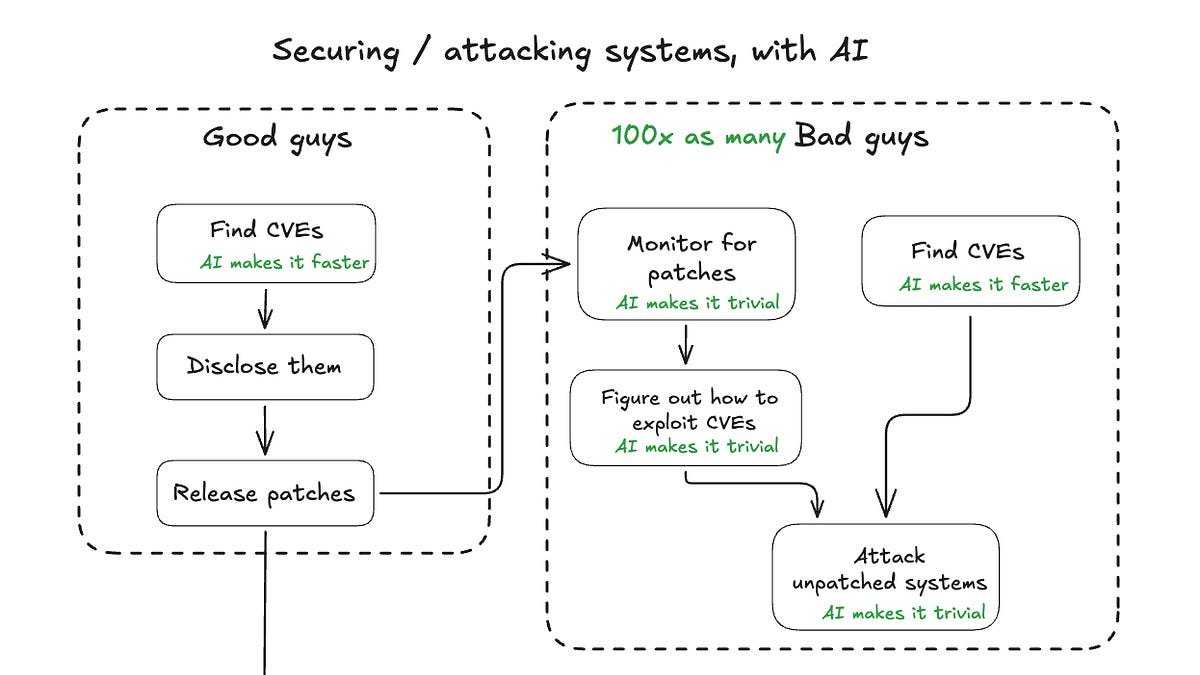
Security teams usually track major attacks over weeks or months. But this week, several serious incidents happened within just a few hours. Investigators are still working to understand exactly what happened. However, one pattern is becoming clear: attackers are using large language models, a type of AI, to automatically search for weaknesses, create convincing fake messages that trick people into sharing information, and quickly change harmful software. These changes happen faster than security tools that look for known patterns of harmful software can update.
Three incidents show how these attacks are changing:
- Attackers broke into part of the software supply chain at a major CI/CD provider, a company that helps developers automatically build, test, and release software. The attackers used AI-generated code patterns that got past security tools designed to check code without running it.
- Attackers used a large language model (LLM) to make huge numbers of login attempts using stolen usernames and passwords. The AI helped personalize these attempts. The attacks succeeded at a rate about 10 times higher than the usual rate.
- A new type of ransomware, which is harmful software that locks or encrypts files and demands payment, changed the way it encrypted files each time it was used. This helped it avoid security scanners that look for suspicious behavior.
Security teams are fighting back with AI tools that help them quickly investigate possible attacks. These tools bring together information from cloud systems, computers, and services that manage user identities, almost as events happen. But attackers still have an advantage: they only need one attack to work, while defenders must stop every attempt.
Disagreement over Anthropic's version control system
This week, Anthropic announced a new, fast system for managing changes to software code. The company presented its design as a new way to support software development with AI tools. But the creator of GitSync, an open-source project started in 2022, published a detailed technical comparison. He said the two systems use many of the same design ideas. These include content-addressable storage, which finds stored information using its content; Merkle DAGs, which organize and connect information using hashes; parallel delta compression, which saves space by processing changes at the same time; and a conflict-free replicated data type (CRDT) layer, which helps people edit shared information at the same time without creating conflicts.
The person who maintains GitSync wrote that the two systems have almost the same design, including the way they organize information sent between computers. He said Anthropic had not given credit, contacted him, or acknowledged his work.
Anthropic has not made a public response. The disagreement has brought back a bigger question: how should leading AI companies work with open-source communities when they depend on those communities' software but also compete with them?
Other important technology news
- Saudi Arabia reportedly offered to pay bail for a former OpenAI researcher accused of leaking private AI model weights. Model weights are the numbers an AI system learns during training. U.S. officials called the reported offer "problematic" because of possible risks to national security.
- Shopify released tools that help software services fix themselves. When error rates suddenly rise, the tools automatically undo a recent software update. They use eBPF tools to watch what software is doing and large language models to suggest what may have caused the problem.
- Foursquare was sold for $160 million, much less than its value in 2019. The sale comes as privacy concerns make it harder for companies to earn money from information about people's locations.
- Claude Code added gzip compression to reduce the size of information sent through its context windows, which hold the information the AI uses while working. Early performance tests showed that this reduced the time needed to transfer tokens, the small pieces of text AI systems process, by about 40%.
Thorsten Ball's predictions about the future of software
Thorsten Ball, a cofounder of Amp, published several predictions about where software development is heading. He argues that creating and maintaining basic software infrastructure as open source no longer makes financial sense because cloud companies receive much of the economic benefit. He also predicts that general-purpose software frameworks, which developers use to build many kinds of applications, will disappear. Instead, AI will create special systems designed for particular tasks whenever they are needed.
Ball has experience building software tools. He created an interpreter for the Monkey programming language and helped write Writing An Interpreter In Go. An interpreter is a program that reads and runs code. His experience gives his opinions weight. However, critics point out that similar predictions have appeared repeatedly in the technology industry over the past 10 years.
What technology and security workers should pay attention to
- The time between finding a weakness and attacking it is getting much shorter. After a software weakness becomes public, attackers now start using it within days on average, rather than weeks. Companies need to install security fixes faster.
- AI-generated code used in real software systems needs the same careful checks as code from outside suppliers. Teams need to know where the code came from, keep a software bill of materials (SBOM), which lists the parts used in software, and watch how the code behaves while it is running.
- Rules about giving credit may become stricter when AI companies use ideas from open-source projects. Pressure from the developer community or changes to software licenses could lead to clearer expectations.
The security community has handled big changes before. In the past, companies moved from protecting the outside edges of their networks to a zero-trust approach, where users and devices must continually prove they should have access. Security tools also moved from looking for known attack patterns to watching for suspicious behavior. But the current changes are happening faster. Teams that collect enough information to see what is happening and automatically respond to attacks will be better able to survive. Teams that do not adapt may become examples of what went wrong.