
Barclays to cut 5,000 jobs and employ more artificial intelligence.
By William Shaw.
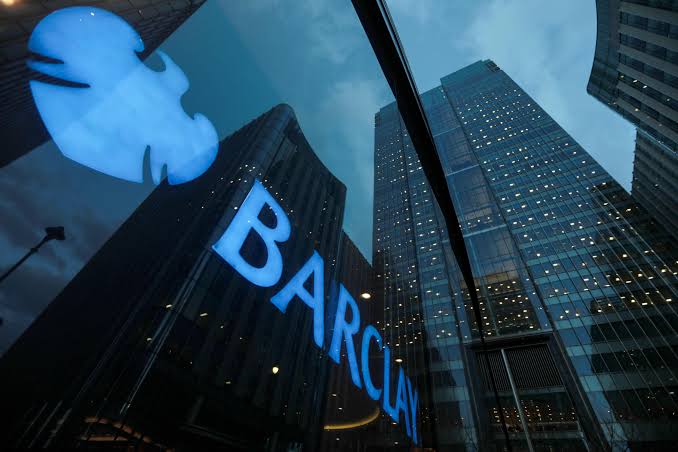
Caption: A Barclays sign is seen through a window that reflects the bank's main office in Canary Wharf, London, U.K. Image: Getty Images.
Barclays Plc said it will cut 5,000 jobs, or about 5% of its workers. The bank is doing this to save money by using more technology, including artificial intelligence (AI), across its business.
On Thursday, Barclays reported its earnings for the third quarter of the year. Several important results were worse than experts had expected. Its bond trading business had the biggest drop among major Wall Street banks during the quarter. This took attention away from the strong results of its share trading business.
Money earned from trading bonds and currencies fell by 19% compared with the same period last year, reaching £1.01 billion ($1.4 billion). This was less than analysts surveyed by Bloomberg had expected.
Meanwhile, the bank's share traders earned 47% more money than a year earlier. Their earnings were almost as high as those from bond and currency trading. It was their best performance since at least 2009. That was the year after Barclays bought Lehman Brothers' North American business.
Barclays said its bond trading results were weaker because customers made fewer trades involving interest rates and credit. The bank also faced more difficulties in September because of wider economic conditions. During a call with reporters, Chief Executive Officer CS Venkatakrishnan said the performance of the bank's fixed-income, currencies and commodities business, known as FICC, was "somewhat disappointing."
"We will use AI widely across the bank," Venkatakrishnan said during the call. But he explained that AI would be an extra tool to improve the business, rather than the main part of it. He described AI as "the icing on the cake, not the cake."
By cutting jobs, Barclays is joining HSBC Holdings Plc and Standard Chartered Plc, which have also announced plans this year to reduce staff as they use AI to make more work happen automatically. HSBC is considering cutting as many as 20,000 jobs over the next few years. Standard Chartered has said it plans to reduce jobs in departments that support the business by more than 15% by 2030.
About 60% of the jobs Barclays plans to cut are in support departments, including jobs held by software developers. The bank already cut about 1,000 jobs during the first six months of this year. The remaining job cuts are expected before the end of 2026. At the end of 2025, Barclays had about 93,000 employees around the world.
Barclays shares were up about 0.8% at 9:46 a.m. in London. The share price had fallen earlier but later recovered.
The changes mean Barclays will spend about £600 million this year to help reduce its costs in the future. This is roughly twice as much as the bank had previously expected to spend. Investors have been watching how Barclays manages its spending. They became concerned after the bank reported higher-than-expected costs in its results for the first half of the year, even though it had announced a new plan to cut costs in February.
Barclays kept its financial goals for the coming years unchanged. Its day-to-day operating costs for the quarter were mostly what analysts had expected. The bank also announced that it would spend £500 million buying back its own shares.
Investment banking
Money earned from trading bonds and currencies fell 19% from a year earlier to £1.01 billion ($1.4 billion). This was below the expectations of analysts whose forecasts were collected by Bloomberg. At the same time, revenue from share trading rose 47%. This brought share trading revenue almost level with bond and currency trading revenue. It was the share traders' strongest performance since at least 2009, the year after Barclays bought Lehman Brothers' North American business.
Barclays said the weaker bond trading results were caused by customers making fewer trades involving interest rates and credit. It also said difficult economic conditions created more problems in September. During the call with reporters, Venkatakrishnan described the results of the fixed-income, currencies and commodities business, or FICC, as "somewhat disappointing."
Overall, Barclays' investment banking business earned £3.13 billion in total income. This was slightly less than analysts had expected.
The bank's services for everyday customers did not earn enough to make up for the weaker investment banking results. Its UK retail banking business stayed mostly unchanged, while its US consumer banking business also had roughly the same results as a year earlier. The US business performed worse than analysts had expected.
"A disappointing performance from Barclays," said Ed Firth, a UK banking analyst at Keefe Bruyette & Woods. He explained that the biggest shortfall came from the part of the bank that investors consider least valuable. However, other parts of the business also did not perform well enough to make up for it.
Other major banks, including JPMorgan Chase & Co., Goldman Sachs Group Inc. and Bank of America Corp., saw similar problems in their bond trading businesses. Their revenue fell by as much as 17% compared with a year earlier. One reason was rising interest rates, which can lower the value of bonds and other debt that already exist. Higher rates can also make customers less interested in trading.
Banks in the UK are preparing for the possibility of higher taxes on their profits. The Labour government is expected to announce its budget next week. The government could use money raised from these taxes to help households struggling with the cost of everyday living.
© 2026 Bloomberg.