
GU Finalizing Claude Partnership
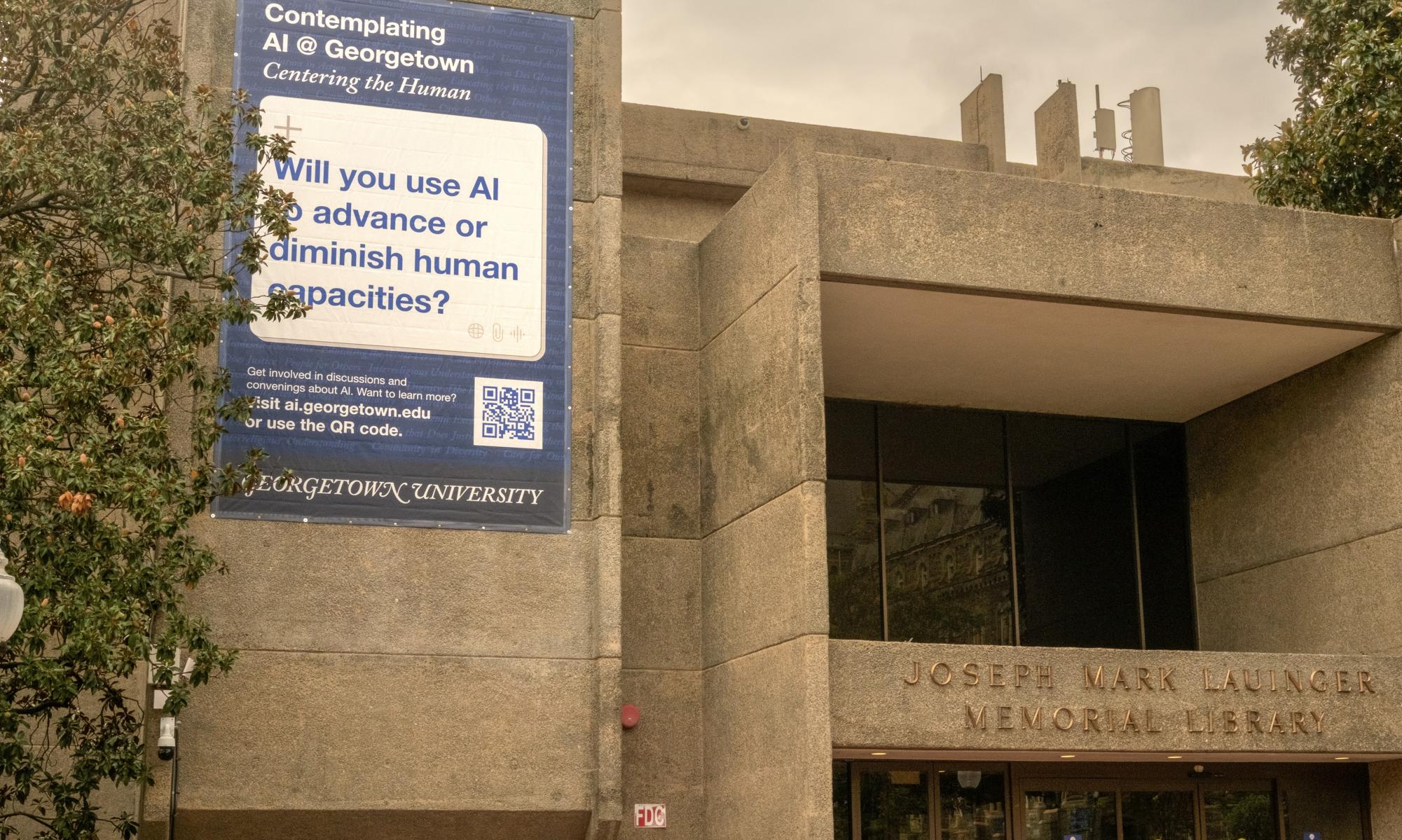
University leaders said they expect to finish the agreement by the end of the fall semester. It will be Georgetown's third publicly announced partnership with a generative AI tool.
Georgetown University is close to making a deal to use Anthropic's artificial intelligence (AI) tool Claude, a university official announced at a Faculty Senate meeting on Oct. 19.
The deal with Anthropic will be Georgetown's third publicly announced partnership with a generative AI platform. In March, the university started offering Gemini, Google's AI assistant. This month, it also started testing a ChatGPT premium program for teachers and staff. The official said talks with Anthropic are almost finished. Georgetown hopes to give some teachers access to Claude by the end of the semester.
Georgetown's Chief Information Officer Douglas Little said the university is still discussing the agreement with Anthropic and hopes to share more details later this semester.
Little said at the Faculty Senate meeting that Georgetown and Claude are still working out rules, safety protections and the terms of the agreement before the university can sign a contract.
University officials did not say whether students would eventually get access to Claude or when that might happen.
Earlier this month, University President Eduardo Peñalver said using AI at Georgetown, especially in classrooms, is an important goal for the university.
In his Oct. 9 inauguration speech, Peñalver said Georgetown would study AI carefully and keep a close watch on how it is used. He said the university had started a project involving the whole campus to decide on the main ideas and values that should guide its use of AI. He also said Georgetown would find ways to protect, encourage and reward people who put in the hard work needed to learn and grow intellectually.
The new agreement comes as Peñalver works on a set of AI rules for the whole university. These rules will guide how AI is used in teaching, research and university work. He plans to present the rules to the board of directors by the end of Spring 2027. For now, Georgetown professors make their own AI rules for their classes.
Andrew Bennett, who leads the government department, said giving teachers access to several AI platforms helps them do research and plan their classes.
Bennett told The Hoya in July that some teachers are using Gemini more than before, while others have only recently started using it. But he said that, based on conversations with coworkers and things he has read, many teachers think Claude works better for many of the tasks they want to do.
Bennett added that he thinks having different AI tools to choose from is a good thing.
In March, Georgetown started giving teachers and staff access to Gemini. Later, it made Gemini available to students and introduced courses involving AI in the College of Arts & Sciences and the McDonough School of Business in Fall 2026. In October, a university spokesperson confirmed to The Hoya that Georgetown was testing ChatGPT premium through a program that teachers and staff could choose to join.
David Burk, an economics professor who uses Claude to help with computer coding, said he understands why Georgetown wants to offer several AI platforms.
Burk told The Hoya that AI tools are competing closely and changing very quickly. He said that even if Claude was the best tool for a certain purpose nine months ago, that does not mean it is still the best today or will be the best six months from now.
James Freericks, a physics professor, uses Claude's principal investigator (PI) scientists program, which gives researchers extra features. He said Anthropic offers different AI models, which encouraged him to use Claude. Claude has now become the AI tool he uses most often.
Freericks told The Hoya that Claude's PI scientist program gives him a higher level of access than anything Georgetown offers, even when he uses the free level of that program.
Jonas Pfefferman (SFS '28), a member of the Georgetown AI Association, said he was not surprised to learn that Georgetown was discussing a deal with Anthropic.
Pfefferman told The Hoya that Georgetown seems to be moving at a normal speed when it comes to AI. He said the university is not among the first to adopt new technology, but it does not seem to be falling behind either. He thinks Georgetown is somewhere in the middle compared with other universities.
Bennett said he hopes to make AI rules more consistent across the government department. He wants the rules to help both students and teachers while Georgetown works on a university-wide plan.
Bennett said one of his goals is to help teachers agree on some common AI rules so students do not have to learn 15 different sets of rules for 15 classes. But he said teachers will still have some freedom to make their own choices. Some may avoid AI completely, while others may welcome it and teach students how to use it.
Aaly Nanji (CAS '29), a student interested in AI, said Georgetown's practice of giving teachers access to new AI tools before students could help people use the technology more thoughtfully.
Nanji told The Hoya that giving teachers access to AI could help them design assignments and find more creative ways to teach. Nanji said teachers could include AI in lessons while still helping students build and use important critical thinking skills.
In September, Peñalver created a committee of nine teachers to help develop Georgetown's university-wide AI rules. This work is part of his larger plan for the university's future. At the Faculty Senate meeting, two committee members shared what they had learned from talking with people across the Georgetown community. They said most of that work was finished.
Andrew Sobanet, who leads the committee, said he hopes the group can create guidance that will remain useful for a long time as Georgetown plans to give more people paid access to generative AI tools.
Sobanet wrote to The Hoya that President Peñalver had asked the committee to create one clear set of important university values and broad rules. These would help people decide when AI should and should not be used. The committee plans to finish and publish them by the end of the Fall 2026 semester. Sobanet said the rules should also take into account that AI tools are expected to change a lot in the future.
Cal Newport, another member of the committee, said Georgetown's Jesuit values will help shape its AI rules.
At the meeting, Newport said the committee often talks about how people develop their thinking skills, how teaching works, the freedom of teachers and researchers to explore ideas, research itself, protecting every person's dignity and doing what is good for the wider community.
Sobanet said students who took part in the committee's discussions believe learning to use AI is important because AI is becoming more common in workplaces.
At the meeting, Sobanet said some students are already expected to use AI during internships, especially in consulting jobs. They also expect to use AI when they start working after graduation. Because of this, they believe learning to use AI now will help them in the future.
Sobanet added that most undergraduate students continue to use AI partly because they feel pressure to do well in school and because AI tools are so easy to access. He said teachers can recognize these pressures on their students.
Nanji said Georgetown should keep working to give more people access to AI.
Nanji said AI is not going away, so simply banning it or avoiding these tools is not the best choice for the Georgetown community or for people in general. Nanji believes people should learn to use AI and understand how to work with it and around its limits. Nanji said the best way to do this is to give people opportunities to try different AI tools.