
UAE researchers win award for AI tool that helps surgeons during operations
Researchers in Abu Dhabi have won an international award at a robotic surgery conference in Italy. They created an artificial intelligence (AI) tool that is designed to help surgeons while they operate on patients.
The team from Mohamed bin Zayed University of Artificial Intelligence (MBZUAI) in Abu Dhabi won the award for creating Janus AI. This tool can show surgeons videos of similar operations performed in the past.
The technology studies videos recorded during surgery performed with robots. It then finds a 30-second video clip from an earlier operation that shows the same stage of the surgery.
The system works much like Google search, but instead of searching websites, it searches videos of robotic surgery. This lets doctors quickly find useful examples while they are operating.
These videos can help surgeons see how other doctors handled the same task. They can also help surgeons decide what steps to take next.
“During robotic surgery, we can show several small videos on the screen at the same time. These videos show similar operations that went well, at exactly the same stage of surgery. This gives surgeons an example they can follow,” said Cesare Stefanini, a professor of robotics at MBZUAI who led the development of the technology.
“Sometimes surgeons need help. They may want to talk to another doctor about what they are doing, but that doctor is not there. This system is a way to share one person's experience with another person,” he said.
Janus AI is named after Janus, an ancient Roman god shown with two faces. One face looks into the past, while the other looks into the future. The name was chosen because the system uses lessons from past operations to help doctors make decisions during operations they are performing now.
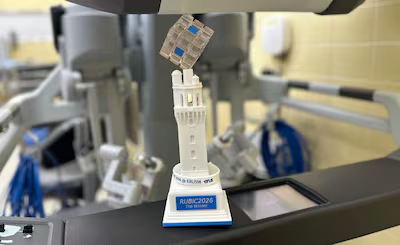
The technology won the Robotic Urology Breakthrough Innovation Challenge award at Erus 26, a conference about robotic surgery involving the urinary system. The event took place in Padua, Italy, in September.
“It feels very rewarding to be recognised not only by experts in computer science, AI and robotics, but also by medical experts. It shows that we are creating something that could be useful in the future,” said Prof Stefanini.
The project was developed with help from surgeons at the University of Illinois Chicago. The University of Turin in Italy also helped with the work.
Edoardo Fazzari, a researcher at MBZUAI who works there after completing his doctorate, did much of the work to develop the system. He spent about five months working on it this year, after the team first discussed the idea with doctors.
He said working on the project was especially satisfying because it could help people in real life, rather than only being useful for university research.
The system can show surgeons videos from three earlier operations, all showing the same stage of surgery. This allows doctors to compare different ways of doing the same task.
“This is useful for doctors who are still training and for surgeons because it lets them see what might happen next. We use experience from the past to help people decide what to do next,” he said.
“It should work very quickly. We are trying to make it respond in milliseconds, which are tiny parts of a second. You just press a button, ask for what you need, and three examples from earlier operations appear. You can then learn from them.”
For now, the system's collection of videos covers robotic urology operations. These are operations involving the urinary system that are performed with the help of robots. They include nephrectomies, which are operations to remove a kidney.
The researchers hope to add videos of other types of surgery as the collection grows. They especially want to include more operations performed with robots.
However, Janus AI is not ready to be used during real operations on patients yet. The researchers still need to improve the technology and get approval from medical regulators before doctors can use it in hospitals.
Once the technology is fully developed, the researchers hope to find a business partner that can help turn it into a product available for hospitals to buy and use.
Prof Stefanini said the project is something the UAE can be proud of. His research group also plans to bring in new students studying for advanced university degrees, including students from the UAE.
He said MBZUAI has created a place where AI researchers can share ideas and work together to develop new technology.
“We have shown that we can produce work that is among the best in the world here in the UAE, using the talented people and strong ideas we have here. This gives us hope for the future,” he said.
“This is not just something that makes us personally proud. It could also become the starting point for more new technology and research here in the future.”