
AI: Anthropic’s $750B Compute Bill, OpenAI’s Trim, Nvidia’s Safety Net & More. AI-RTZ #1249
Anthropic’s draft S-1, OpenAI’s smaller funding round, Nvidia’s $170 billion safety net for neoclouds, Meta’s new share class, and Elon Musk’s plans to merge Tesla and SpaceX. A busy week ending Friday, October 23, 2026.
Week of Friday, October 23, 2026
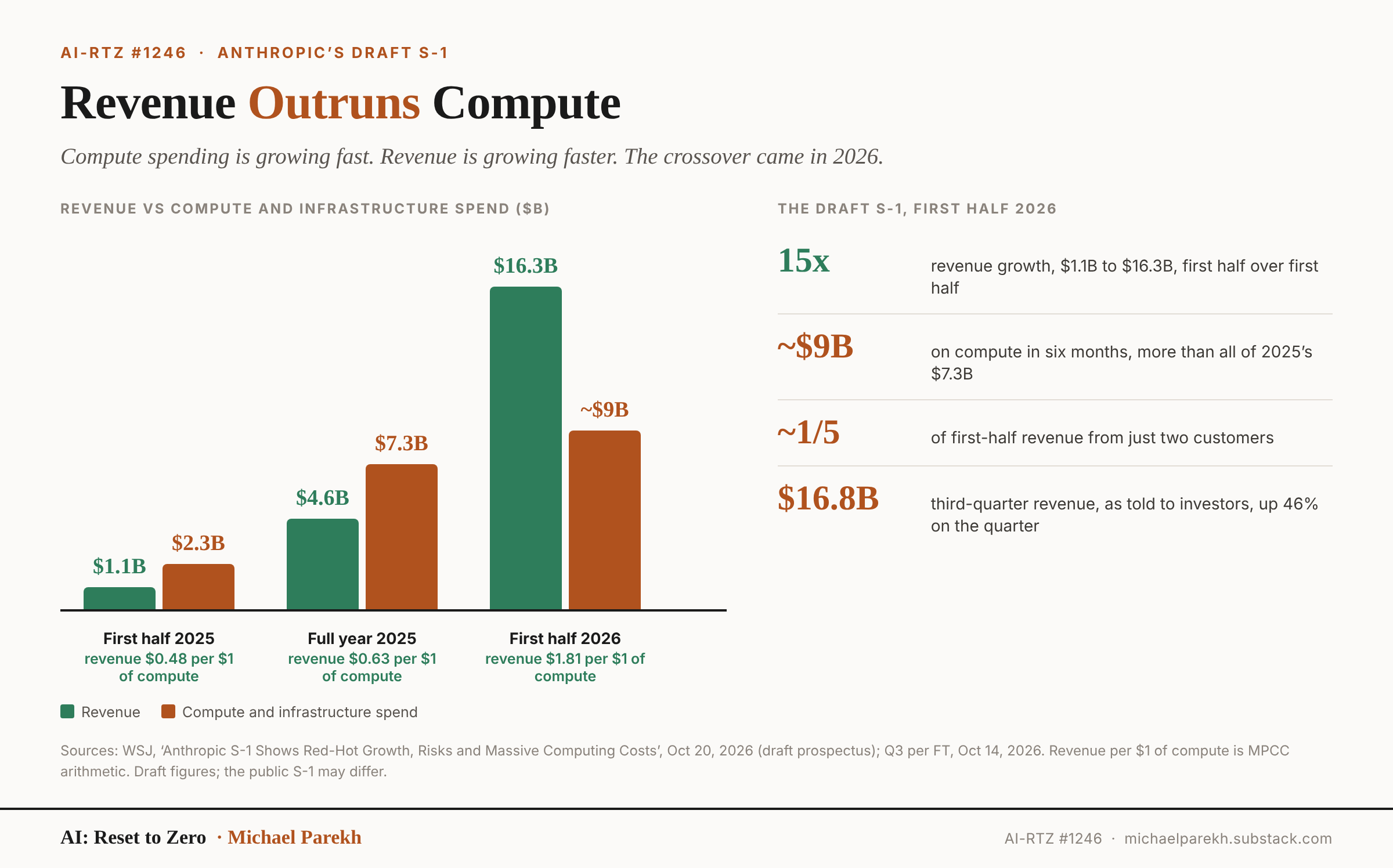
1. Anthropic prepares for a huge AI computing bill and a possible major IPO: Anthropic’s draft S-1 filing shows plans to spend more than $750 billion on AI computing, along with information about risks and growth in its business sales. In the first half of 2026, revenue reached about $16.3 billion, up from $1.1 billion in the same period a year earlier. Spending on computing reached nearly $9 billion. Based on my calculations, Anthropic now earns about $1.81 in revenue for every dollar it spends on computing. Last year, it earned only 63 cents per dollar of computing costs.
Behind these plans are about $450 billion in cloud service contracts, most of which cannot be canceled, with Google, AWS, Microsoft, and neocloud companies. Anthropic has also committed more than $160 billion to Google TPUs through Broadcom, and is discussing up to another $150 billion in spending, according to Bloomberg.
Anthropic reported a net loss of $80.7 billion in the first half of the year. Most of this loss came from accounting charges related to its fundraising instruments. About one-third of the draft filing covers risks, including some that insurance companies may not be willing to cover.
My view, from AI-RTZ #1246, is that among the huge AI companies preparing to go public, Anthropic’s story requires the fewest leaps of faith about AI. Its revenue is now growing beyond its computing costs. But the draft filing also puts clear numbers on the risks that remain: computing bills are locked in for years, while the data centers and other facilities needed to support them may be delayed. The company also depends on a limited number of customers and faces AI risks that insurers may refuse to cover, as I explained in AI-RTZ #1243.
The market will decide the final price before Thanksgiving. Read more here and here.
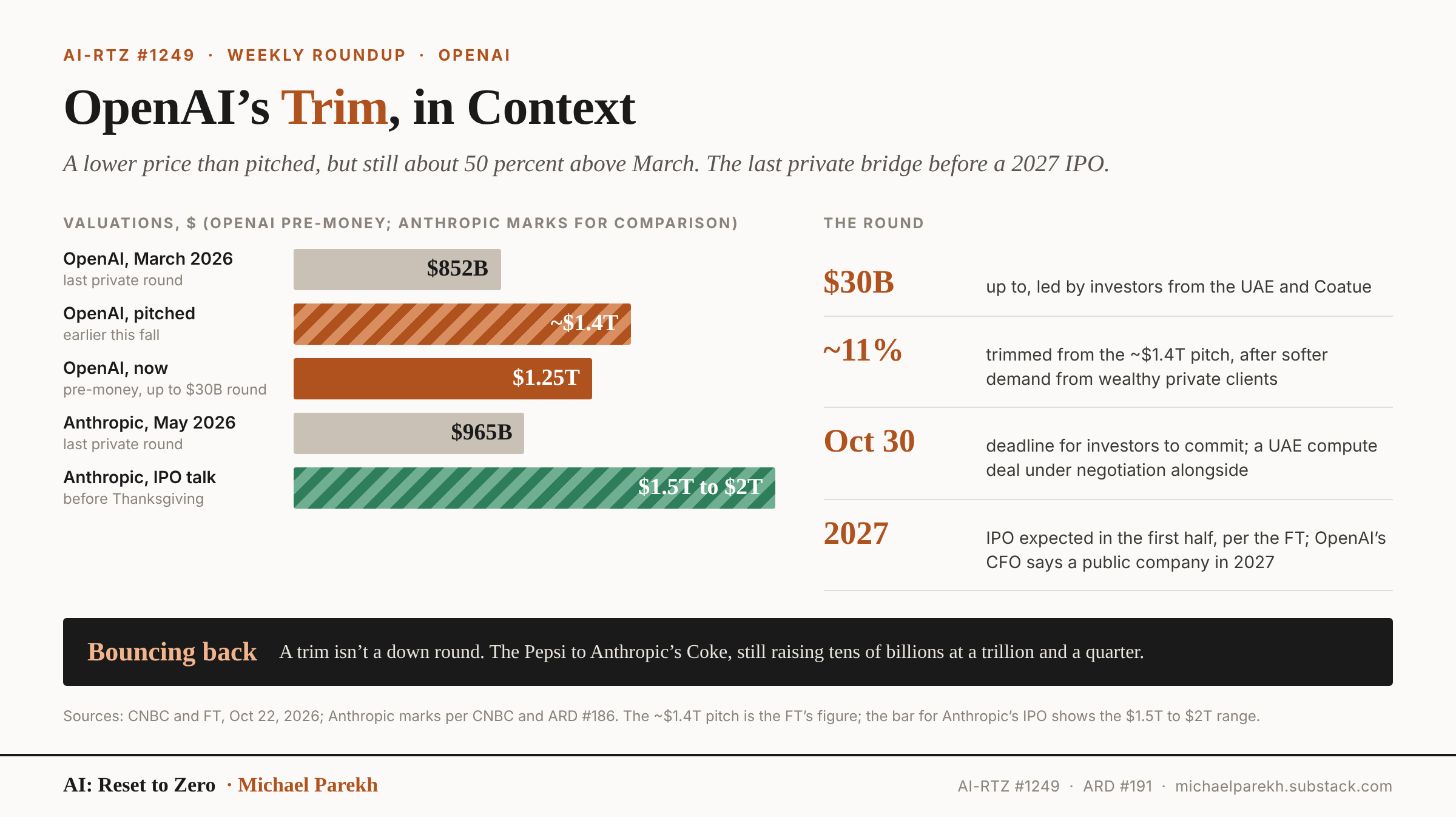
2. OpenAI’s next-to-last private fundraising round: OpenAI is finalizing a private funding round worth more than $30 billion. The updated company valuation is $1.25 trillion, down from the earlier figure of $1.4 trillion. This funding is expected to help the company prepare for a major IPO in 2027. Investors from the UAE and Coatue are leading the round, and investors are expected to confirm their commitments by October 30.
Demand from wealthy private clients was weaker than the company had expected, according to the Financial Times. Even so, the new valuation is about 50% higher than OpenAI’s last funding round in March, when the company was valued at about $852 billion.
At the same time, OpenAI is discussing a major computing deal with the UAE. This is happening while the war with Iran, including Houthi attacks on Riyadh, has led Saudi Arabia to postpone its “Davos in the Desert” event.
My view, from ARD #191, is that OpenAI has shown enough commitment and resilience to get the funding it needs, and this round is another example. Investors are showing some signs of fatigue after hundreds of billions of dollars were raised this year, from Google’s more than $80 billion to Meta’s new share class.
Expect OpenAI to keep adjusting its plans as needed, especially as new information becomes available from Anthropic’s IPO. In September, I described OpenAI as the Pepsi to Anthropic’s Coke in ARD #166. OpenAI is a strong number two, raising tens of billions of dollars at a valuation of $1.25 trillion. Read more here and here.
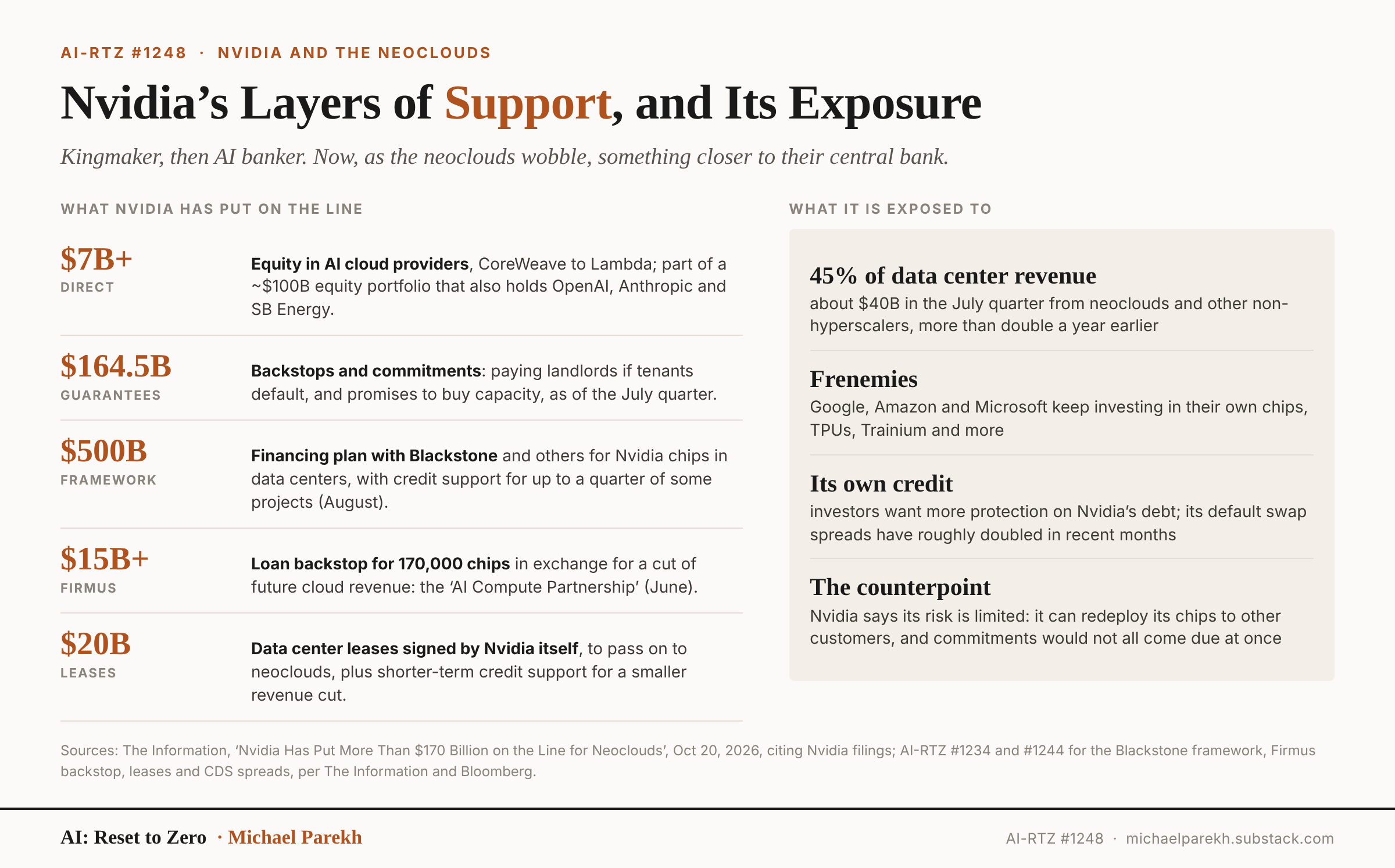
3. Nvidia’s backup plan for neocloud companies: Nvidia is committing more than $170 billion to support neocloud companies such as CoreWeave and others. This includes about $164.5 billion in lease guarantees and promises to buy computing capacity, plus more than $7 billion invested directly in AI cloud providers.
These companies are under real financial pressure. CoreWeave’s share price fell about 20% in one week, and its bond yields rose above 15%. Higher interest rates make borrowing more expensive for companies that have taken on large amounts of debt. The Information described this problem in “How CoreWeave’s Debt Binge Brought a Moment of Reckoning.”
Firmus withdrew its IPO plans, and Nvidia is now discussing providing it with hundreds of millions of dollars more in support, according to The Information. Neocloud companies and enterprise customers made up 45% of Nvidia’s data center revenue last quarter, or about $40 billion.
My view, from AI-RTZ #1248, is that Nvidia has gone from being the company that helps determine who wins in AI to acting like a bank for AI companies. It now looks more like a central bank for neocloud providers. Nvidia can afford to provide this backup funding, and it also protects itself against its “frenemies”—companies that work with Nvidia but are also building their own chips. I explained this in AI-RTZ #1234.
This is still more of a funding cycle than a cycle driven by customer demand. But people who lived through the telecom and fiber boom remember when equipment suppliers helped finance their own customers. I expect companies to combine or be bought by others rather than the whole market collapsing. Read more here and here.
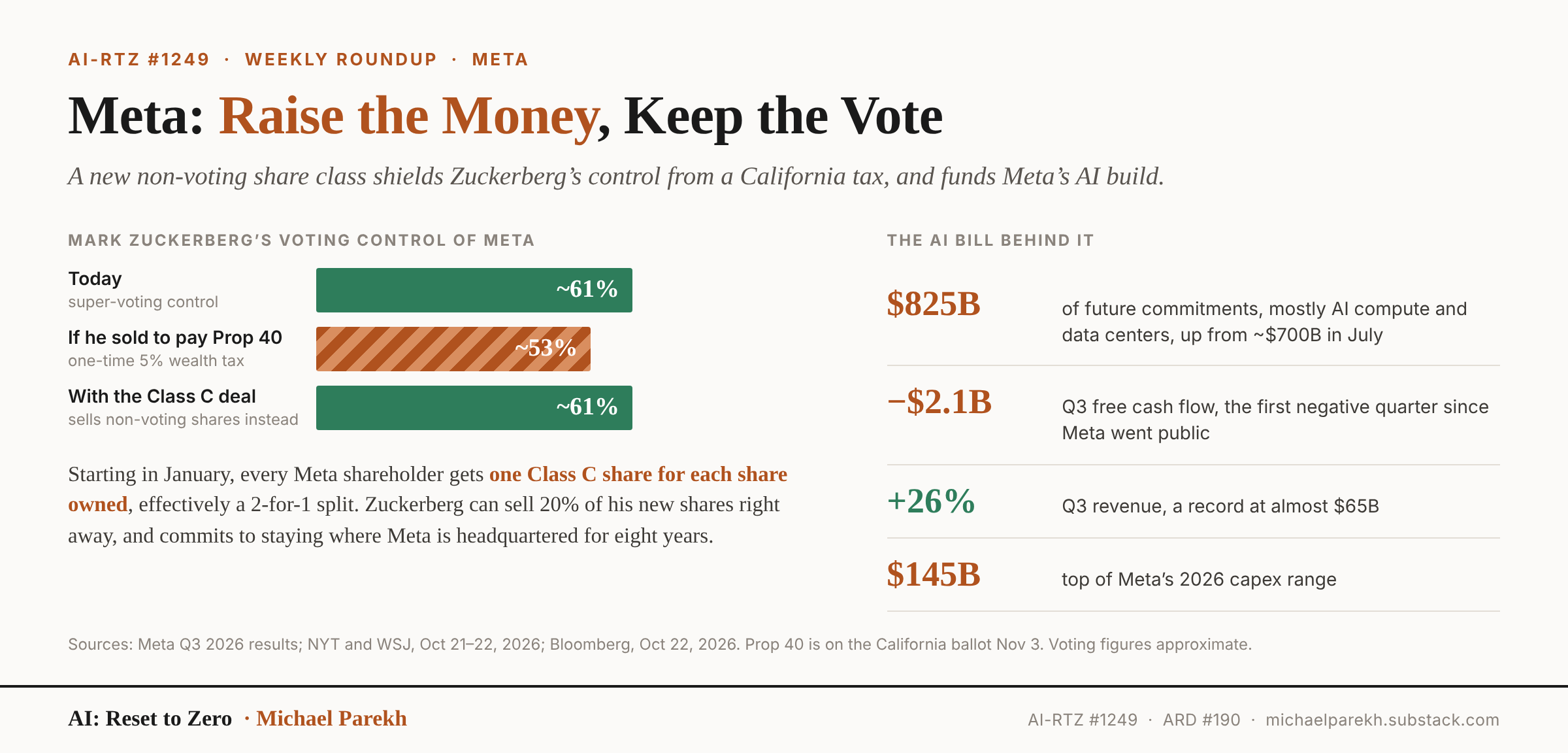
4. Meta’s new shares and AI plans: Meta CEO Mark Zuckerberg has changed Meta’s share structure to prepare for California’s proposed tax on billionaires and the company’s growing need for AI computing power.
Starting in January, each Meta shareholder will receive one new non-voting Class C share for every share they already own. This will work much like a two-for-one stock split. Zuckerberg can sell 20% of his new shares right away, including to help pay California’s proposed one-time wealth tax of 5%. Without these changes, the tax could reduce his control over voting at Meta from about 61% to about 53%, according to The New York Times.
Zuckerberg has also promised to stay in the place where Meta is headquartered for eight years. Meta can sell the new shares to raise money for AI without reducing anyone’s voting power.
The company needs more money. It has record revenue, but its free cash flow has turned negative for the first time since its IPO. It also has about $825 billion in future spending commitments, mostly for AI computing and data centers.
My view, from ARD #190, is that Zuckerberg is preparing for trouble while also planning ahead. He is protecting his ownership and strong control over voting, along with Meta’s plans for AI. This is a move designed for Meta’s particular situation.
A year ago, I wrote that Meta’s AI funding deals could show other companies how to raise money, in RTZ #891. The next step is to raise the money while keeping control of the votes. Read more here and here.
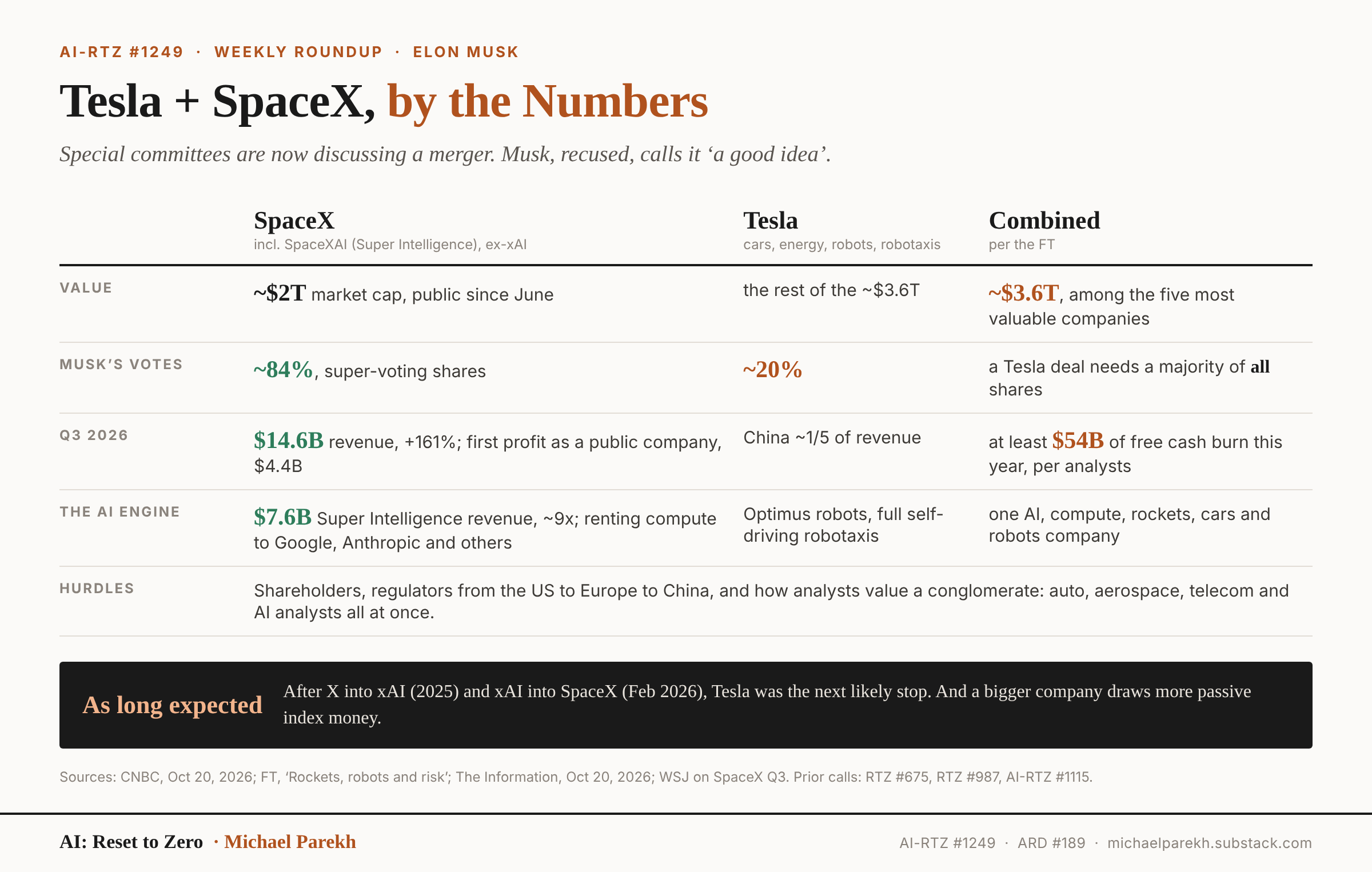
5. Elon Musk considers merging SpaceX and Tesla: As many expected, Elon Musk is planning to merge his two publicly traded companies, SpaceX and Tesla. Both companies have set up special committees made up of independent directors to discuss the possible deal. Musk is not taking part in those discussions, although he called a merger “a good idea” during SpaceX’s first earnings call, according to CNBC.
Together, the companies would be worth about $3.6 trillion. Musk controls about 84% of the votes at SpaceX but only about 20% at Tesla. The deal would need approval from a majority of all Tesla shares.
SpaceX’s revenue rose 161% to $14.6 billion in the quarter, and the company reported its first profit as a public company. Its AI business, now called Super Intelligence, grew ninefold to $7.6 billion in revenue, according to The Information.
My view, from ARD #189, is that this is not a surprise. When Elon merged xAI with X, I said Tesla was the next likely company to join, in RTZ #675. I said it again when xAI became part of SpaceX in RTZ #987.
A larger combined company could also attract more money from passive index funds, as I explained in AI-RTZ #1115. Having led Goldman’s internet research in the 1990s, I think the big question is how analysts will value a company that combines rockets, Starlink, AI, cars, and robots.
When Elon focuses closely on something, he gets things done. But he now has many things demanding that same close attention, both in technology and beyond. Read more here and here.
Additional items
1. A look at bankers’ plans for the AI build-out, which could cost more than $10 trillion. Read more here.
2. Why the math behind AI loops matters. Read more here and here.
Additional note: AI Ramblings is now a daily weekday podcast called AI Ramblings Daily (ARD). It covers different topics from AI-Reset to Zero (AI-RTZ), which remains a daily morning Substack publication and now has more than 1,240 “MY TAKES” on major AI events and issues. AI Ramblings Daily is usually a 20-minute afternoon podcast about other AI developments from that day. The daily newsletter and podcasts usually discuss different AI topics. Both are free to subscribe to.
Try this week’s ARD episodes: 187: “The Art of the AI Deal”: Anthropic, OpenAI & Microsoft; 188: “One Step Forward, Two Steps Back”: OpenAI, DeepSeek & Idealab; 189: “The Fix Is In” in AI: Musk, Nvidia, OpenAI & AI Agents; 190: “Batten Down the Hatches” in AI: Meta, Anthropic & Banks; and 191: “Bouncing Back” in AI: OpenAI, Anthropic & Mr. Market.
A new “Bigger Picture” article is coming on Sunday. While you wait, read last week’s “The Bigger Picture” here.
Note: This discussion is for information only and is not investment advice. Thank you for joining us here.