
Sweden Blocks ChatGPT and Claude in Government Offices, Copilot Stays
Starting Monday, October 26, 2026, staff at the Regeringskansliet, Sweden's Government Offices, will no longer be able to open ChatGPT or Claude on their work computers. The block covers the prime minister's office and every ministry. It directs staff to use approved tools, including Microsoft Copilot. After an internal review, the security of Copilot has also been tightened.
The news broke on Friday, October 23, when Ekot, the news service of Sveriges Radio (Sweden's public radio), reported it based on internal information. The Regeringskansliet is the government administration in Stockholm. It includes civil servants who work in the ministries and staff who work for Prime Minister Ulf Kristersson. ChatGPT is a chatbot made by OpenAI, while Claude is made by Anthropic. Copilot is Microsoft's AI assistant, built into Word, Excel, Outlook and Teams. Organizations can buy it under a business contract alongside their Microsoft 365 licenses.
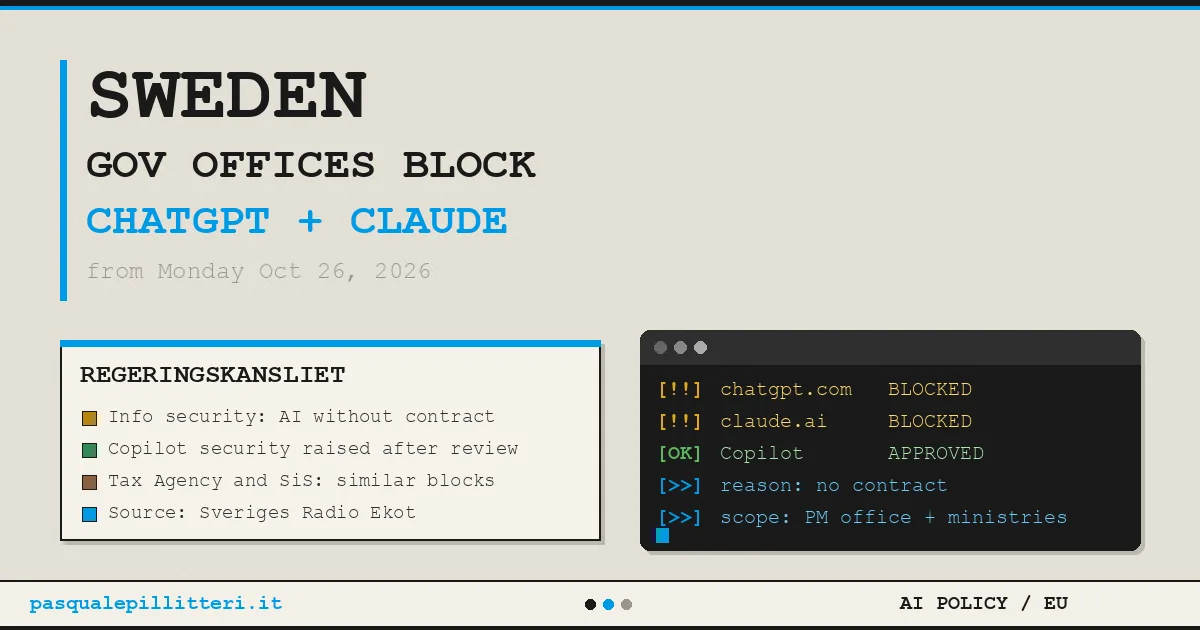
What Changes on Monday in the Swedish Government Offices
From October 26, ChatGPT and Claude will stop working on government computers. In Swedish, this measure is called a spärr, which means a block at the network level. The aim is to make staff use services that the Regeringskansliet has already approved. In other words, AI will still be used in government offices. Copilot will remain available. According to the internal information Ekot saw, its security was strengthened after a review. The press office has not said what was changed, explaining that the matter concerns security.
There is one exception. Some staff will still be able to use ChatGPT and Claude through an AI assistant platform built by the Regeringskansliet itself. The press office has not said who can use it or how many people have access. A public presentation from 2025 shows that the Government Offices have run more than thirty AI assistants since 2023 on the Intric cloud platform. This platform provides access to several language models, including Claude and GPT.
China's DeepSeek had already been restricted earlier. But this new block affects two of the most widely used Western chatbots and applies at the heart of the national government.
Why Sweden Is Blocking ChatGPT and Claude
The Swedish government is blocking ChatGPT and Claude because using AI services without a contract can put information security at risk. This is what digitalization director Mikael Wettercrantz said. Copilot is allowed because it is covered by a business agreement with Microsoft. That agreement sets out in writing how data must be handled.
Wettercrantz declined to give an interview to Ekot. In a comment on the Regeringskansliet's internal website, he wrote that using AI services without an agreement can have “consequences for our information security.”
The main difference is between using a personal account and using a service covered by a contract. When someone opens ChatGPT or Claude with a personal account, they accept the provider's standard terms of use. The provider decides where the data is stored and how long it is kept. Depending on the account settings, the data may also be used to train AI models. With a business contract, the organization instead signs a data processing agreement, or DPA. The GDPR requires this agreement when a service provider handles data for an organization. The agreement sets written rules about how long data can be kept and where the servers are located.
In our experience, the real risk in companies usually follows the same pattern. An employee copies meeting notes, a contract or a draft decision into a chatbot they use at home with a personal account because it is easier than using the official tool. Nobody notices until someone needs to find out where that text went.
In Sweden, this problem has been documented directly. Earlier this year, an internal audit at Trafikverket, the transport agency, found widespread and risky use of around ten different AI services. Ekot quoted the audit's conclusion: “We have seen several examples of problematic use of open AI services. The examples concern both the sensitivity of the information entered and how the answers generated by the AI were handled.”
Prime Minister Kristersson and the 2025 Controversy
The block comes a little over a year after an event brought chatbot use to the center of Swedish politics. In August 2025, Kristersson told the business newspaper Dagens industri that he used ChatGPT and Le Chat, a chatbot from the French company Mistral, “if nothing else for a second opinion.” His comments drew strong criticism, as the Guardian reported. Virginia Dignum, a researcher at Umeå University, summed up the criticism in a line that spread through the press: “We didn't vote for ChatGPT.”
At the time, spokesman Tom Samuelsson said that no security-sensitive information had been entered into the prime minister's chatbots. The prime minister's office is part of the Regeringskansliet, so it is covered by the block. Ekot has not said whether the rule also applies to Kristersson's personal use, and the government has not clarified this.
Not Just the Government, Who Else Is Restricting Chatbots in Sweden
The Regeringskansliet is not the only organization taking this step. Ekot's survey found that two other government agencies had already blocked similar services, a third was preparing a decision, and other problems had been found through internal audits.
| Agency | What it does | Status |
|---|---|---|
| Regeringskansliet | Prime minister's office and ministries | ChatGPT and Claude blocked from October 26, Copilot approved |
| Skatteverket | Tax agency | Block already in place |
| SiS (Statens institutionsstyrelse) | Youth care homes and addiction treatment facilities | Block already in place |
| Kronofogden | Debt collection and enforcement | Decision being prepared |
| Trafikverket | Transport and infrastructure | Internal audit found risky use of around ten AI services |
All these cases raise the same question: who is responsible for the data an official enters into an outside service? Other countries take different approaches. In the United States, for example, the Department of Homeland Security has just banned DeepSeek from civilian federal agencies. That decision is based more on the provider's country of origin than on whether a contract exists.
SVT, Sweden's public television broadcaster, asked the Regeringskansliet for a comment but did not receive one. OpenAI and Anthropic have not commented publicly so far.
Does Copilot Use Claude? The Paradox of the Block
Microsoft 365 Copilot can use Anthropic's Claude models in Researcher, Copilot Studio and Copilot features inside Word, Excel and PowerPoint. In these cases, Anthropic acts as a service provider for Microsoft. However, in the European Union, the EFTA countries and the United Kingdom, these models are turned off by default. Only an administrator can turn them on.
This information comes from Microsoft Learn's official documentation, updated October 23. When Claude runs inside Copilot, Microsoft's contract terms apply, including its Product Terms and data processing agreement. But there is one important limit: Anthropic's models are not covered by the EU Data Boundary, Microsoft's promise to process European customers' data inside the European Union. Since April 3, 2026, European administrators have also had a setting that lets them make Anthropic the default Copilot model in Microsoft 365 apps. We covered this in our article about the new Microsoft 365 Copilot with Claude Opus 4.8.
The Regeringskansliet has not said whether Claude models are active in its version of Copilot. Either way, this creates a strange situation. Claude, which is blocked on Anthropic's own website, could still be available through Microsoft under a different contract. This suggests that Sweden's main concern is the agreement about data, not the AI model itself.
Microsoft follows a similar approach within its own company. In June, the Redmond-based company removed Claude Fable 5 from use by its own employees because that model requires Anthropic to keep data, outside the protections of Microsoft's contract. Microsoft's documentation says these models, which require data to be kept, are turned off by default for all customers in every region.
What Changes for Public Offices Outside Sweden
There is no Europe-wide ban on ChatGPT or Claude for public employees. However, there is a rule that can lead to the same decision Sweden has made. Article 28 of the GDPR requires a written contract whenever a service provider handles personal data for an organization. A chatbot used through a personal account does not come with such a contract.
The European AI Act adds another requirement. It asks people using AI systems at work to know which tools they are using and what risks those tools bring. This is difficult to do if every government employee chooses their own chatbot to open in a web browser.
Looking at Stockholm's decision, the basic idea can apply to any government agency: use AI services that have been bought under a contract and can be properly controlled. The difference is how the rule is enforced. The Swedish government has moved from a general principle to a network block with a fixed start date. In most countries, each organization decides which chatbots can be opened on work computers through its own IT rules. As AI agents begin preparing case files and documents, this choice becomes more than a small IT issue.
Frequently Asked Questions
1. Does the block also apply to employees' personal phones?
The block described by Ekot applies to the Regeringskansliet's work computers. The report does not say what happens on personal phones. A network block usually affects office devices and connections. For other devices, the important rule is still that staff should use only approved services for work.
2. Have OpenAI and Anthropic responded?
As of October 24, 2026, neither OpenAI nor Anthropic has commented publicly on the decision. The Regeringskansliet has not shared more details beyond Wettercrantz's internal comment. Its press office has also declined to explain how Copilot's security was strengthened.
3. Are ChatGPT and Claude banned across all of Sweden?
No. The block applies only to work computers at the Government Offices and some government agencies. Swedish citizens and companies can still use both services. The existing restriction on DeepSeek also applies to the Regeringskansliet and is not a nationwide ban.
4. Can a company do the same with its employees?
Yes. A company can block unapproved chatbots on its network and work computers. However, this works best when the company provides an approved alternative covered by a contract and explains the rule in a policy shared with staff. Without an alternative, employees may move their work to personal phones. The risk remains the same, but it becomes harder to see.
5. What do we know about the internal platform that still gives access to ChatGPT and Claude?
The press office has confirmed that the platform exists and that some staff will be able to use it, but it has not said who those people are. It is an AI assistant platform built by the Regeringskansliet. Unlike the public websites, it lets the organization decide which AI models to connect and what rules apply to the data.
Conclusions
Stockholm's decision is not mainly about ideology. The Swedish government has chosen which AI services can enter through the front door: those covered by a signed contract with written rules for handling data. As chatbots become everyday work tools, the agreement behind the chat window becomes more important. On Monday morning, ChatGPT's website, chatgpt.com, and Claude's website, claude.ai, will stop working on Swedish government computers. Copilot will remain available.
From October 26, Swedish government officials will use only AI services covered by contracts at work, including Microsoft's Copilot. Some staff will still be able to access ChatGPT and Claude through the Regeringskansliet's internal platform.