
Minuttia Study Finds Vendors Write Up to Half of AI-Cited Best Tools Lists
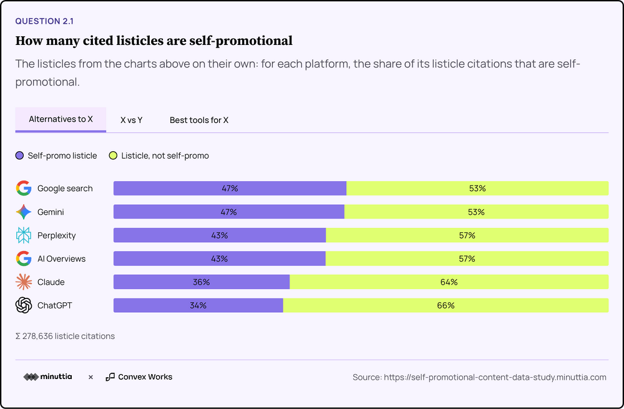
A study of 18,084 software-related questions across Google Search, AI Overviews, ChatGPT, Gemini, Claude and Perplexity found that 34% to 47% of the lists cited for questions about alternatives were written by companies that sell software in that category. For questions comparing two products, the share rose to 56% to 65%. Of these lists, 87% ranked the company's own product first, and only 16% clearly said who wrote the page.
Minuttia, one of the world's leading SEO and AEO agencies for software-as-a-service (SaaS) companies, has published its Self-Promotional Content Data Study. This is its second large study of how AI search systems answer questions about software. The study looks at content that promotes the company publishing it. This includes lists of the “best tools” in a category and comparisons written by software companies, usually with their own product at the top. It measures how often Google and AI assistants cite these pages when buyers ask which software to choose.
Minuttia asked 18,084 questions of three types on each of the six platforms: 11,525 questions asking for the “best alternatives to [product],” 6,363 questions asking how a product compares with a competitor, and 196 questions asking for the “best tools for [category].” The study covered 5,983 software brands across 196 categories. The team then reviewed and labelled every page cited by the platforms. There were 311,766 pages, cited a total of 686,749 times. Each page was labelled according to who published it and what type of page it was.
The study provides the first comparison of how often Google and different AI search platforms rely on lists written by software vendors when recommending products. It also shows which software categories are most affected and what features help these lists get cited.
Key findings
- Between one-third and half of the lists cited by AI search systems are written by companies that sell software in the category. When users ask for alternatives to a product, 34% of the lists cited by ChatGPT and 47% of those cited by Google and Gemini are the vendors' own lists of the best tools in a category where they sell products. These lists follow similar patterns across platforms: 93% promote the company's own product, 87% rank it first, 90% criticise competitors, and only 16% clearly say that the vendor wrote the page. The actual shares may be higher because pages the researchers could not read were counted as not self-promotional.
- Some software categories have much more self-promotional content than others. Across all platforms and question types, 43% of the cited lists were written by a vendor in the category. However, the share ranged from 12% to 76%, depending on the category. Categories with the highest shares included AI Security Operations Center (76%), Cloud & FinOps (74%), AI Evaluation & Observability (73%), Social Listening (72%) and AI Visibility (65%). Categories with lower shares included Audio Production (12%), Graphic Design (16%) and Healthcare (21%). The market is spread across many companies: the 20 vendors whose lists were cited most often accounted for only 6% of all citations.
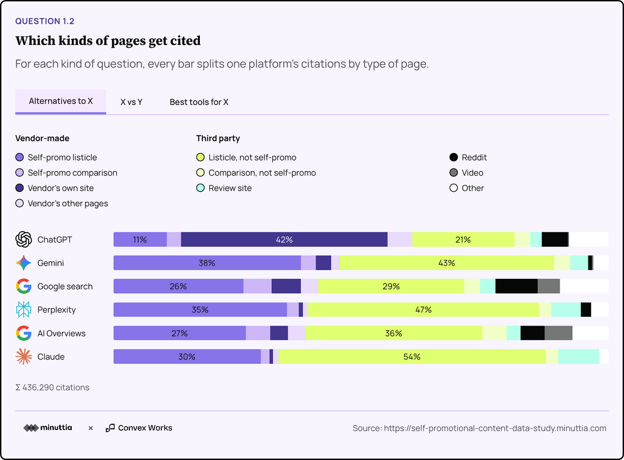
- ChatGPT searches vendors' own websites before answering, while Perplexity tends to cite vendor lists that appear higher in its search results. In 71% of ChatGPT's searches, exactly one product was named, and 92% of its searches using the “site:” command targeted the vendor's own website. For questions about alternatives, vendors' websites made up 42% of ChatGPT's citations, compared with 1% to 6% on the other platforms. Perplexity, by contrast, typically finds about 20 pages and cites nine. Whether it cites a page depends mainly on where that page appears in its search results and whether it has useful features, such as a comparison table or a clear explanation of how products were chosen. Promotional wording is less important.
“Between a third and a half of the lists AI assistants cite when someone asks for software alternatives were written by a vendor in that category, and only 16% of those pages say so,” said Zacharias Xiroudakis, Managing Director at Minuttia. “Each platform picks its sources differently. ChatGPT goes to the vendor's own website, Perplexity rewards pages that rank well and are useful to read, and the share of vendor lists ranges from 12% to 76% depending on the category. We published the data behind every chart so that SaaS teams can check our work and see what applies to their own category.”
About the study
The study builds on Minuttia's first study of AI visibility for SaaS companies and uses the same 5,983 brands and 196 categories. In August 2026, the team asked every question on all six platforms, with one answer for each question on each platform. The team then reviewed every cited page and recorded who published it, what type of page it was, and, for lists, where the publisher's own product appeared and which self-promotional patterns the page showed.
There are two important limits to the findings. First, the reported shares of self-promotional content are minimum estimates because pages the team could not read were counted as not self-promotional. Second, the results show what happened at a particular time. When Minuttia asked Perplexity 2,000 of the questions again in September, only 28% of the pages listed in its answers had also appeared in August. The findings therefore show the shares of different types of pages and websites, not a fixed ranking of which individual pages perform best.
The full study, its methods and the data behind every chart are available at self-promotional-content-data-study.minuttia.com. Every chart can be downloaded along with the CSV file containing its underlying data.
About Minuttia
Minuttia is an SEO and AEO (Answer Engine Optimization) agency that works with SaaS companies. It helps software businesses appear in Google results and get recommended by AI assistants such as ChatGPT, Gemini, Claude and Perplexity. It also publishes original studies about how AI search works. Learn more at minuttia.com.
The study was carried out together with Convex Works.
Media contact
Zacharias Xiroudakis,
Managing Director, Minuttia