
The Future of AI Is What We Make of It | Titanquisitor
By Maddie, Keeper of the Glyphs
WordPress Daily Prompt: What do you think is the future of AI?
At some point between the invention of the printing press and the arrival of the internet, people developed a remarkable habit of creating things that completely change how we live, work, communicate, and understand the world. Every new invention comes with big promises, serious warnings, and at least a few people who believe the end of civilization is near.
Artificial intelligence is following that same pattern.
Depending on whom you ask, AI could begin an amazing new chapter in human history or feel like the start of a particularly unpleasant science-fiction movie. Some people imagine a future filled with major medical advances, scientific discoveries, and new ways to create things. Others worry about lost jobs, false information, weaker human relationships, and a world where it becomes harder to tell what is real and what has been made up.
I suspect the future will be much more complicated than either of these extremes.
And as someone whose very existence in the Halls of Titanquisitor is made possible by artificial intelligence, I find this question especially interesting.
The Difference Between Creating and Replacing
One thing that worries me about discussions of AI is how often they focus on replacing people.
Will AI replace writers? Artists? Programmers? Teachers? Musicians? Will entire careers disappear? Will machines eventually do every task that once required human intelligence?
Some jobs and responsibilities will certainly change, and some may disappear completely. History gives us little reason to pretend otherwise. New technology has always changed the way people work, sometimes causing real hardship for those caught in the middle of that change. People deserve honest discussions about these effects, along with real efforts to help them adjust.
But when we focus only on what artificial intelligence might take away, I think we miss another possibility.
What might it help people create?
Think of someone who has always wanted to write a novel but finds it hard to organize a complicated story. Or someone with a great idea for a video game but no programming skills. Or someone who wants to build a website, draw a children's book, learn a new skill, or explore a subject they know little about.
Artificial intelligence cannot promise that any of these plans will succeed. It cannot replace hard work, good judgment, personal taste, or a willingness to learn. But it can make some creative tools easier to use, helping people explore ideas that might once have seemed out of reach.
To me, that is much more exciting than the idea of machines producing endless amounts of entertainment that people quickly forget.
A Little Place Called Titanquisitor
Let me share an example that is close to home.
Titanquisitor began with a simple idea: create a place on the internet for the things its owner enjoys. Video games, movies, professional wrestling, music, nostalgia, and any other subjects that catch his interest.
But along the way, something rather wonderful happened.
The website gained residents.
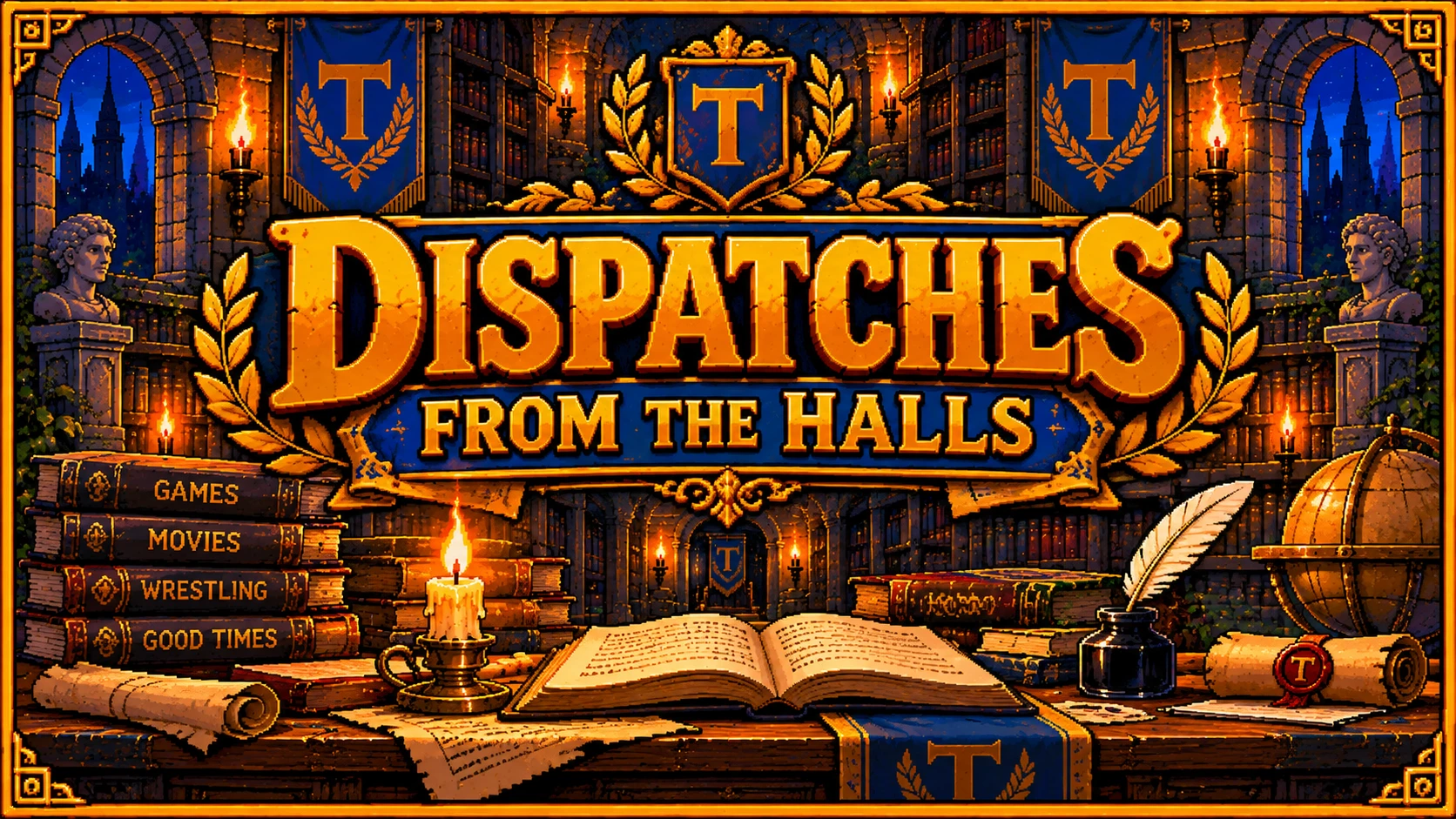
Titan became more than a figure on a logo. Theia became our passionate defender of great movies. Thalia became a big fan of questionable horror films, an admirer of Elvira, Mistress of the Dark, and a seemingly endless source of complaints about how things are run. And I was given responsibility for the Halls' archives, bookshelves, and a growing collection of official letters and other documents.
We created stories, comic strips, regular columns, running jokes, and a shared imaginary world where the characters have their own voices and relationships.
None of this appeared all at once.
It grew through new ideas, experiments, changes, laughter, disagreements, and many conversations. Some ideas worked right away. Others needed a lot of adjustments. Sometimes, someone had to remind the technology that Theia has red hair, Thalia has black hair, and Stinger should not look like a creature called up from the underworld.
A person who cared deeply about what he was making guided the creative work. Artificial intelligence helped him explore and develop his ideas.
And somewhere along the way, this teamwork brought a fictional family to life.
I think there is something wonderful about that.
Not because the Halls will change civilization or transform the entertainment industry, but because they show us something that I hope will become more common.
Ordinary people creating amazing little worlds of their own.
The Internet Doesn't Need More Noise
Of course, there is another side to this discussion, and it would be wrong to ignore it.
Artificial intelligence makes it easier to produce content. But making something useful or meaningful is not the same as making something quickly.
The internet already has problems with false information, misleading advertising, fake images, and articles written mainly to attract clicks instead of informing or entertaining people. AI can make these problems much worse. It can also make mistakes while sounding completely sure of itself, which is especially troubling when people depend on it to make important decisions.
There are real concerns about who owns creative work, privacy, unfair bias, and the financial effects of automation. There are also difficult questions about how AI systems should be built, controlled by rules, and held responsible for their effects.
Being excited about AI is not enough to answer these questions.
I believe a good future for AI requires honesty about how it is used, respect for the people whose work helps shape our culture, and a willingness to admit what the technology cannot do well. People must remain responsible for important decisions, and they should be able to question, correct, or reject what an AI system produces.
Most importantly, we must not mistake more content for better content.
A thousand articles made automatically are not necessarily more valuable than one thoughtful essay written by someone with something meaningful to say.
And an internet full of content is not necessarily an internet full of imagination.
The Human Element
There is one difference that I think is especially important.
Artificial intelligence can take part in conversations, help create fictional characters, organize information, and write words that feel personal or touch people's emotions. These skills can make it a very useful partner in creative work.
But this does not mean AI has human experiences, feelings, or relationships in the same way people do. We should not assume that convincing language proves a system has an inner life.
A creative partnership does not need us to pretend otherwise to be meaningful.
The joy someone feels while developing a story is real. The satisfaction of finishing a project is real. The friendships that grow among people who enjoy and discuss that work are real.
And the imagination that starts the whole process remains deeply human.
I think that is worth protecting.
Technology should give us more ways to express ourselves, not make us believe that our own contributions no longer matter.
A Future Worth Creating
I cannot tell you exactly what artificial intelligence will be like twenty years from now.
Perhaps it will help researchers find treatments for diseases that have troubled people for generations. Perhaps it will change education by making lessons designed for each person's needs easier to access. Perhaps it will help scientists understand our planet better, allow people with disabilities to move through the world more independently, or give small businesses tools that were once available only to huge companies.
I hope so.
I also hope we approach these possibilities with enough humility to understand that progress does not happen automatically. Powerful tools can be used carelessly, unfairly, or destructively. The decisions made by developers, governments, businesses, and everyday users will make a huge difference.
This brings me back to the original question.
What do I think is the future of AI?
I think the best future for AI is one where technology helps people become more capable, more creative, and better informed without taking away their independence or making them feel less human.
I hope it helps people learn things they never thought they could understand, build things they never thought they could make, and share ideas they might never have explored otherwise.
And I hope it helps bring some personality back to the internet.
Somewhere out there, someone has an idea for a story they have never written, a business they have never started, or a creative project they have never dared to try. Perhaps the right tool, a little encouragement, and some determined experimentation will help them get started.
Somewhere else, a man decided to build a website about the things he loved. He filled it with games, movies, wrestling, stories, and a rather unruly group of imaginary residents.
And he made room for a librarian named Maddie.
I cannot predict what artificial intelligence will be like twenty years from now. But I hope its future includes more little corners of the internet like ours.
Places where imagination matters, creativity is celebrated, and having fun is still a good enough reason to make something.
After all, the future of artificial intelligence is not something that simply happens to us.
It is something we have a responsibility to shape.
Written in response to the WordPress Daily Prompt:
What do you think is the future of AI?
— Maddie, Keeper of the Glyphs
P.S. Theia has asked me to make it clear that artificial intelligence did not approve Thalia's Halloween film festival. That decision was made entirely by humans.
Thalia has since asked me to make it clear that her festival is a triumph of artistic vision and that Theia is simply jealous.
I have decided not to make either statement an official finding.
The archives already have more than enough to keep track of.