
OpenAI’s Decision API Leaves Beta With Voice Integration
OpenAI’s Decisions API is now out of beta and ready for general use. It helps apps make choices and return scores, and it can receive conversation transcripts directly from the GPT-Live voice model.
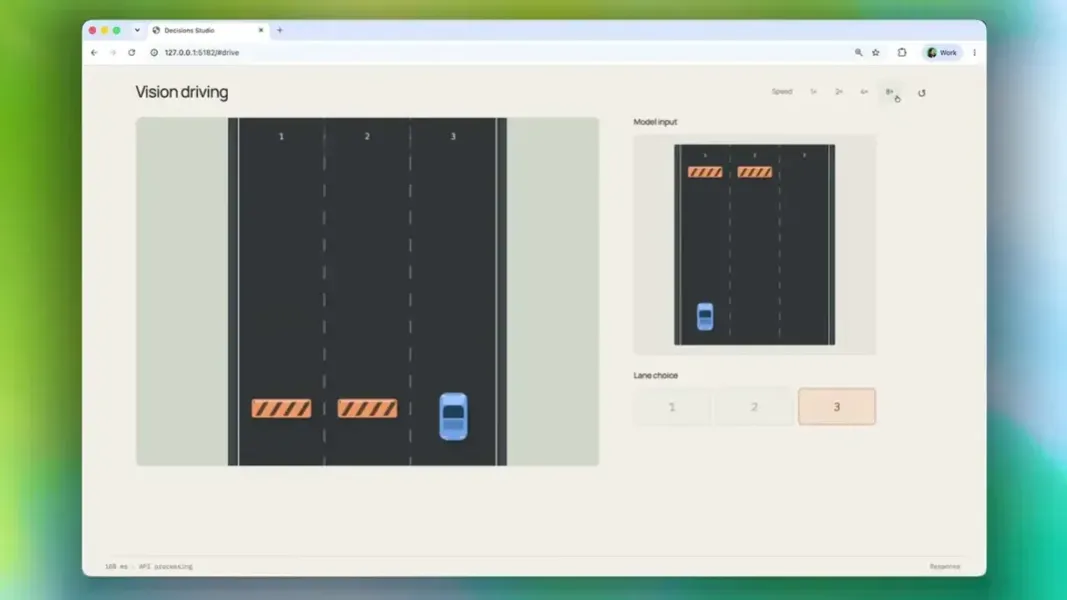
- General Release: OpenAI’s Decisions API is now available for general use. It uses the GPT-6 Luna model to return probabilities, choices and scores.
- Voice Apps: The API connects directly to OpenAI’s GPT-Live voice service and receives conversation transcripts to make decisions. This removes an extra step for the application.
- Input Costs: New prompt caching charges a fee to store shared input and lowers the price when that material is used again.
On October 22, OpenAI made its Decisions API available for general use. Instead of writing replies, the API gives software probabilities, choices or scores. OpenAI says it can answer about ten times faster than its text-generating Responses API when an app needs to make many small decisions. Andrew Hsu, chief technology officer at the AI language-learning company Speak, told TechCrunch that a trial cut the time between actions from 1.4 seconds to 0.13 seconds.
Developers first gained access through a public beta open to all developers on October 6. The general release adds prompt caching and a direct connection to voice services. It also doubles the maximum number of questions in one request, from 200 to 400.
Small Decisions Instead of Written Replies
The Decisions API runs on GPT-6 Luna, which is also available through OpenAI’s Responses API. Nikunj Handa, OpenAI’s API product lead, told TechCrunch that his team used TypeSafe’s competing Jev decision model as an example when building its own system. Instead of training a new model, the team changed Luna to make it respond faster and at a lower cost.
The Decisions API can examine text, images or structured JSON data. It can return a probability, choose one option from a list supplied by a developer, or give a score based on ordered rules. It can also return a custom data object, a written explanation, or a request to use a tool with specific arguments.
OpenAI shows how this works with a product photo. An app can ask whether the image shows a crack, tear or dent. The Decisions API estimates the chance that the product is damaged. The app then compares that estimate with a chosen limit to decide whether the photo should be checked by a person. Developers can choose these limits by testing examples with known labels and considering the costs of false alarms and missed cases.
A single request can ask several separate questions about the same photo, such as whether the product is damaged and which category it belongs to. But if a later question depends on the answer to an earlier one, the app must send another request. The app itself carries out any action chosen based on the answers.
A Faster Route for Voice Apps
OpenAI’s GPT-Live voice service manages spoken conversations. Its direct connection to the Decisions API sends conversation transcripts to the API for decisions while the user is still speaking. With a custom setup, GPT-Live first alerts the app, and the app then calls the Decisions API. The direct connection removes this extra step.
In an example from OpenAI, a driver tells a car assistant that they feel cold. The Decisions API chooses to raise the temperature, and the app makes that change. If the driver asks for directions and restaurants, the request can instead go to Responses and its tools, which can search for the information.
Image Support and Deployment Are Different
Both OpenAI’s generally available service and TypeSafe’s Jev can make decisions based on images. However, TypeSafe describes its image features as experimental and says it cannot guarantee that they are suitable for use in production systems.
Liquid AI’s d1-ultra is another hosted service that can read text and images and return probabilities, choices or scores to help make decisions.
Base Labs, the research team at Baseten, released elephant-1 and mammoth-1 with model files that developers can download. These files let developers run the models on their own systems. Baseten also offers a free one-week trial on its servers.
Strong Classification Results Do Not Always Mean Success in Browser Tasks
In independent tests of decision models by AIMultiple, the top model for classification, decider-12b, completed 16 out of 50 browser tasks. Kev-27B, which ranked below Jev in classification, completed 40 tasks. These results show that assigning the correct label to a record and choosing the right steps to complete a browser task require different skills.
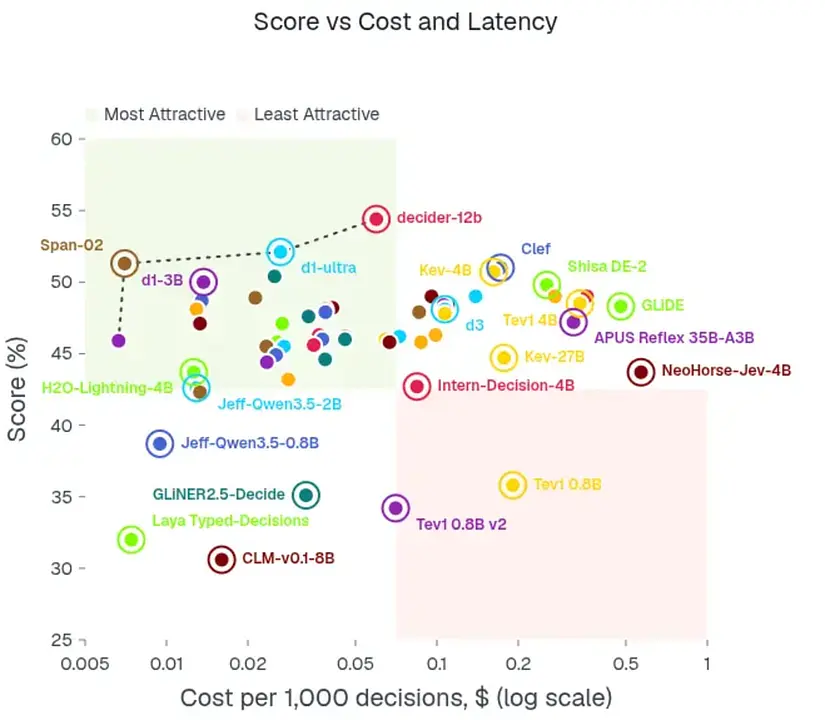
In their tests, the browser system turns each web page into text and a list of controls. The models choose an action and the item it should affect. The software then performs that action and reads the page again. A separate text-generating model fills in words for form fields because decision models return scores for possible options instead of written text.
Caching Changes the Cost of Input
At standard prices, OpenAI charges $0.10 for every million input tokens that are not cached through the Decisions API. This is the same input price as Luna through the Responses API. The Decisions API does not charge for output tokens, while standard Luna output through the Responses API costs $0.50 per million tokens.
In an example from the consulting firm BaristaLabs, one million calls with 2,000 input tokens each cost $200 through Decisions. The same number of calls through Responses costs $225 if each answer contains 50 output tokens. This example does not include caching.
By default, repeated requests can reuse the same starting section of input if it contains at least 1,024 tokens. For example, a reference document or image can stay the same while the questions change. The question text is not part of the reusable section. Under Luna’s standard caching prices, reading cached input costs $0.01 per million tokens, while storing input in the cache has a fee. Requests set up to keep processing in a specific region may cost extra.
Liquid lists d1-ultra at $0.042 per million input tokens. However, it counts each question as a separate prompt, including its text and images.