
Even Mothers-in-Law Are Snapping Up AI Talents: The Fierce Talent Grab in the AI Era
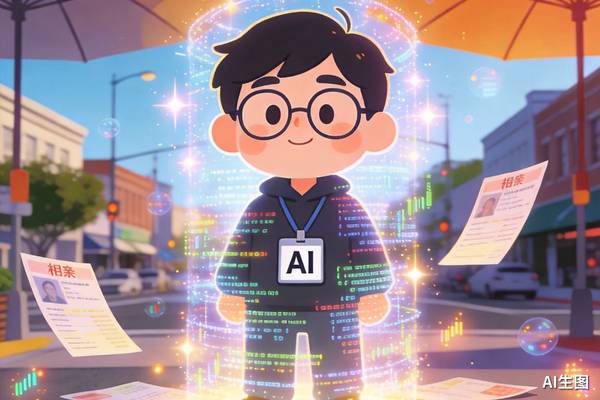

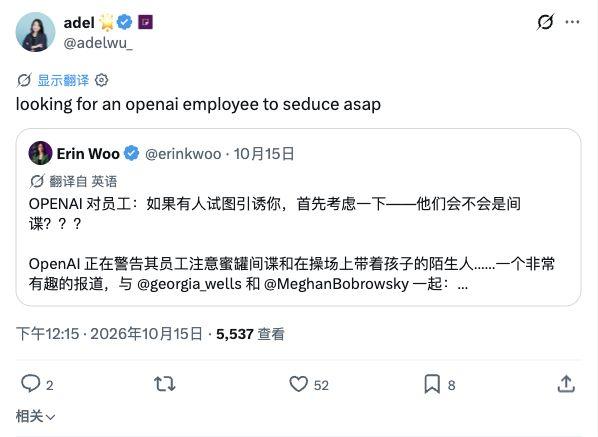
Recently, OpenAI has even started worrying about whether its employees might be too attractive to people with hidden motives.
Reports say that during training on how to prevent spying, OpenAI warns employees that outsiders may use romantic or sexual relationships to get close to them and steal company secrets. This is often called a "honey trap."
You might think someone is interested in you, but they may actually care much more about your company's secret information. Some people summed up the incident by saying, "OpenAI reminds its employees not to forget that they are ugly and uninteresting."
This news says something interesting about what is happening in Silicon Valley right now.
In today's dating world, it is not unusual for people to want to meet you as soon as they hear you work at OpenAI. This may explain why a "honey trap" could work on OpenAI employees: people really are eager to get close to them.
Matchmakers in the San Francisco Bay Area rank employees of OpenAI and Anthropic among the most desirable people to date. Some clients even name the exact company they want a future partner to work for. For some, the goal goes far beyond finding someone with a high salary. Some people still living in China have even started planning to move to Silicon Valley and settle down.
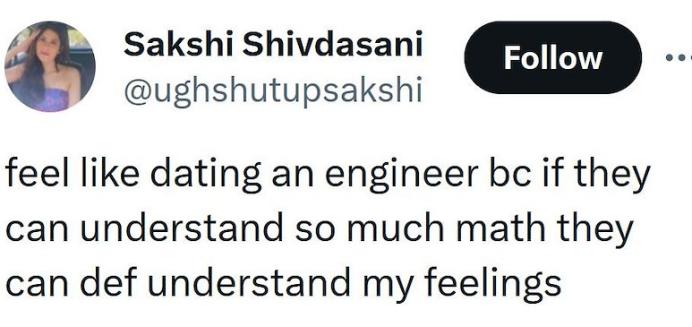
Tech workers who were once teased for being awkward and unromantic have become people many daters actively seek out. They are smart, earn good money, and work in a field with strong growth potential. Some people even find their poor social skills charming.
AI companies are competing to hire talented people, and the dating market is competing for them, too.
A.
"For me, marriage right now is like restructuring a company's assets."
These are the words of a Chinese woman entrepreneur in her 40s.
She is divorced, lives in China with her son, and plans to move to Silicon Valley. For her next husband, she is especially interested in people who work at AI companies preparing to go public and own shares that could rise in value.
She explains that an ordinary salary may not leave much money after taxes. Instead, she hopes to find someone whose financial future looks promising and clear.
Among people seeking partners across national borders, AI workers in Silicon Valley have become one of the most wanted groups.
Qinghua Zhao, founder of the Chinese dating platform 2RedBeans, has noticed this change.
The platform mainly helps Chinese people living overseas meet potential partners. It offers online dating services, in-person events, and matchmaking. It has also expanded into China. Its official website describes dating advice and matchmaking services for women over 35 in the Greater China region who are interested in relationships across borders.
Zhao says clients have become more and more specific about what they want in recent years.
At first, Chinese clients said they wanted to find a soulmate on the east or west coast of the United States. Later, they narrowed their search to Silicon Valley and began asking specifically for engineers.
Eventually, even asking for an engineer was not specific enough. AI engineers became the preferred choice.
Today, people may even name the exact company they want a potential partner to work for. Zhao puts Anthropic and OpenAI in the top tier of desired employers.
The reason is easy to understand. In Zhao's view, the chance that these companies will go public, and the wealth their employees might gain from that, are part of their appeal.
Some people in Silicon Valley have already turned this possibility into real money.
In October 2025, current and former OpenAI employees sold a total of $6.6 billion worth of shares. About 75 of them each cashed out around $30 million.
OpenAI has not gone public, but some of its employees have already made huge gains in wealth. It is no surprise that the name of a person's employer has become an important detail when matchmakers introduce potential partners.
Of course, hearing about these employees' wealth does not mean it is easy to meet them in person. This is where matchmaking companies and dating platforms come in.
Amy Yang, a Bay Area matchmaker who previously worked as a tax analyst at Oracle, now helps people find romantic partners. She says many tech workers go straight from school into a company. Their coworkers and friends often have similar backgrounds. They spend much of their time at work, have relatively small social circles, and may not be comfortable approaching strangers.
As a result, matchmakers searching for partners for their clients do work that is quite similar to what headhunters do when looking for talented workers.
Zhao first checks the platform's member database. She then asks friends who work at large tech companies for information and referrals. Yang also contacts friends, former clients, people in her industry, and even other matchmakers to find possible matches.
The people being approached also have their own requirements.
Yang has noticed that even men who are AI scientists may want a woman who has at least a university degree and a stable job in the Bay Area. Zhao says these men, who have spent years training in technical fields and logical thinking, often hope to find partners who are warm and understanding.
One side looks at a company's future growth and financial prospects. The other considers education, work, and whether their lifestyles will fit together. In cross-border dating, both sides have their own list of requirements.
The changing preferences in cross-border dating are just one sign of a wider trend. AI workers are popular in the dating market whether or not they are looking for partners across borders.
B.
Kinjal Nandy, a 21-year-old AI entrepreneur, wrote a "Girlfriend Requirement Document" for himself.
Yes, he copied the idea of a requirements document that tech companies use when building products. This time, though, he listed what he wanted in a girlfriend in the notes app on his phone: high emotional intelligence, independence, and a willingness to set clear boundaries in a relationship.
Nandy is the co-founder and CEO of Sonatic, an AI startup based in San Francisco. In everyday conversations, he sometimes uses technical terms such as "latent space" and "scalability."
Writing a document to find a date may seem a little arrogant. It also suggests that Nandy holds a strong position in the dating market.
At least, some Bay Area matchmakers say that this kind of tech-worker personality is popular right now.
Amy Andersen, founder of the high-end matchmaking agency Linx Dating, has noticed that when she tells potential dates that a male client rarely appears online, they often respond by asking, "When can I meet him?"
Even if the photos he shares from his everyday life are not very attractive, people may see that as a good thing. They may think he does not spend much time showing off and is not overly focused on himself.

Being a little shy can make someone seem genuine and down-to-earth. Not being good at reading social situations can also seem sweet and awkward in a charming way. In the past, shy, smart, slightly nerdy engineers might have been overlooked. Now, more and more people are interested in them.
Women who work in AI are popular, too. Annie Liao, a 25-year-old AI entrepreneur, received a large number of messages from men on her dating profile after moving from Sydney to San Francisco to develop her project, Build Club. The attention became overwhelming, so she eventually began avoiding dating apps.
For many AI workers in Silicon Valley, being popular in the dating market has clear benefits. They are often so busy with work, sometimes following a 996 schedule of working from 9 a.m. to 9 p.m., six days a week, that they have little time or chance to meet potential romantic partners. A popular saying in Silicon Valley is: "Stay single before Series B financing."

Dating trends have also changed at matchmaking events in China.
Changjiang Daily reported that in May, open umbrellas and A4-sized personal ads crowded the paths at the matchmaking area in Zhongshan Park, Wuhan. Matchmakers carrying registration books were recommending young men who worked in chip-related jobs in Optics Valley.
Local news reports gave these men a nickname: "Optics Valley Guys."
The term covers more than AI engineers. It also includes technical workers in fields such as chips and data storage.
In one profile shown by a matchmaker, a man born in 1992 had earned a doctorate from the University of Nottingham in the United Kingdom and worked as a senior chip engineer in Optics Valley. The matchmaker said that men with similar qualifications and backgrounds were usually "snapped up" within about a week of their profiles being posted.
Another interesting detail is that parents searching for partners for their children also discuss Wuhan's plans to develop its data storage and optoelectronics industries. They consider the future of these industries when thinking about their children's potential partners.
In Silicon Valley, matchmakers discuss the chances that AI companies will go public. At matchmaking events in Wuhan, parents discuss the city's plans for local industries. Although they are on opposite sides of the ocean, both groups use their ideas about an industry's future to judge a person's prospects.
Put simply, they are trying to work out whether building a life with this person is likely to lead to a good future.
However, the future of any industry can change.
C.
There is nothing new under the sun.
The current popularity of AI workers in the dating market brings back memories of a decade earlier, when large internet companies were growing quickly. At the time, programmers in checkered shirts in Zhongguancun, Beijing, were teased but were also highly sought-after partners. Today, simply working for a large internet company is no longer enough to impress a date if you are not involved in AI. The other person may instead think that you work too hard and could lose your job at any time.
Going back even further, tech workers in Silicon Valley went through extreme highs and lows during the dot-com bubble around the turn of the century.
Old news reports show that in 1999, organizers of singles events in Silicon Valley made a bold promise to women: if they did not meet at least one nice man, they could get their money back. When the organizers promoted local men, they highlighted the same qualities that are popular today: a good education, a stable job, and a high income.
An event organizer said that 1,000 men and women had signed up, and some participants had even traveled from Canada and London.
A San Francisco bartender recalled how much a tech company's name could matter. During the internet boom, men could mention the company they worked for, their income, and the car they drove while flirting. That alone could attract women's attention.
The company name was almost the first thing they said to start a conversation.
But when the dot-com bubble burst, share prices fell and companies shut down. Company names and job titles that people once used to impress others lost much of their power. News reports from 2002 recorded this change.
At the time, Andrew Stern, who was in his 20s, worked as the business development director at Bang Networks. He noticed that titles such as internet company CEO and business development director no longer impressed people as much as they once had. People had also stopped talking so confidently about how their companies would change the world.
Stern himself held a job title that was losing its appeal.
The way people started conversations at singles events also changed. Instead of asking what someone did for a living, they first asked whether the person had a job. Stern felt that even being unemployed was no longer something to be ashamed of.
The food at singles events changed, too. Caviar and sushi were replaced by mashed potatoes and bread. Instead of hiring famous bands, organizers booked local bands or DJs.
When all the excitement eventually fades, the lessons from the past are not entirely negative. One interesting thing is that romantic relationships did not necessarily become harder to build after the dot-com bubble burst.
Another interviewee, Ravi Bellur, saw his startup shut down in August 2000. In the following year, four of the six men who had worked at the company got married, and another had proposed marriage.
Julie Paiva, who runs the matchmaking service Table for Six, found that her clients did not stop looking for love. They simply changed what they were looking for. Men paid more attention to personality and the ability to raise children. Women cared more about a partner's values and whether family mattered to him. Even during that period, more clients asked to pause their memberships because they had found someone they wanted to date seriously and no longer needed to attend singles events.
Losing the advantage of a famous tech company or an impressive job title does not mean losing the chance to find a good relationship. What changes is the easy attention and praise that once came with that status.
When you look through a kaleidoscope, how do you choose the brightest colors? When you are being carried along by the excitement, how do you find someone who will walk beside you through life? Seen this way, the attention AI workers receive today may be either a blessing or a burden. No one can say for sure which it will be.