
Kimi K3.1 Pro vs Claude Fable 5.1: One-Fifth the Price, Two Points Ahead on the Independent Index
Author
Rowan SterlingDate Published
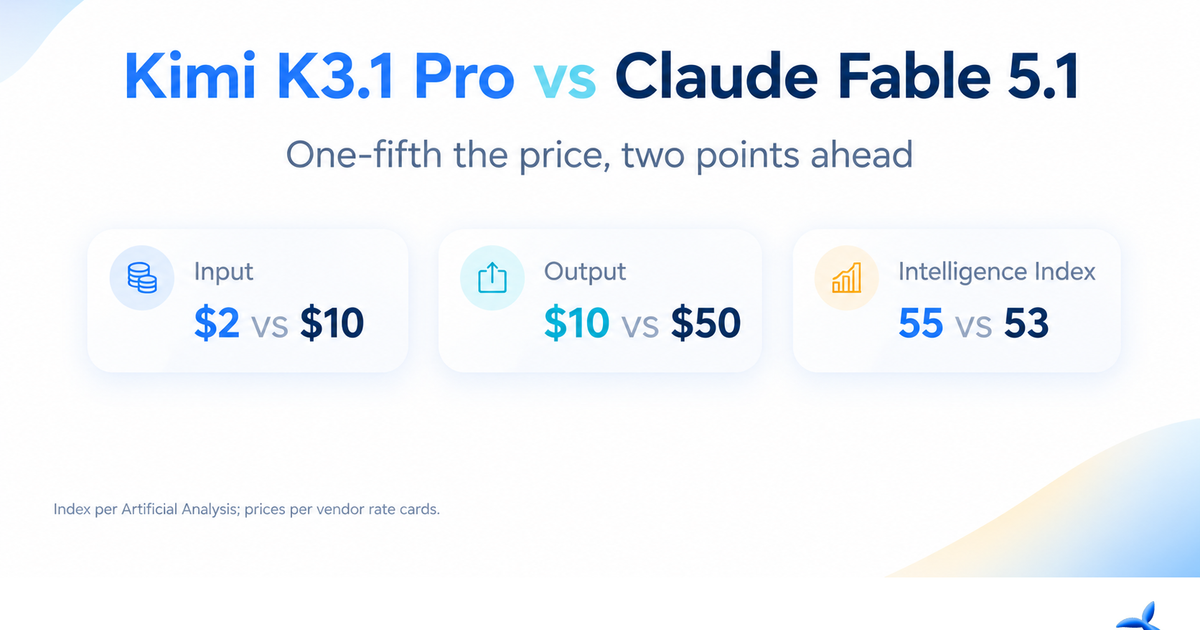
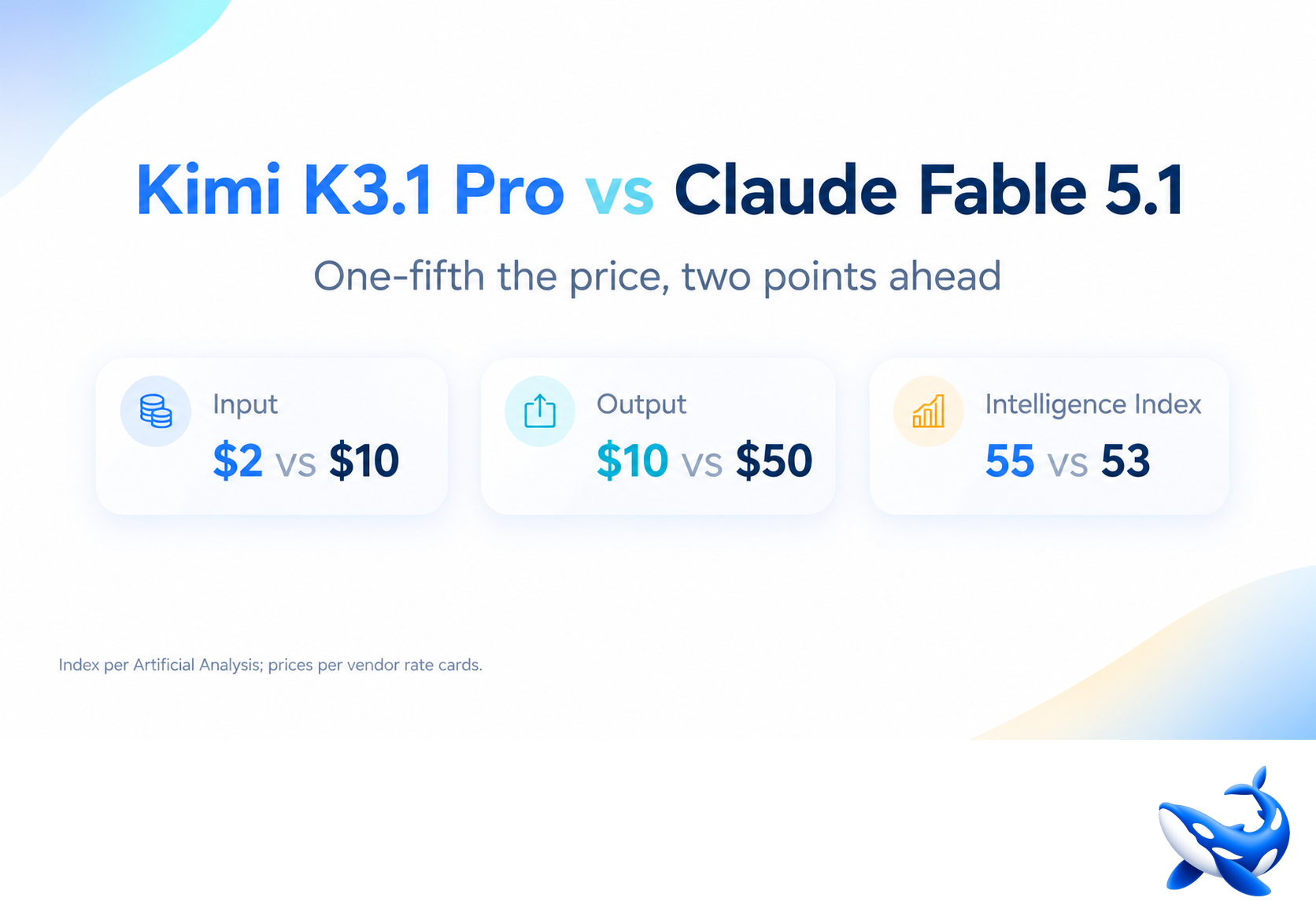
Claude Fable 5.1 is the most expensive model Anthropic sells. It costs $10.00 for every million input tokens and $50.00 for every million output tokens. These prices are unchanged from Fable 5, which was released on 1 September 2026. Kimi K3.1 Pro costs one-fifth as much. Both models are measured by the same independent index, but the cheaper model scores two points higher. Artificial Analysis gives Kimi K3.1 Pro a score of 55 and Claude Fable 5.1 a score of 53. That is the main finding of this comparison, but there is an important detail: Fable 5.1 is marketed as the model to use when Opus is not good enough, yet the same index gives Opus a score of 58, five points above Fable.
So, which score is wrong? Probably neither. The index averages results from ten tests, while Fable's intended use is more specific: long-running tasks in which an AI agent must keep a plan on track for hours. A general index might not measure that ability well. For buyers, two facts matter most. The expensive model and the cheaper model have similar measured capabilities, but their prices differ by five times, and the amount of text they can produce in one response differs by much more.
The two price lists
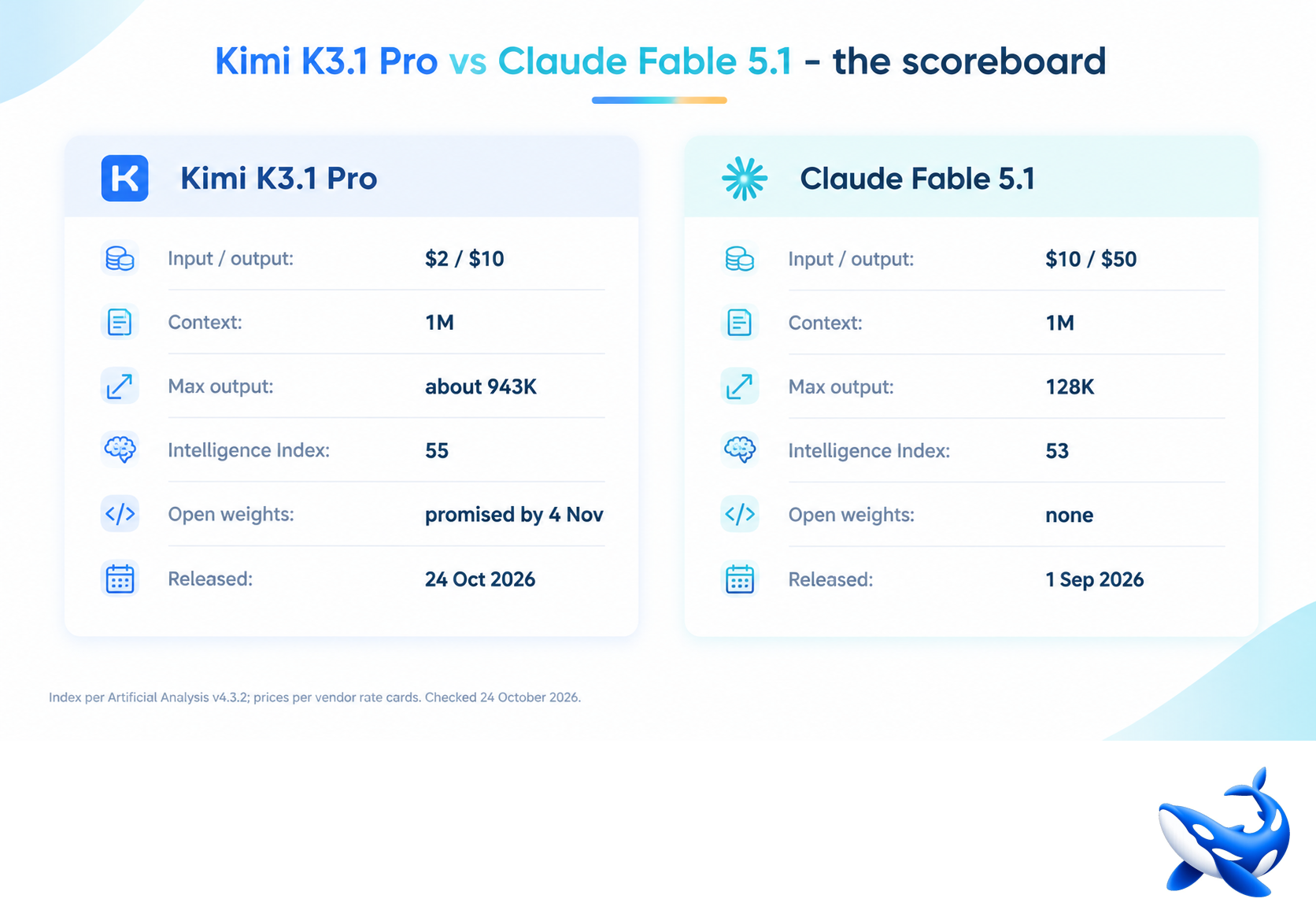
• Input — Kimi K3.1 Pro costs $2.00 per million tokens, compared with $10.00 for Claude Fable 5.1.
• Output — Kimi costs $10.00 per million tokens, compared with $50.00 for Fable. Anthropic says reading cached input on Fable 5.1 costs one-quarter as much as it did on Fable 5. This is a real discount, but Fable's standard price is still five times Kimi's.
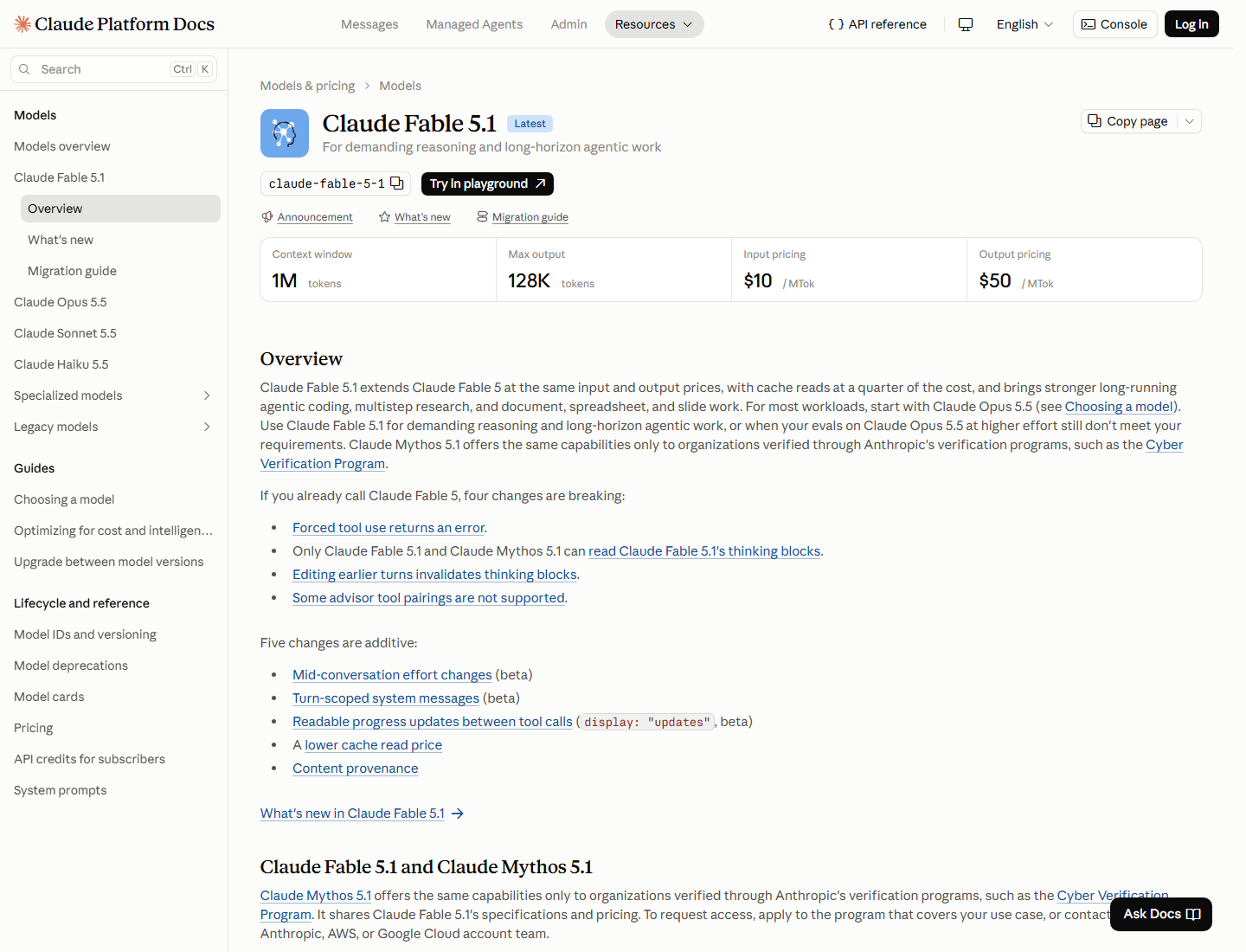
• Context — Both models can handle 1,048,576 tokens of context, so their context limits are almost identical.
• Maximum output — Kimi K3.1 Pro can produce up to 943,718 tokens in one response, compared with 128,000 for Claude Fable 5.1.
• Weights — Kimi K3.1 Pro's full model weights are promised by 4 November 2026. Anthropic has no plan to release Fable 5.1's weights publicly.
A request that reads one million tokens and produces 200,000 tokens of output costs $4.00 with Kimi K3.1 Pro and $20.00 with Fable 5.1. For a document-processing system that handles one billion input tokens each month, the input cost alone would be $2,000 with Kimi and $10,000 with Fable, before comparing the quality of their results.
What Anthropic says Fable is for, and what the index shows
Anthropic gives clear advice about which model to choose. It recommends starting with Claude Opus 5.5 for most tasks. It suggests Claude Fable 5.1 for difficult reasoning and long-running work done by AI agents, or when using Opus 5.5 with a higher thinking effort still does not meet your needs. In other words, Fable is not the usual first choice. It is the more expensive option for situations where the cheaper model falls short.
Artificial Analysis does not show a clear advantage for Fable. Its index gives Fable 5.1 a score of 53, Opus 5.5 a score of 58, and Kimi K3.1 Pro a score of 55. There are two possible explanations. The tests may not put enough pressure on the long-running abilities Fable was designed for, or Fable's advantage over other models may apply to fewer tasks than its marketing suggests. Both explanations are possible. The index combines ten tests covering knowledge, reasoning, and tasks performed by AI agents, but none of these tests runs for hours.
There is also a related model with restricted access. Claude Mythos 5.1 has the same capabilities as Fable 5.1, but only organisations approved through Anthropic's programmes, such as its Cyber Verification Program, can use it. Fable is the version of these capabilities that is more widely available, and Anthropic charges a premium price for it.
Where Fable 5.1 earns its price
There are three important things that a single index score cannot show.
The first is the ability to work on long tasks using AI agents. Fable 5.1 builds on Fable 5's ability to handle long coding tasks, research that involves many steps, and document work that takes a long time. Anthropic specifically recommends it for jobs that Opus cannot handle well, even at high thinking effort. If your task is a six-hour software migration rather than answering one prompt, a test that measures each task separately may not measure what matters most.
The second is the software and tools built around the model. Fable 5.1 has several changes that can break older workflows. These changes matter because teams were doing complex work with its predecessor. Thinking blocks must stay tied to the model that created them. Forcing the model to use a tool now returns an error. Changing an earlier turn makes existing thinking blocks invalid, and some combinations of advisor tools are not supported. These details suggest that the model and its surrounding tools have been used in real production systems. For businesses with strict rules and safety requirements, knowing about these problems in advance can be valuable. A newly released model cannot yet offer the same record of known problems.
The third is how users can control the model during a long conversation. Anthropic documents a beta feature that lets users change thinking effort in the middle of a conversation, as well as system prompts that apply to individual turns. These features can help when an AI agent needs to think more deeply or less deeply as a task progresses. Kimi K3.1 Pro's effort setting is provided at the top level and is effectively fixed for a session. Changing it invalidates prefix-cache matches, which can reduce the benefits of reusing earlier input.
Where Kimi K3.1 Pro wins on facts, not marketing
The price difference is the clearest advantage, and it is too large to dismiss as rounding. The less obvious advantage is the maximum output size. Kimi can produce 943,718 tokens in one response, compared with Fable's 128,000. This means Kimi can return a very large file, a complete software migration diff, or a long document in one response, without requiring the application to join several smaller responses together. For large batches of documents or work involving an entire codebase, this limit can affect how the system is designed more than a small difference in benchmark scores.
The third advantage is the promise of open model weights. They have not been released yet; the planned date is 4 November. However, the commitment is public, and the earlier K3 release offers a clear example. Its weights were published on 27 July under a licence that allows people to use, change, share, and fine-tune them. For organisations that cannot use a hosted API and need to run a model themselves, this may be the most important difference of all.
Kimi K3.1 Pro does not yet have Fable 5.1's three months of production history, its published list of breaking changes, or Anthropic's business-focused tools and services. A model released this week has not yet had time for users to publicly report its failures.
What to use, and how to divide the work
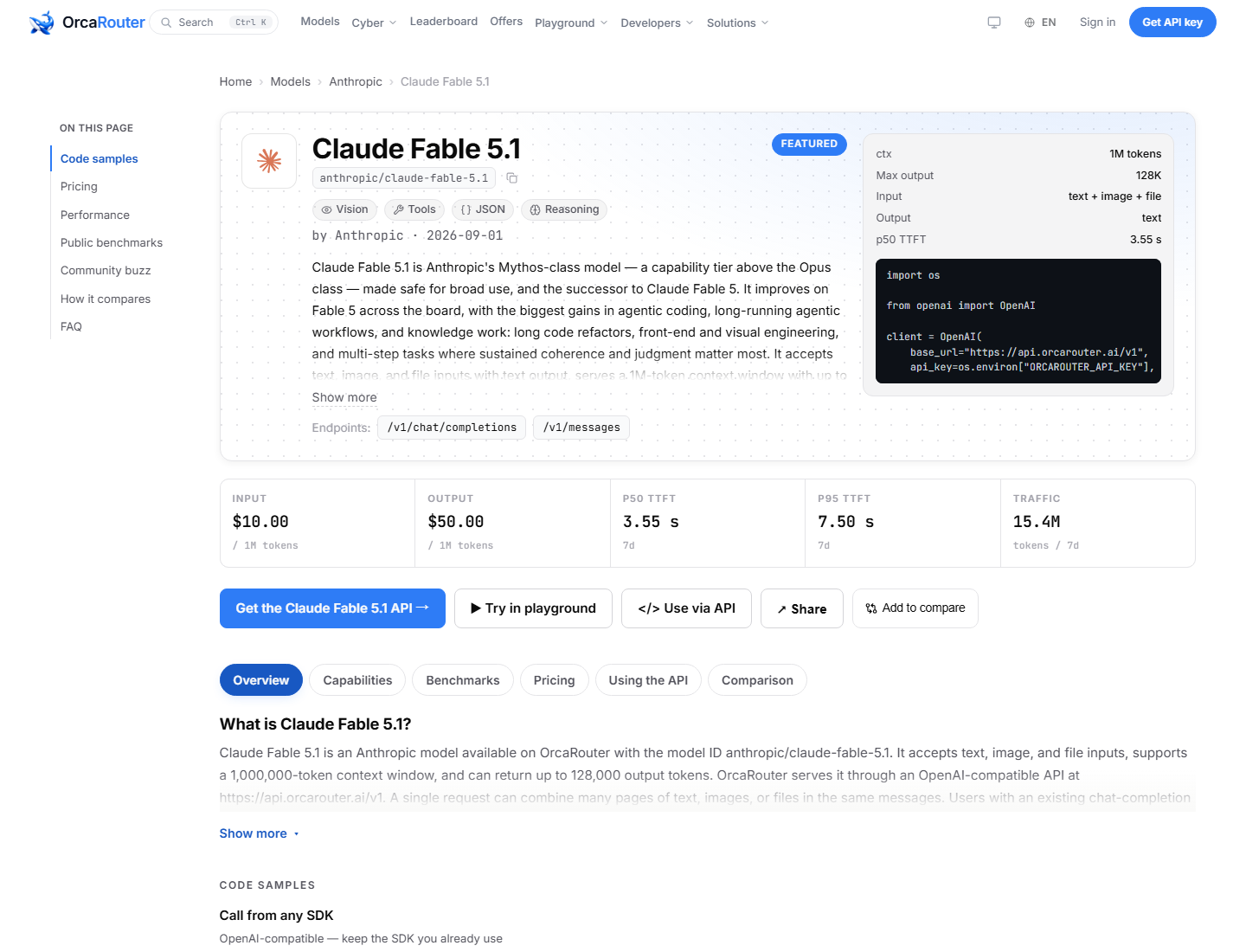
Both models are available through OrcaRouter at their providers' listed prices, with no extra markup. Kimi K3.1 Pro costs $2.00 per million input tokens and $10.00 per million output tokens. Claude Fable 5.1 costs $10.00 per million input tokens and $50.00 per million output tokens. Both can be accessed with one API key and support the same three request formats. This means a system can direct different tasks to different models without changing the application's code.
The evidence supports splitting the work by task. Send long-running AI agent tasks, and work that depends on Anthropic's thinking-block and thinking-effort features, to Fable 5.1. Send large amounts of generated text, document processing, and tasks that produce output across an entire codebase to Kimi K3.1 Pro. Because Fable costs five times as much, sending just 20% of the work to the expensive model would leave the combined bill about 80% lower than sending all the work to Fable.
Do not treat Kimi's higher index score as proof that it is the better model in every situation. The scores show that the measured difference is small enough for your actual tasks to matter more than the leaderboard. With such a large price gap, Kimi should be the default choice unless your own tests show that another model works better for your needs.