
Twelve-year-old wins Australian slam competition prize with poem about ChatGPT: ‘It’s totally unnecessary’
Blake Mackenzie wrote his poem the day before Sunday's final. It explores problems linked to AI, including brain rot, loneliness and harm to the environment.
Twelve-year-old Blake Mackenzie used a 90-second poem called Dear ChatGPT to describe some of the problems young people face in the age of AI, including loneliness, brain rot and seeing pornography too young. His poem won the youth prize at the 2026 Australian Poetry Slam competition.
Blake is a year six student from Newcastle. On Sunday night, he impressed all 10 judges at the Sydney Opera House with short, clever lines such as “You’re designed to addict us and never contradict us” and “Your friendship is endless so why do I feel friendless?”.
The judges were chosen at random from the audience. They might have been even more impressed to learn that Blake had written his poem just one day earlier.
“I was making them as I went through [the competition],” he told Guardian Australia on Monday. “I just kept winning and it was all because I wrote a cool poem in class one day.”
The Australian Poetry Slam competition is now in its 22nd year. Organisers held 65 heats in 60 towns and cities across the country to choose 16 finalists.
As the youth winner, Blake shares a prize package worth $20,000 with Bivor, a poet from Alice Springs who won the adult category with his poem Politics is Doing You.
Over the next year, both poets will represent the competition at writing and poetry festivals. Blake will attend events in Australia, while Bivor will travel to Indonesia and Singapore.
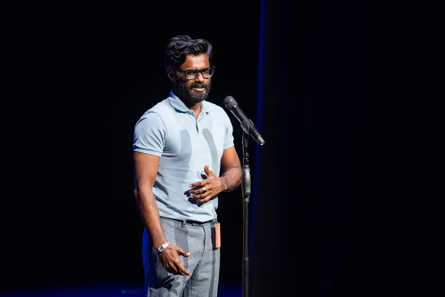
Blake entered the competition after his teacher, Mrs Welsh, encouraged him. She came to watch him perform in his first heat and at the state final before Sunday's grand final.
“She got a T-shirt that says ‘I’m Blake’s teacher’. I wouldn’t be here without her telling me to enter this, assuring me that I was a good poet. She’s been a really big part of this.”
Blake said he wrote Dear ChatGPT because he had seen his friends using chatbots and other AI tools in ways he thought were unnecessary.
“Instead of reading the book we’re learning in class, they get ChatGPT to summarise each chapter – and by the time you’ve read the summary you could have read the chapter. It’s such a waste of water,” he said.
“The more we use it, the more power we give it,” Blake said. “More water will be wasted. It’s totally unnecessary.”
Sydney Water has said that data centres in Sydney alone could need as much as 250 megalitres of water every day by 2035. That is more water than Canberra uses for all its drinking needs. “That’s eventually so much water that could be given to people who have none,” Blake said.
Blake did not use AI to help write his poem. “No, that’s very not allowed,” he said. He also generally avoids using chatbots.
Blake does not know any other children his age who enjoy spoken-word poetry, but he believes it is a good way to raise awareness of issues he cares about. “I try to talk about things that affect people my age,” he said. “I feel really proud of it. I could not be more happy with it.”
Blake's first poem of the night, which helped him reach the final, was called I Love My Country. He said it was about Australia, inequality and racism. In the poem, he criticised the way political parties such as One Nation divide people. He also spoke about the fact that Australia was built on land taken from its original owners. “It’s hard to love your country if you don’t feel welcome in your own country,” he said.
“Literally every single person’s poem was on a whole different level. They were so good,” Blake said. “One of the judges came up to me and said ‘I didn’t vote for you just because you’re a kid. I did it because your poem was amazing.’”