
Students and artificial intelligence industry leaders connect at inaugural Michigan AI Business Conference
Students attend the Artificial Intelligence Business Conference at the Ross School of Business on Friday afternoon. Will Larson/DAILY. Buy this photo. Students attend the Artificial Intelligence Business Conference at the Ross School of Business on Friday afternoon. Will Larson/DAILY. Buy this photo.

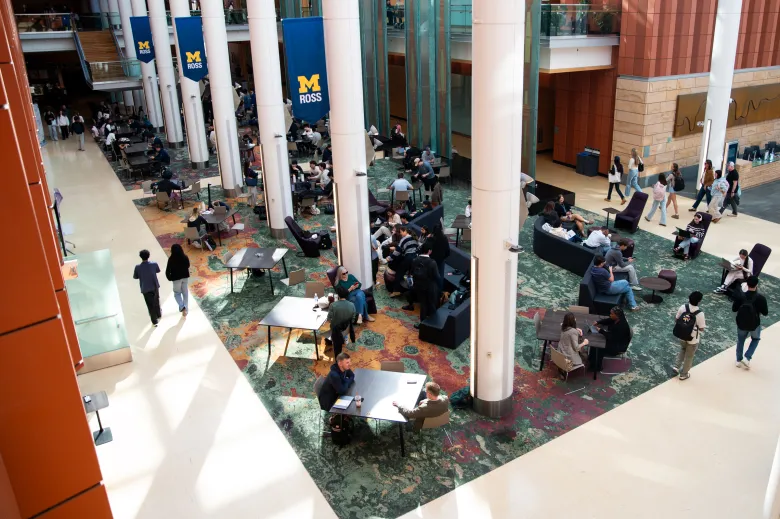
More than 250 students, professors and business leaders gathered on Friday for the first Michigan Artificial Intelligence Business Conference at the Ross School of Business. Speakers and panel members came from Citi, Bank of America, J.P. Morgan and Microsoft. The event was organized by AI Business Group and held in partnership with the Business School, School of Engineering and School of Information.
The conference aimed to connect students with professionals who explained how artificial intelligence (AI) is changing the business world.
Michael Koury, a second-year Business student and vice president of conferences for ABG, wrote in an email to The Michigan Daily that the group wanted to give students useful information and help them build professional connections.
“Our goal was to put students in the room with people who are actually using AI at work, not just reading about it,” Koury wrote. “A lot of us are recruiting into careers that AI is already changing, so we wanted the day to be practical, with real conversations with speakers, a chance to meet recruiters, and something students could use right away.”
Jennifer Marsman, the keynote speaker and a principal AI engineer at Microsoft, explained how businesses are using AI in their work. She said Microsoft has recently used AI to help people work more efficiently through its Microsoft Copilot Checkout partnership with Etsy. This tool turns users' searches into product suggestions tailored to their interests.
Marsman said other industries also use AI in different ways. Journalists use AI models to speed up editing. Retailers use AI models to suggest clothes based on individual preferences. Fast-food chains use speech-to-text models to run drive-through services.
Although Marsman spoke positively about what AI can do, she also said industries must be careful not to depend on it too much. She recommended balancing the use of AI with work done by people, so people still have reasons to keep learning as the industry changes.
“As it’s getting easier and easier to have something do your thinking for you, make sure you are still exercising your mind,” Marsman said. “It’s so important. People who stay curious, who want to learn, who want to understand what’s happening underneath — those are the people who are going to be successful.”
Marsman also described how AI can help with work beyond business. She talked about her work with a Microsoft team focused on protecting the environment called AI for Earth. The team studied how infectious diseases spread by using AI-powered traps to identify and catch mosquitoes based on their wingbeat patterns. The team also developed a project to stop poaching. It used drones with infrared cameras and AI to track animals and identify people hunting them illegally.
In an interview with The Daily, Lia Toltzman, a second-year Business student, said learning about AI for Earth gave her a new way to think about AI and showed her that it can be used in more ways than she had expected.
“Hearing from Jennifer’s experiences in such a diverse mix of AI usages, such as AI for Earth, was really cool,” Toltzman said. “AI being used for environmental purposes was something that I hadn’t really considered before because I feel like everyone associates AI with tech for the most part.”
Some students said that hearing from professionals at the conference also changed how they thought about their future careers. Chanse Rivera, a second-year student in the College of Literature, Science, and the Arts (LSA), said the conference made him more interested in the technical side of business.
“After this conference, I’m more interested in doing the technical side of things as opposed to just a client-based thing,” Rivera said. “I feel like a lot of people are talking about how being in front of clients is very important in the AI age because it’s the last thing that can’t be automated, but I still think there’s a lot of room for technical growth and technical opportunities.”
Daily Staff Reporters Hannah Hiller and Alexandra Sim can be reached at [email protected] and [email protected].