
Anthropic's founders pledged to donate most of their stock. Their IPO tells another story.
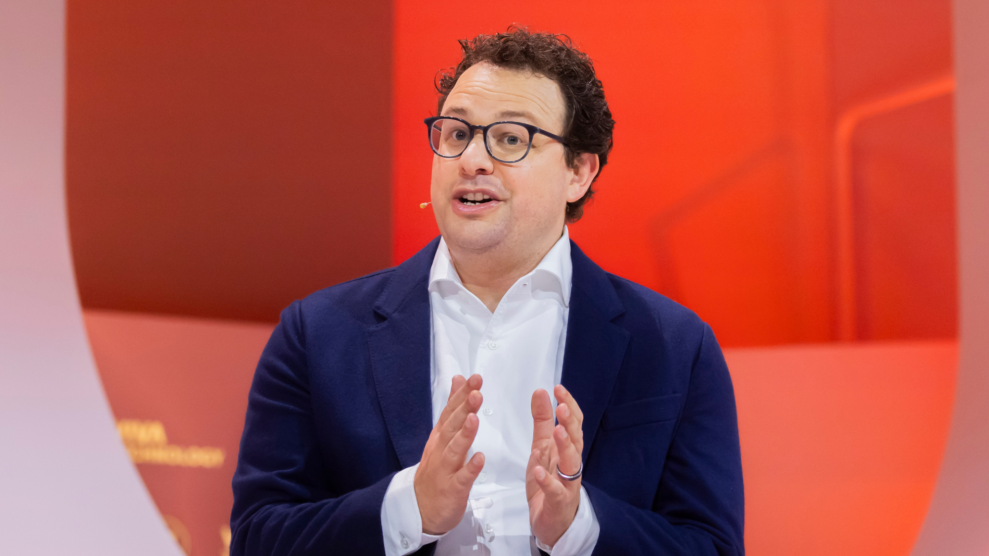
Dario Amodei, Anthropic's co-founder and CEO, speaks at the Viva Technology conference in Paris, France, on May 22, 2024.Vincent Isore/IP3/Zuma
The AI company Anthropic filed documents for its initial public offering (IPO) with the US Securities and Exchange Commission (SEC) on Monday. The sale of its shares to the public is expected to become one of the biggest stock market launches in history.
The IPO is expected to happen around the middle of November. The public documents do not say exactly how much the startup is worth or how many shares it will sell, or at what price. But investors estimate its value could be around $1.5 trillion to $2 trillion. That would be close to the estimated value of Elon Musk's SpaceX when it launched its IPO earlier this summer, at $2.1 trillion.
Anthropic has filed an S-1 registration statement with the SEC related to its proposed IPO.
— Anthropic (@AnthropicAI) October 26, 2026
Read more: https://t.co/zuRMrxXzNx
Legal disclaimer: A registration statement relating to these securities has been filed with the SEC but has not yet become effective. These securities…
The company expects to be worth an enormous amount despite reporting losses of more than $80 billion in the first half of 2026, even though it earned $16.3 billion in revenue during that period, according to Anthropic's filing. The startup owes $6.2 billion in debt, most of it to Amazon. It also owes companies that provide computing power more than $475 billion. This includes about $115 billion to Google through 2033, $110 billion to Amazon over the next ten years, and as much as $120.5 billion to SpaceX for access to Nvidia graphics processing units (GPUs) through 2029.
Anthropic's filing also seems to weaken—or at least make less firm—the promise its co-founders made when they started the company. They pledged to give 80 percent of the shares they personally own in the AI startup to charitable causes. But the filing says these promises to donate are voluntary and can be taken back. They do not create legally binding duties.
Part of the filing says: “The timing, amount, recipients, structure, and manner of any donations in furtherance of this pledge are uncertain and will depend on a variety of factors, including each co-founder’s individual circumstances, tax and estate planning considerations, applicable transfer restrictions, market conditions, and philanthropic priorities at the relevant time.” In other words, when the founders donate, how much they give, who receives it, and how they give it will depend on many factors, including their personal situations, taxes, plans for their estates, limits on transferring shares, market conditions, and charitable goals at the time.
The filing also points to political opposition to the infrastructure needed for AI. Anthropic says it must be able to “build, operate, and maintain the infrastructure required to deploy frontier models cost-effectively and at scale.” It specifically mentions temporary bans on building new data centers as a possible challenge. It also says the company must deal with changing rules around the world, which are uncertain and sometimes differ from one place to another.
Even if Anthropic can deal with growing political and regulatory pressure, its filing also warns about the “catastrophic or existential risks to humanity” that could arise if AI is developed without “appropriate safeguards.” The company says these dangers could also make it difficult to get enough insurance. Because of the “scale of harm that could result from a catastrophic AI-related incident,” the company writes, “no single insurer, and potentially the insurance industry in the aggregate, may have sufficient capacity or expertise to underwrite insurance commensurate with such exposure.” In other words, the damage from a major AI disaster could be so great that even the entire insurance industry might lack the ability or knowledge to provide enough coverage.
In short: We're losing tens of billions of dollars. We need hundreds of billions more. We might destroy everything. Can anyone pay for the damage?