
Anthropic IPO Discloses Plans for Life Sciences Growth
Anthropic plans to grow its work in life sciences by investing more in knowledge, skilled workers, partnerships, and possible acquisitions. The artificial intelligence (AI) company revealed these plans in its long-awaited filing to sell shares to the public for the first time, known as an initial public offering (IPO).
Anthropic filed its Form S-1 Registration Statement with the U.S. Securities and Exchange Commission on Monday. The filing did not explain which research areas the company is exploring in the molecular biology lab it announced last month. It also did not say whether the company plans to discover and develop any new treatments, or how much it spends on life sciences overall.
The filing also did not say how much money Anthropic hopes to raise by selling shares on Wall Street, or how many shares it will sell and at what price. News reports have said the company is seeking a remarkable valuation of $2 trillion. That is 13% higher than the $1.77 trillion valuation of Elon Musk’s SpaceX when it went public in June. Anthropic plans to list its public shares on the Nasdaq Global Select Market under the ticker symbol ANT.
However, the filing said Anthropic is building AI agents based on its Claude family of large language models. These agents are meant to do more than speed up drug discovery and development. They are also being designed to carry out many of the physical tasks involved in making new treatments.
“Claude is used in drug discovery and development by our customers, our biotechnology partners, and our own researchers. We are building AI agents that support scientists at each stage of that process,” Anthropic stated.
“Beyond knowledge work, we believe frontier AI has the power to transform physical work. Advances in Claude’s general capabilities, together with our Model Hardware Standard, now allow it to operate lab and manufacturing equipment such as microscopes, liquid handlers, and off-the-shelf robotic arms.”
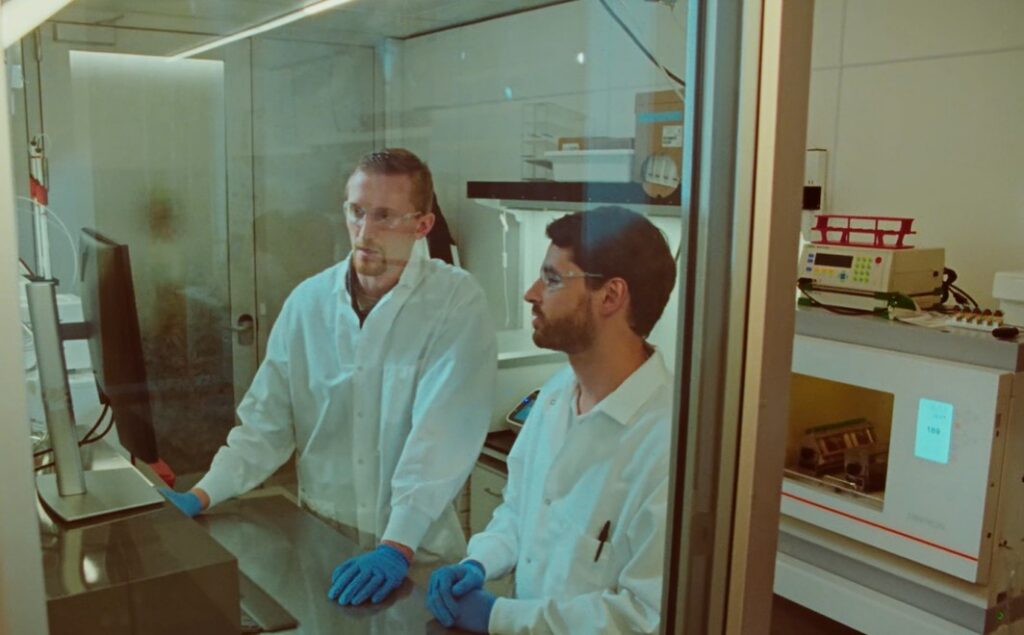
In August, Anthropic publicly previewed its Model Hardware Standard (MHS). It began as a joint project between Anthropic and the Howard Hughes Medical Institute (HHMI) Janelia Research Campus. Anthropic described MHS as “a shared specification for AI agents to safely operate physical devices, to a first group of scientific research labs and advanced manufacturers.”
“Currently in research preview, our Model Hardware Standard enables AI agents to find, understand, and safely operate lab and manufacturing equipment such as microscopes, liquid handlers, and off-the-shelf robotic arms,” Anthropic explained in its IPO filing. “Our Model Hardware Standard is model-agnostic and lets any agent harness reach devices with a programmable interface through standard protocols such as MCP.”
AI workbench
In June, Anthropic released Claude Science, an AI workbench for scientists. It brings together research tools that are usually spread across different systems. These include more than 60 scientific databases and connections already set up for fields such as genomics, proteomics, and structural biology. The tools work together through a single system that helps the AI reason about information. Anthropic partner Basecamp Research has made its EDEN models available through Claude Science for global public health research. These models are used to design antibiotics and predict possible vaccine targets.
In its IPO filing, Anthropic also described many, but not all, of its recent activities in life sciences: “To build the best tools for the industry, we have invested in deep life sciences expertise of our own, hiring industry experts, building a molecular biology lab, acquiring Coefficient Bio, and partnering with industry leaders.”
Anthropic said these efforts have helped it attract major customers. As of September 30, 2026, nine of the 10 largest pharmaceutical companies were among its customers. The company did not name them. These pharmaceutical companies are part of the more than 50% of Fortune 500 companies that Anthropic counts as customers generating at least $100,000 in revenue over the trailing 12 months (TTM). Anthropic also said every company in the Fortune 10 and more than 30% of the Forbes Global 2000 were customers generating at least $100,000 in TTM revenue.
Anthropic is conducting life sciences research in a molecular biology lab and through a research group formed earlier this year. Last month, the company said the group was created “to see whether general AI models can systematize and accelerate discoveries capable of revolutionizing biology and medicine.” It added: “Our focus is on fundamental biology research using Claude: exploring datasets of DNA to identify uncharacterized protein families, generating hypotheses at scale, and testing them through experiments in the lab.”
The IPO filing did not say how many researchers work in the lab or how much of Anthropic’s total research and development (R&D) spending goes toward it. The company’s R&D spending increased more than fivefold in the first six months of 2026, reaching $9.741 billion, compared with $1.85 billion from January through June 2025. For all of 2025, Anthropic spent a total of $6.338 billion on R&D, according to its Form S-1.
The lab made headlines around the world last month when Anthropic announced that its Claude large language model had “discovered a novel enzyme system with properties reminiscent of CRISPR, with only high-level direction from our scientists.”
In a post on X, Anthropic CEO Dario Amodei explained more about the finding. He described the enzyme system as “a molecular machine that we suspect could represent a new gene editing mechanism. Its precise function, biotechnological utility (if any), or level of significance is not yet clear, but at minimum it is work I would have been proud to do as a PhD student.”
‘Something interesting’
“The work was done mostly, though not entirely, by Claude: our life sciences team suggested a broad area of research, Claude read through the literature and a bunch of genome data and discovered something interesting, then Claude proposed experiments to verify the discovery and our team carried them out,” Amodei added.
In April, technology news outlets The Information and the Substack newsletter Newcomber, founded by Eric Newcomber, first reported that Anthropic had bought Coefficient Bio, a secretive AI biotechnology startup, for about $400 million in stock. Anthropic confirmed the acquisition in its IPO filing but did not confirm the price. It said it bought the company “to accelerate our research in the life sciences.”
Coefficient Bio was founded last year. According to OncoDaily, the company developed an AI platform that can help plan drug research and development, manage regulatory strategies for clinical studies, and identify possible new drugs. Its co-founders include Nathan Frey, PhD, and Samuel Stanton, PhD, who both previously worked in Genentech’s Prescient Design computational drug discovery unit. Another co-founder, Aris Theologis, is the company’s CEO. He previously served as chief business officer at Evozyne and as a vice president at Paragon Biosciences.
According to the IPO filing, Anthropic reported a net loss of $80.748 billion for January through June 2026. This was more than six times its net loss of $12.969 billion in the first six months of 2025. However, revenue grew 14-fold, reaching $16.286 billion in the first half of 2026, up from $1.163 billion in the same period of 2025.
Anthropic’s operating loss also fell in the first half of 2026, from $2.135 billion a year earlier to $693 million. An operating loss means a company’s operating expenses are greater than the revenue it earns from its main business activities.
For all of 2025, Anthropic reported a net loss of $41.965 billion. That was five times its $8.309 billion net loss in 2024. The 2024 loss was itself more than five times the $1.531 billion net loss reported in 2023.
Goldman Sachs and Morgan Stanley are jointly leading the IPO, with 20 other banks and investment institutions also taking part.