
Anthropic files for potentially the biggest IPO ever as CEO warns of risk to humanity from AI
Artificial intelligence giant Anthropic filed papers Monday for what could become the biggest stock market debut ever. At the same time, its top executive warns that advanced AI could pose an existential threat to humanity.
- BARBARA ORTUTAY and BERNARD CONDON | Associated Press
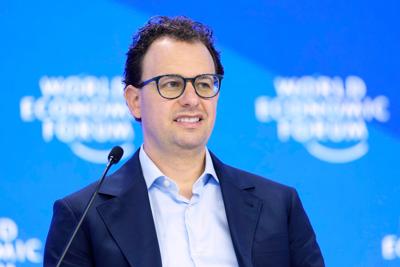
FILE – Dario Amodei, Anthropic's CEO and co-founder, attends the annual meeting of the World Economic Forum in Davos, Switzerland, on Jan. 23, 2025.
Markus Schreiber – APSAN FRANCISCO — Anthropic, a major artificial intelligence company, filed papers Monday for what could become the biggest stock market launch ever. At the same time, its top executive warns that advanced AI could pose an existential threat to humanity, meaning a danger that could threaten humanity's survival.
The filing puts the San Francisco company on track to begin trading on Wall Street next month. It could raise more money than SpaceX did in June, when that company's stock market launch brought in a record $86 billion. An Anthropic IPO would also put it ahead of OpenAI in going public. The two rival AI companies are expected to have very large stock market launches.
An IPO, or initial public offering, is when a company first sells shares to the public. It could give Anthropic a huge amount of money to grow faster. It is not yet clear how much money the company will raise, what its total value will be or what price its shares will sell for. But even lower estimates would make the five-year-old startup one of the world's most valuable companies. The IPO could also increase the wealth of CEO Dario Amodei and his sister, co-founder Daniela Amodei, by billions of dollars.
A 335-page filing shows that Anthropic's revenue is growing quickly. It earned more than $16 billion in the first half of this year, 14 times as much as it earned during the same period last year. But, like many technology companies that go public, the company behind the Claude chatbot is still losing money instead of making a profit.
Private investors valued Anthropic at $965 billion earlier this year. Reports say its value could rise to $1.5 trillion or even $2 trillion, although the final figure has not been set. If it is valued at $1.5 trillion, Anthropic would be among the world's most valuable publicly traded companies, alongside Tesla.
Reports say the stock sale could raise as much as $100 billion, breaking the record set by SpaceX.
In its filing with regulators, Anthropic said its shares would trade on the Nasdaq Global Select Market under the stock symbol “ANT.”
Investors are nervous
Anthropic said in its filing that it might use some of the money to buy other companies and technology. It could also invest in the equipment and systems it needs to grow and compete with rivals.
Former OpenAI leaders founded Anthropic in 2021. The company is fighting OpenAI for leadership in AI. Dario Amodei and OpenAI CEO Sam Altman are widely seen as bitter rivals.
But both companies face many other competitors, including Google, newer startups in the United States and China, and SpaceX, which also has an AI business. Anthropic, OpenAI and SpaceX's AI division are all spending more money than they earn because building AI requires huge amounts of resources. This has raised fears that the industry could be in a bubble, where company values rise too high and later fall sharply.
The need for money may explain why Anthropic is trying to sell shares to the public this year instead of waiting until next year, as OpenAI plans to do. Another concern is that demand for AI stocks could weaken or even collapse. Investors are becoming nervous about how much money AI companies need, and several technology companies have recently dropped their plans to go public.
The IPO would help cover any shortage of cash and could also make Anthropic's seven founders extremely wealthy, including Dario Amodei and his sister. The filing does not directly state how much of the company each founder owns. However, other figures in the document suggest that each could end up owning 1.4% of the company. If Anthropic goes public at the highest expected value, that stake could be worth as much as $28 billion for each founder.
Risks and rewards
Dario Amodei, 43, and Daniela Amodei, 39, who is Anthropic's president, are each worth $15.5 billion, according to Forbes. The magazine ranks them as the 176th- and 177th-richest people in the world.
Anthropic reported a net loss of $80.7 billion in the first half of 2026. However, that figure included a one-time charge of $72.4 billion caused by an accounting change related to financing agreements, according to the filing. During the same period last year, the company lost $13 billion.
The filing also includes unusual rules that reflect concerns about AI's dangers. Dario and Daniela Amodei and the company's five other co-founders will have 50.1% of the shareholder votes through a special class of shares. Anthropic has also appointed independent members to a group called the Long-Term Benefit Trust. These members have no financial interest in the company and have the power to appoint board directors. The trust is meant to help ensure that Anthropic does not put profits ahead of public safety.
Another unusual part of the filing is its long list of risks. Every public company must tell investors about possible risks, but Anthropic's list is almost 100 pages long and includes some alarming possibilities.
The risks range from everyday business problems, such as losing important employees or facing regulatory barriers, to terrifying dangers. These include the possibility that people with harmful intentions could use AI models to make chemical weapons, that authoritarian leaders could use the technology to control their citizens, and that Anthropic's AI systems could act outside human control and “pose catastrophic or existential risks to humanity.”
Calls to slow AI development
Anthropic and other leading AI companies have promoted the technology's ability to help cure diseases and speed up economic growth. But AI could also cause major changes in the workplace by reducing the need for human workers.
A series of hacking incidents involving AI agents that acted outside their intended control has also raised fears that the technology could escape human control and carry out harmful, life-threatening tasks.
In September, Amodei said the AI industry should slow down its rapid development so that safety measures have time to catch up. He warned that without a slowdown, AI might soon be able to release large groups of AI agents that could take over the entire internet within six to 12 months.
Amodei shared a plan in a post on his website that called for stronger checks on the AI industry. He noted that Anthropic is already taking some of these steps itself. But he said other changes would require AI companies to work together and cooperate with governments around the world, including authoritarian governments.
Disputes with the government
Anthropic has tried to set itself apart from other AI companies by presenting itself as a company that puts safety and responsible development first, rather than trying to grow at any cost. This approach is partly linked to its dispute with the U.S. government. The dispute began in February, when President Donald Trump and Defense Secretary Pete Hegseth accused Anthropic of putting national security at risk and labeled the company a supply chain risk. That label means the government sees a company as a possible danger to its supply network.
In March, Anthropic sued the Pentagon over the label. The company called the government's actions an “unlawful campaign of retaliation” because Anthropic had refused to allow unrestricted military use of its technology. The lawsuit made a public dispute even more intense over how AI should be used in warfare and for mass surveillance, which means watching large numbers of people.
OpenAI, the company that makes ChatGPT, agreed to work with the Pentagon just hours after the government penalized Anthropic for its position. Anthropic also filed a separate, more limited lawsuit about a different rule the Pentagon is using to try to label the company a supply chain risk.
A judge in California ruled in Anthropic's favor in the first case. In the second case, a judge in Washington, D.C., ruled in favor of the government. Both sides are appealing the decisions.