
The Outlook for the Artificial Intelligence (AI) in Predictive Toxicology Market Strengthens as Global Demand

Artificial Intelligence (AI) in Predictive Toxicology Market

Artificial Intelligence (AI) in Predictive Toxicology Market Share

Artificial Intelligence (AI) in Predictive Toxicology Analysis
The Business Research Company’s 2026–2035 Global Market Report on the Outlook for Artificial Intelligence in Predictive Toxicology
LONDON, GREATER LONDON, UNITED KINGDOM, October 27, 2026 /EINPresswire.com/ -- Artificial intelligence (AI) is changing how researchers predict whether drugs and other substances may be harmful. Its use in predictive toxicology is growing quickly. These technologies help researchers predict toxicity faster and more accurately. This allows pharmaceutical and life sciences companies to work more efficiently and rely less on traditional testing methods. This article examines the market's current state, the main reasons it is growing, regional trends, market segments, and competition.
Expected Market Value and Position of AI in Predictive Toxicology
By 2030, the Artificial Intelligence (AI) In Predictive Toxicology market is expected to be worth more than $2 billion. This market is an important part of the larger AI in Pharma market, which is expected to reach about $11 billion by the same year. AI in predictive toxicology is expected to account for about 21 percent of the AI in Pharma market. Compared with the wider Information Technology industry, which is expected to reach $13,788 billion by 2030, this specialized market will account for about 0.02 percent of the total value.
Request a free sample of the Artificial Intelligence (AI) in Predictive Toxicology Market Report
https://thebusinessresearchcompany.com/sample_request?id=45386033&type=smp&name=Artificial%20Intelligence%20%28AI%29%20In%20Predictive%20Toxicology%20Market%20Report%202026&utm_source=EINpresswire&utm_medium=Paid&utm_campaign=Oct_PR
Asia-Pacific Is Expected to Lead the AI Predictive Toxicology Market by 2030
Asia-Pacific is expected to become the largest regional market for AI in predictive toxicology, with a value of about $0.80 billion in 2030. This is a large increase from $0.18 billion in 2025 and represents a compound annual growth rate (CAGR) of 34 percent. The region's rapid growth is mainly driven by expanding pharmaceutical and biotechnology research, greater investment in AI-based drug discovery platforms, and wider use of computer-based toxicology by contract research organizations. Government support for life sciences innovation and the availability of large biomedical data sets also help researchers develop advanced AI models.
The USA Is Expected to Lead Among Individual Countries
Among individual countries, the USA is expected to have the largest share of the AI predictive toxicology market by 2030, with a value of $0.69 billion. The US market is expected to grow from $0.22 billion in 2025, at a CAGR of 26 percent. Key reasons include the presence of leading AI technology companies and pharmaceutical firms, growing regulatory acceptance of computer-based safety assessments, major investments in precision medicine and computational biology, active partnerships between technology companies and drug developers, and ongoing improvements in cloud-based AI platforms used to predict toxicity.
Read the full Artificial Intelligence (AI) in Predictive Toxicology Market Report here
https://thebusinessresearchcompany.com/report/artificial-intelligence-ai-in-predictive-toxicology-global-market-report?utm_source=EINpresswire&utm_medium=Paid&utm_campaign=Oct_PR
Solutions Are Expected to Lead the AI Predictive Toxicology Market
When the market is divided by component, the solutions segment is expected to have the largest share. It is forecast to account for 63 percent of the market, or about $1 billion, in 2030. Growth is driven by wider use of AI software that predicts toxicity, greater demand for integrated platforms that support computer-based safety checks, increased use of predictive analysis in early drug research, growing reliance on automated decision-making tools, and improvements in machine learning methods for evaluating toxicity.
Market Categories by Technology, Toxicity Type, and End User
The AI in predictive toxicology market includes machine learning and other advanced technologies. The types of toxicity studied include genotoxicity, hepatotoxicity, neurotoxicity, cardiotoxicity, and other forms of toxicity. Customers include pharmaceutical and biotechnology companies, chemical and cosmetics businesses, contract research organizations, and other industries that use predictive toxicology tools.
Expected Annual Growth Shows Rapid Market Expansion
The market is expected to grow at a compound annual growth rate (CAGR) of 29 percent through 2030. This forecast reflects the rapid adoption of AI for predicting toxicity and evaluating drug safety.
Main Factors Driving Market Growth Through 2030
The growing need to discover drugs faster is a major reason for market growth. Pharmaceutical and biotechnology companies are increasingly using AI-based toxicology tools to identify possible safety problems early in drug development. Finding these problems sooner can reduce costly failures later and help researchers choose promising drug candidates more efficiently. AI-based toxicity prediction also helps teams make decisions faster, manage resources better, and shorten development timelines, improving the efficiency of early-stage research. This growing use of AI in drug discovery is expected to add about 1.3 percentage points to annual market growth.
Another important growth driver is the increasing availability of large and varied data sets. Growing amounts of toxicology, genomic, proteomic, chemical, and clinical data help researchers build more accurate and reliable AI models for predicting toxicity. High-quality data from different sources improves how well algorithms work and supports more uses in pharmaceutical and chemical safety research. This factor is expected to add about 1.0 percentage point to annual market growth.
Concerns about public health and the environment also help the market grow. Greater efforts to reduce animal testing, improve chemical safety assessments, and meet changing regulatory requirements are encouraging the use of computer-based toxicology methods, known as in silico methods. Organizations use predictive models to help develop safer products, assess environmental risks, and meet modern regulations. These concerns are estimated to add about 0.8 percentage points to annual market growth.
Growth Opportunities in the Solutions and Services Segments
The greatest opportunities for growth are expected in the solutions and services segments, which together are forecast to exceed $2 billion by 2030. Growth is supported by wider use of AI-based toxicity prediction platforms, increased use of computer-based safety assessments in pharmaceutical research, greater investment in cloud-based predictive analysis, and rising demand for computer-based testing tools that meet regulatory requirements. These trends reflect the life sciences industry's efforts to speed up drug development, improve prediction accuracy, and reduce dependence on traditional toxicity testing.
Between 2025 and 2030, the solutions segment is expected to grow by $1 billion. The services segment is also expected to grow by $1 billion. The market includes companies that develop AI software for life sciences, specialists in computer-based toxicology, and biotechnology businesses. They are focusing on machine learning tools for predicting toxicity, computer-based safety platforms, analysis of large data sets, AI systems that explain how they reach their results, and the use of toxicity prediction in drug discovery and chemical risk assessment. Their main goals include reducing animal testing, improving prediction accuracy, speeding up early safety checks, and meeting changing regulations. Understanding the competitive landscape is important for businesses that want to take advantage of growth opportunities, develop new technology, and build strategic partnerships in this changing market.
Certara Inc. Leads the Market with AI-Based Predictive Toxicology Solutions
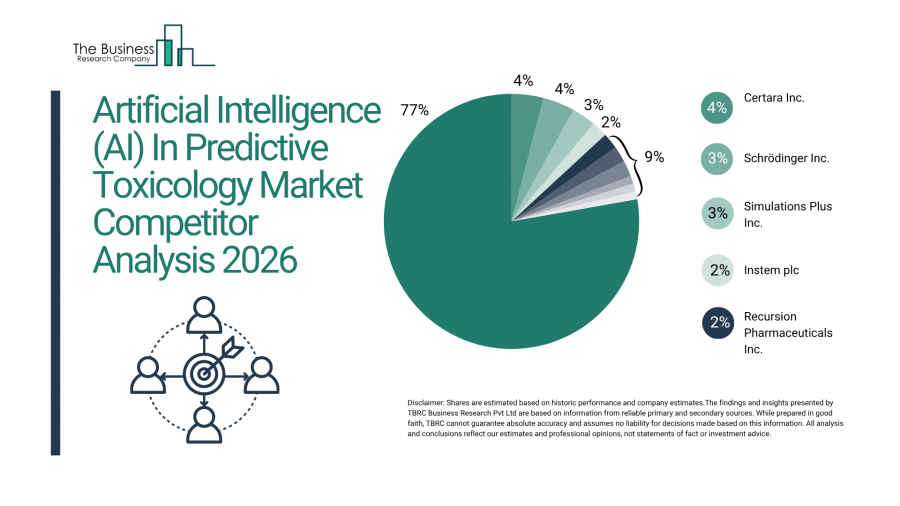
Research indicates that Certara Inc. led the global AI in predictive toxicology market in 2025, with a 4 percent share. Its products include AI-based predictive toxicology and biosimulation tools. These tools use advanced computer models, toxicity prediction software, simulations of biological processes, and computer-based safety assessments. They help researchers screen for toxicity early, support regulatory decisions, make drug development more efficient, and improve chemical safety assessments across pharmaceutical and life sciences industries.
Major Companies Driving Innovation in AI Predictive Toxicology
The market includes several important companies: Certara Inc., Schrödinger Inc., Simulations Plus Inc., Instem plc, Recursion Pharmaceuticals Inc., Insilico Medicine Inc., BenevolentAI, Merative L.P., ChemAxon Ltd., Optibrium Ltd., ArisGlobal, Chemotargets S.L., ACD/Labs, Leadscope Inc., Biovista Inc., Toxys B.V., Berg Health (BPGbio), MultiCASE Inc., Algorithme Pharma, Celsius Therapeutics Inc., and BioTeam Inc. These companies play important roles in developing AI-based toxicology platforms and computer-based safety assessment tools.
Market Competition Shows Moderate Fragmentation and Barriers to Entry
The AI in predictive toxicology market is moderately fragmented. In 2025, the 10 largest companies accounted for 23 percent of total revenue. Companies face several barriers to entering the market, including the need for validated AI algorithms, access to high-quality toxicology data, regulatory acceptance of computer-based safety methods, and specialized knowledge of predictive modeling and life sciences. Leading companies, including Certara Inc., Schrödinger Inc., Simulations Plus Inc., Instem plc, Recursion Pharmaceuticals Inc., Insilico Medicine Inc., BenevolentAI, Merative L.P., ChemAxon Ltd., and Optibrium Ltd., maintain important market positions through broad AI toxicology platforms, advanced modeling tools, partnerships with pharmaceutical companies, and continued development of predictive safety technology. As demand grows for faster toxicity screening, data-based risk assessment, computer-based testing that meets regulations, and AI-supported drug development, innovation, partnerships, and platform expansion are expected to strengthen these companies' competitive positions.
Major Suppliers of Raw Materials and Technology Supporting the Market
Important suppliers of materials and technology for the AI in predictive toxicology market include Thermo Fisher Scientific, Illumina, QIAGEN, Agilent Technologies, Revvity, Bio-Rad Laboratories, MilliporeSigma, Charles River Laboratories, Labcorp, Eurofins Scientific, GenScript Biotech, Sapio Sciences, DNAnexus, Benchling, Oracle Corporation, Amazon Web Services, Microsoft Corporation, Google Cloud, and NVIDIA Corporation. These companies provide important data, tools, cloud computing infrastructure, and computing power needed to develop AI and apply predictive toxicology.
Major Wholesalers and Distributors in the AI Predictive Toxicology Market
Major companies supporting the distribution network include VWR International, Fisher Scientific, Avantor, Thermo Fisher Scientific eCommerce, Carahsoft Technology, SHI International, CDW Corporation, Insight Enterprises, Softchoice Corporation, SoftwareONE, Crayon Group, TD SYNNEX, Ingram Micro, Redington Limited, Bechtle AG, Computacenter plc, Arrow Electronics, Westcon-Comstor, Bytes Technology Group, and Noventiq. These organizations help deliver AI tools, software, and services to customers around the world.
Main End Users of AI Predictive Toxicology Technology
Major customers for AI-based predictive toxicology solutions include pharmaceutical and biotechnology companies such as Pfizer Inc., Roche Holding AG, Novartis AG, Merck & Co., Johnson & Johnson, AstraZeneca PLC, Sanofi SA, Bristol Myers Squibb, Eli Lilly and Company, GSK plc, Bayer AG, AbbVie Inc., Amgen Inc., Boehringer Ingelheim, Takeda Pharmaceutical Company, Novo Nordisk A/S, Regeneron Pharmaceuticals, Biogen Inc., Moderna Inc., and Gilead Sciences Inc. These companies use AI tools to improve drug safety assessments, speed up development, and meet regulatory requirements.
Current Competitive Trends Shaping the Market
Strategic partnerships focused on AI are changing the predictive toxicology market. These partnerships aim to improve toxicity predictions, speed up drug discovery, and create biologically active compounds that are easier to make and have properties optimized for safety. For example, in January 2024, SyntheticGestalt partnered with Enamine to develop AI models that can generate biologically active compounds that can be made in practice while improving their physical and chemical properties and their absorption, distribution, metabolism, excretion, and toxicity (ADME/Tox) profiles. The partnership combines SyntheticGestalt's proprietary AI technology with Enamine's REAL database, which contains 38 billion molecules. This is expected to strengthen toxicity prediction, make compound improvement more efficient, and support faster, data-based drug discovery for pharmaceutical companies and academic researchers.
Strategies Companies Use to Maintain Market Leadership
Companies use several strategies to remain competitive. These include applying AI models to identify toxicity risks early, combining data from multiple biological sources to improve prediction accuracy, developing explainable AI to build regulatory trust and encourage adoption, forming strategic partnerships to speed up innovation in AI-based drug safety, and expanding cloud-based predictive toxicology platforms to make research more accessible. These approaches help leading companies take advantage of new opportunities and continue developing technology in this field.
Our 2026 market reports now include more strategic information. New features include market attractiveness scores and analysis, total addressable market (TAM) analysis, company scoring matrix graphics and tables, Excel-based dashboards, infographics showing key market opportunities, analysis of important technologies and future trends, and updated graphics and tables.
Learn more about The Business Research Company
The Business Research Company (www.thebusinessresearchcompany.com) is a market intelligence firm that specializes in research on companies, markets, and consumers. It has published more than 30,000 reports covering 27 industries and over 60 geographic areas. Its research uses 1,500,000 data sets, extensive research of existing sources, and special insights gathered through interviews with industry leaders.
The company provides ongoing and customized research services. Its specialized packages include the Market Entry Research Package, Competitor Tracking Package, Supplier & Distributor Package, and other options.
Disclaimer: The Business Research Company (TBRC Business Research Pvt Ltd) bases its findings, conclusions, and recommendations on information collected in good faith from primary and secondary sources. However, it cannot always verify that this information is accurate. For this reason, TBRC Business Research Pvt Ltd accepts no liability for actions taken based on information that may later prove incorrect. The analysis and findings in its reports and presentations are estimates and opinions, not statements of fact or investment advice.
Contact us:
The Business Research Company
Americas +1 310-496-7795
Europe +44 7882 955267
Asia and other regions +44 7882 955267 & +91 8897263534
Email: [email protected]
Follow us on:
LinkedIn: https://in.linkedin.com/company/the-business-research-company
Oliver Guirdham
The Business Research Company
+44 7882 955267
[email protected]
Visit us on social media:
LinkedIn
Facebook
X