
Generative AI moves crop breeding from natural selection to molecular
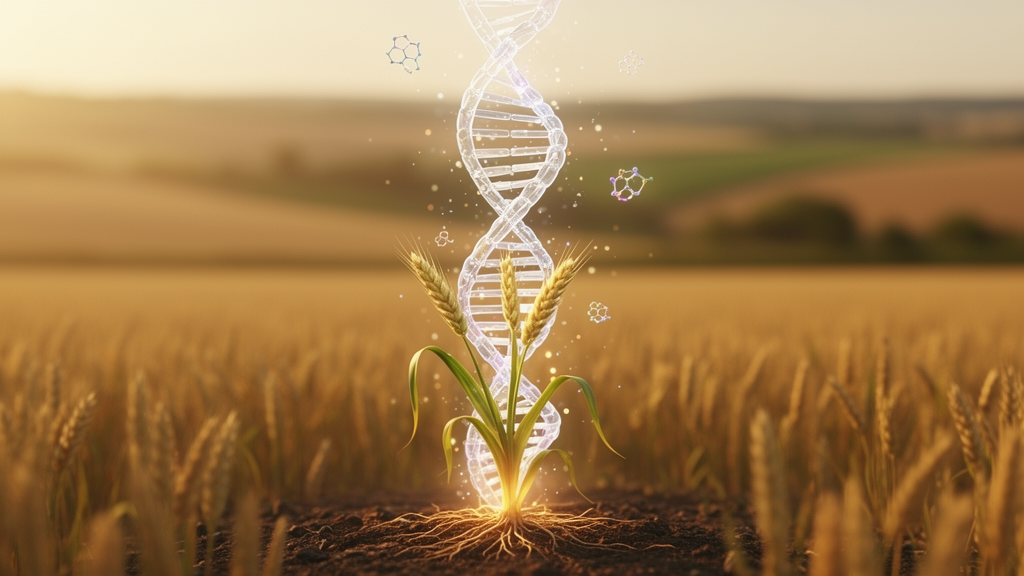
Plant breeders used to save seeds from the plants that grew best, cross promising plants, and wait to see what nature produced. A review published in Science China Life Sciences says this long-standing approach may now be reaching a major turning point. A research team led by Professor Xiangfeng Wang and Associate Professor Jun Yan of China Agricultural University explains how generative artificial intelligence (AI) could change crop science. Unlike AI that only ranks existing options, generative AI can create new biological sequences. The authors call this new approach Breeding 5.0. It uses intelligent, precise design to create DNA sequences, proteins, and elements that control genes before a single seed is planted.
The review explains how crop breeding has changed over time. Traditional crossbreeding, which involves much trial and error and saving seeds from the best plants, is called Breeding 1.0. Over the past century, scientists introduced molecular markers and genomic selection, leading to Breeding 2.0 and 3.0. These methods greatly improved how accurately breeders could find and combine useful genetic variations.
More recently, large-scale biological data technologies helped create Breeding 4.0. These technologies allowed scientists to discover more crop genes by measuring and studying entire genomes. Even with these advances, developing a new crop variety using traditional methods can still take a difficult ten to fifteen years, from the first cross to a variety ready for sale. Breeders also face a major challenge: many important crop traits depend on large networks of genes whose effects interact with unpredictable weather and climate conditions. Improving yield, stress resistance, and crop quality all at the same time remains an unsolved problem because these goals can conflict with one another.
The authors clearly explain the difference between the AI tools commonly used in agriculture so far and the newer models behind this approach. Earlier tools mainly used discriminative AI. This means they assessed, ranked, or sorted genetic variations that already existed in plant collections and breeding populations. These systems are like a breeder walking through a field and choosing the best plants already growing there. They can identify the strongest available choices, but they cannot suggest options beyond those that already exist.
Generative AI works differently. It learns patterns from large collections of biological data and uses those patterns to suggest new DNA sequences, proteins, and elements that control genes for specific biological purposes. This allows researchers to explore possibilities beyond the genetic variations found in nature. The review explains four main types of generative AI models.
Variational autoencoders turn complex biological sequences into simpler numerical representations called latent spaces. Researchers can use these representations to adjust gene activity gradually. The authors compare this to turning a volume knob smoothly rather than flipping a switch between on and off. Generative adversarial networks use two neural networks that compete with each other. One creates possible sequences, while the other checks whether they look real. This process can produce clear, varied DNA sequences with realistic biological features. Both methods give breeders flexible ways to explore genetic possibilities, rather than limiting them to the separate options found in natural plant collections.
Diffusion models are a third type. They create target molecules by starting with random noise and gradually removing it, step by step, until the desired structure takes shape. The review highlights their ability to create precise three-dimensional protein structures and fine-tune gene promoters, which are DNA regions that help control when and how strongly genes are active. The gradual process is like a sculptor shaping an object from a rough piece of material. Large language models are the fourth main type. Biological versions include genome language models, protein language models, and scientific text models. They treat DNA building blocks called nucleotides as letters, groups of nucleotides called codons as words, and genes as sentences.
Trained on large amounts of evolutionary data, these models learn deep patterns that help determine which changes a genome can tolerate. They can also turn broad farming goals into specific molecular designs. After explaining these model types, the review examines 67 representative generative tools and identifies six major areas where they could help design crop molecules. The first is the intelligent design of gene-control elements. AI can create synthetic promoters and enhancers that activate genes only when certain environmental conditions occur. For example, a plant's stress-response system could switch on during drought or heat without reducing yield when conditions are normal.
The second area is creating new proteins with useful functions. Generative models can design customized enzymes intended to improve photosynthesis, the process plants use to turn light into energy. They can also design synthetic binders that disable pathogen effectors, which are molecules harmful pathogens use to attack a plant's defenses. The other areas go beyond designing biological sequences. Small-molecule generation aims to discover environmentally friendly plant growth regulators and chemicals that protect crops from specific threats. These carefully designed compounds could replace broad-spectrum agricultural chemicals that affect many different organisms.
The third area beyond sequence design is improving gene-editing tools. AI-generated proteins could help scientists create new CRISPR-Cas enzymes that edit DNA with extremely high accuracy. Researchers could also design sets of guide RNAs, which direct gene-editing tools to particular DNA locations. These guides would be adapted to the large, complex genomes of major crops, where unwanted edits and polyploidy, a condition in which cells have more than two sets of chromosomes, make gene editing harder.
The fourth area is simulating single-cell multi-omics data, which combine different kinds of biological measurements from individual cells. This could lead to AI virtual cells, or AIVCs, that simulate how cells respond to different conditions using computer models. For example, researchers could model how root cells respond to salty conditions before growing any plants. The fifth area is discovering connections across different fields of knowledge. Scientific AI can examine decades of agricultural research and build connected maps linking genes to traits. This could turn information spread across many research papers into a searchable map of relationships.
To turn these developments into practical breeding methods, the authors propose a framework called DESIGN. It divides AI-assisted breeding into six connected abilities. Discover means finding useful patterns in large collections of genetic and structural data. Engineer means carefully improving molecular parts while respecting the limits of physics and living cells.
Simulate means predicting how possible designs will perform in virtual environments before testing them in fields. Integrate means combining data from different biological measurements, environmental conditions, and scientific publications into one connected map of biological knowledge. Generate means creating useful genetic elements that go beyond the variations found in nature.
Navigate means searching through many possible combinations to find the best balance between competing goals. For example, breeders may need to balance drought resistance against grain yield. Traditional breeding can find this balance only through repeated, costly experiments that take a long time. Importantly, the six abilities are not used in a simple, one-way sequence. Instead, they work together in a repeating cycle that the authors call LDBT, short for Learn, Design, Build, and Test.
Data collected at every stage of an experiment are fed back into the model so it can improve its designs over time. This creates an ongoing partnership between computer predictions and real-world experiments. The review shows how this process could work through an example involving the design of promoters that respond to drought. The project combines data from different biological measurements, AI-generated promoters that respond to specific conditions, experimental testing, and feedback from active learning, a method that helps a model learn from selected results. Each round of promoter designs is built and tested in a laboratory. The results are then used to train the generative model again, allowing it to suggest better designs in the next round. This example shows how the parts of the DESIGN framework can work together in practice.
The authors openly discuss the gap between computer code and real farming results. Using generative AI to improve crops faces several major challenges. Plant data are scattered across different institutions and stored in different formats. Greenhouse experiments can test only a limited number of designs in each round. It can also be difficult to understand how an AI model reached its decision, which matters when breeders must spend time and resources testing the sequences it suggests. The review also stresses that AI will not replace plant breeders.
The authors argue that future success depends on close cooperation between people and AI. Breeders must set goals and use their knowledge of farming, while AI explores complex molecular possibilities on a scale that people cannot search on their own. Whether Breeding 5.0 lives up to its promise will depend on collecting better shared datasets, testing more designs in less time, and developing models whose reasoning breeders can examine and trust. If the LDBT cycle becomes effective, the review suggests, the decade-long process of developing new crop varieties could become much shorter. Instead, a new variety could be designed on a computer, tested, and improved before its seeds are ever planted.
Subject of Research: Generative AI applications in crop molecular design and breeding
Article Title: From natural selection to de novo design: Generative AI ushers in "Breeding 5.0" for crops
Article References: From natural selection to de novo design: Generative AI ushers in "Breeding 5.0" for crops. Original publication (Bibliographic details unavailable.)
Image Credits: AI Generated
DOI: Not provided
Keywords: generative AI, crop breeding, Breeding 5.0, DESIGN framework, diffusion models, large language models, CRISPR-Cas, gene regulatory elements, AI virtual cells, protein engineering, Science China Life Sciences, natural