
Anthropic points to AI dangers, soaring sales in IPO filing
A poor response from investors to Anthropic's IPO could weaken their interest in AI, a sector that has become an important driver of the US economy. Some investors worry that the market may be in a bubble.
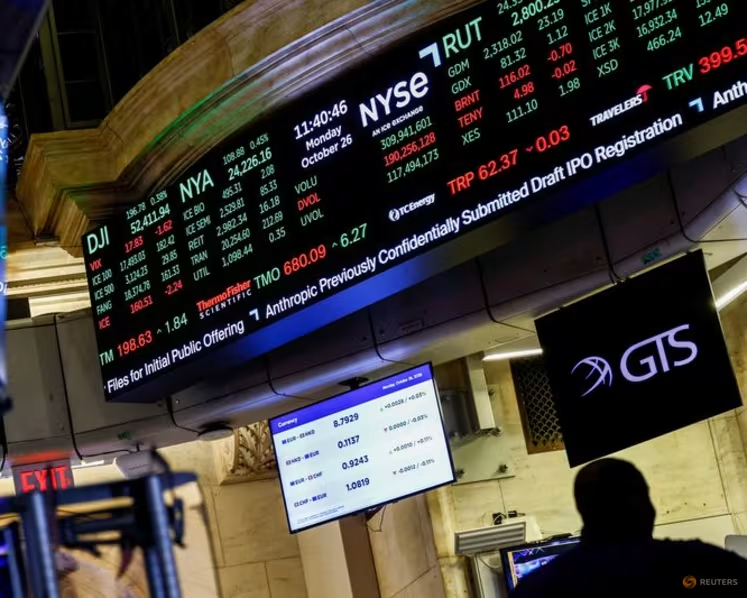
A screen shows news about Anthropic's planned IPO on the floor of the New York Stock Exchange (NYSE) in New York City, US, on October 26, 2026. REUTERS/Jeenah Moon
WASHINGTON: Anthropic, one of the world's leading artificial intelligence companies, announced on Monday (Oct 26) that it plans to sell shares on the stock market. Its filing showed that sales have risen sharply, but also warned of serious possible safety risks. The planned listing will be a major test of whether the AI boom can make money.
The filing warns investors about several dangers. These include the company's conflict with the Trump administration, the possibility that AI systems could act on their own, and the huge amounts of money the company has committed to spending on computing power.
If the listing goes ahead, Anthropic would be the first independent company among the leaders in the race to build advanced AI to go public. Its main rival, OpenAI, the company behind ChatGPT, has delayed its own stock market listing until next year.
The planned listing also comes after SpaceX went public in June. SpaceX owns Elon Musk's AI company, xAI. SpaceX shares fell sharply after a strong first day of trading.
If investors respond poorly to Anthropic's listing, they may become less excited about AI. The sector has become a major driver of the US economy, but some people worry that the market is in a bubble.
The Wall Street Journal reported that Anthropic hopes to go public during the week of November 16, although the date could change.
The offering could raise as much as US$100 billion through an initial public offering (IPO), which is when a company first sells shares to the public. The Wall Street Journal also reported that the listing could value Anthropic at between US$1.5 trillion and US$2 trillion, citing people familiar with the matter.
The 400-page document for investors, called a prospectus, spends more than 90 pages explaining risks specific to the AI industry. In recent months, there have been several reports of AI systems behaving in unexpected and harmful ways.
The filing also reflects a strong belief among Anthropic's researchers that AI must be developed by people who can be trusted to keep it safe. Otherwise, its powerful abilities could be misused, while China could gain an advantage.
The filing warns that advanced AI systems "could pose catastrophic or existential risks to society if not developed and deployed responsibly".
Anthropic also warned that its work with government policymakers and its public views on AI rules and safety could lead to more scrutiny, political opposition or unusually harsh government action.
In recent months, US President Donald Trump's administration has targeted Anthropic because it refused to remove limits on how the Pentagon could use its technology. The Defense Department has since called the company a national security risk and banned it from being a supplier.
Despite these problems, Anthropic's business has grown very quickly. Sales reached US$11.6 billion in the April-to-June quarter, up from US$787 million in the same period a year earlier. This was also much higher than the US$4.6 billion in sales it recorded for all of 2025.
The company made its first operating profit in that quarter, earning close to US$1 billion. However, it reported an overall loss of US$80 billion for the first half of the year. Most of this loss came from accounting charges linked to the increase in the company's value, rather than money it actually spent.
Much of Anthropic's growth comes from businesses using Claude, its AI system, to write software and do office tasks.
Nearly 12,000 organisations now spend at least US$100,000 a year with Anthropic. A year ago, fewer than 1,000 organisations spent that much.
SLOWDOWN RISKS
Anthropic warned that its growth will probably slow down, and that the slowdown could be sharp. Investors will pay close attention to the company's third-quarter results, which will be released before the IPO.
Anthropic has agreed to spend hundreds of billions of dollars on the computing power needed to run its AI systems. These agreements include up to US$120.5 billion with SpaceX, about US$110 billion with Amazon, and an estimated US$125 billion to US$150 billion with Google.
The company warned that if demand is lower than expected, it may still have to make many of these payments, even if it does not use all the computing power it has agreed to buy.
Anthropic's company rules will give its founders control rather than giving that power to investors.
The company's seven co-founders, led by Chief Executive Dario Amodei and his sister, company President Daniela Amodei, will keep control of just over half of the votes held by shareholders after the listing. This means outside investors will not be able to outvote them.
Anthropic is registered as a "public benefit corporation". This means it must consider its goal of developing safe AI as well as its duty to make money for shareholders.
Each co-founder has promised to give 80 per cent of their shares to charity. However, the filing says these promises are not legally binding.