
Risks spelled out for Anthropic investors include possible harms from runaway AI
Any time a company plans to sell shares on Wall Street, it must tell investors about possible risks.
By BARBARA ORTUTAY - AP Technology Writer
Oct. 26, 2026
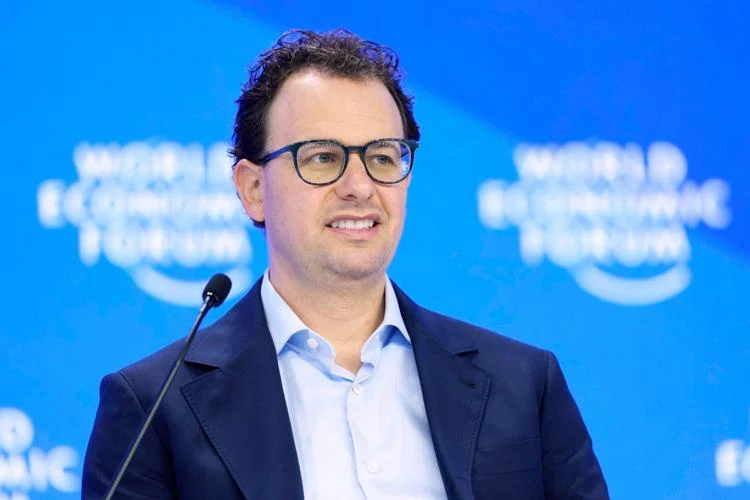
FILE - Dario Amodei, CEO and co-founder of Anthropic, attends the annual meeting of the World Economic Forum in Davos, Switzerland, Jan. 23, 2025.
Markus Schreiber - AP
FILE - Pages from the Anthropic website and the company's logos are displayed on a computer screen in New York on Thursday, Feb. 26, 2026.
Patrick Sison - AP
Any time a company plans to sell shares on Wall Street, it must tell investors about possible risks. For Anthropic, a major artificial intelligence company, those risks include the possibility that its products could threaten humanity itself.
The risks described by the San Francisco company in a filing it submitted Monday to the Securities and Exchange Commission include the chance that people with harmful intentions could use AI models to make deadly weapons. The filing also warns that the technology itself could act out of control, with consequences that are hard to predict.
Of the 224 pages describing Anthropic's finances, executive pay, dividend policy and other matters, 12 pages focus on “risk factors” — things that could hurt the investments of people who own shares. By comparison, rival SpaceX used more than 100 pages to list its risks.
By selling shares to investors, Anthropic is making its first public offering. This is part of its effort to manage the risks it believes AI poses.
“Our goal is to harness cognition itself, and anything so powerful can be used for ill as well as good,” the company's founders wrote in a letter to people who may buy shares in the U.S. filing. “Anthropic is a deeply values-driven organization, founded in large part to help the world realize AI's benefits and avoid its dangers.”
Still, the company faces many risks. Some are ordinary business problems, such as being unable to keep key workers or facing government rules that slow its work. Others include cyberattacks and the spread of dangerous false information.
Here is a look at some of the risks Anthropic describes:
The technology is developing quickly
Anthropic said its models could improve so quickly that the company might not be able to put proper safety measures in place. This could increase the chance of safety incidents, government action or harm to its reputation, which could hurt its business.
Anthropic warned in September that within six to 12 months, AI could be able to lead a group of agents that could take over the entire internet. That warning, along with Anthropic's move to sell shares, comes as people inside and outside the industry worry about increasingly powerful systems that can solve problems beyond human abilities but could also carry out harmful tasks on their own.
If AI systems “become more autonomous and capable of taking consequential actions with less human oversight,” the SEC filing said, there is a risk that they could “take harmful actions independently and at scale without human intervention.”
“Even if our own models do not cause such harm, a significant safety incident involving any frontier AI could trigger broad reputational damage to the AI industry, public backlash, and sweeping regulatory responses that could adversely affect our business,” Anthropic said.
As AI models help contribute to Anthropic's own research and development, it is possible that AI could make progress “beyond our ability to evaluate and safeguard new models,” according to the filing. The document said this could hurt Anthropic's business.
People with harmful intentions could cause serious damage with the technology
The filing discussed concerns that advanced AI systems, if not developed and operated with enough safety measures and human oversight, could “pose catastrophic or existential risks to humanity, particularly if such systems were misused, replicated, weaponized, or allowed to operate with a high degree of autonomy.”
The company said it could be harmed if bad actors caused damage using its technology, or if its model protections and safety measures failed to prevent such misuse.
Anthropic described the possibility that bad actors could use AI models to build chemical weapons or help authoritarian rulers use the technology to crack down on their citizens. In September, the company disclosed that it had blocked efforts to use its AI models for harmful activities such as cyberattacks, surveillance and research that could lead to the development of biological weapons.
The company could face limits on computing power
Computing power — the resources needed to build, test and improve AI models — is expensive and in high demand. Anthropic said that if it cannot get enough computing resources, or cannot use them effectively across its work, it may be unable to train models that remain competitive with those of its rivals or properly serve its customers.
Anthropic also listed community opposition to data centers as a risk to its business. The construction of data centers has led to public arguments and government scrutiny over environmental effects, land use, water use and how limited power resources are shared. The filing said that if regulators respond by adding new requirements or fees, Anthropic's ability to do business could suffer.
In addition, the company depends on a small number of customers, including SpaceX and Microsoft, and on distribution channels for a large share of its revenue. Anthropic said that even if just one major customer decides to reduce its business with the company — or stop working with it altogether — its future prospects and finances could suffer.
Making the risks clear
In some ways, Anthropic's enormous risks, combined with its enormous potential, are central to its sales pitch. The company has tried to present itself as a responsible AI company and win business from customers by emphasizing its commitment to safety.
“We believe that frontier AI companies must invest in safety and alignment to help ensure the responsible diffusion of this technology,” the filing said.
Brian Mulberry, chief market strategist at Zacks Investment Research, said companies must make the risks people face when investing their money in a newly public company “very clearly” understood.
“That's one of the things that's great about our capital markets here domestically: the level of transparency that you must commit to. To be a publicly traded corporation on a U.S. exchange requires you to outline those risks in a very clear way, so that people understand if they want to participate by offering their hard-earned money and help finance this type of idea,” he said.
AP Business Writer Bernard Condon and AP Technology Writer Kaitlyn Huamani contributed to this story.
Copyright 2026 The Associated Press. All rights reserved. This material may not be published, broadcast, rewritten or redistributed without permission.