
PSI Used OpenAI and Claude Models on 5 Open Quantum Problems
Physical Superintelligence (PSI), a physics research company that says it has raised more than $58 million, announced on X on 26 October 2026 that it had found answers to five long-standing problems in quantum information theory. Its research page says each result comes with a paper, a formal proof written in Lean, and code that checks the proof.
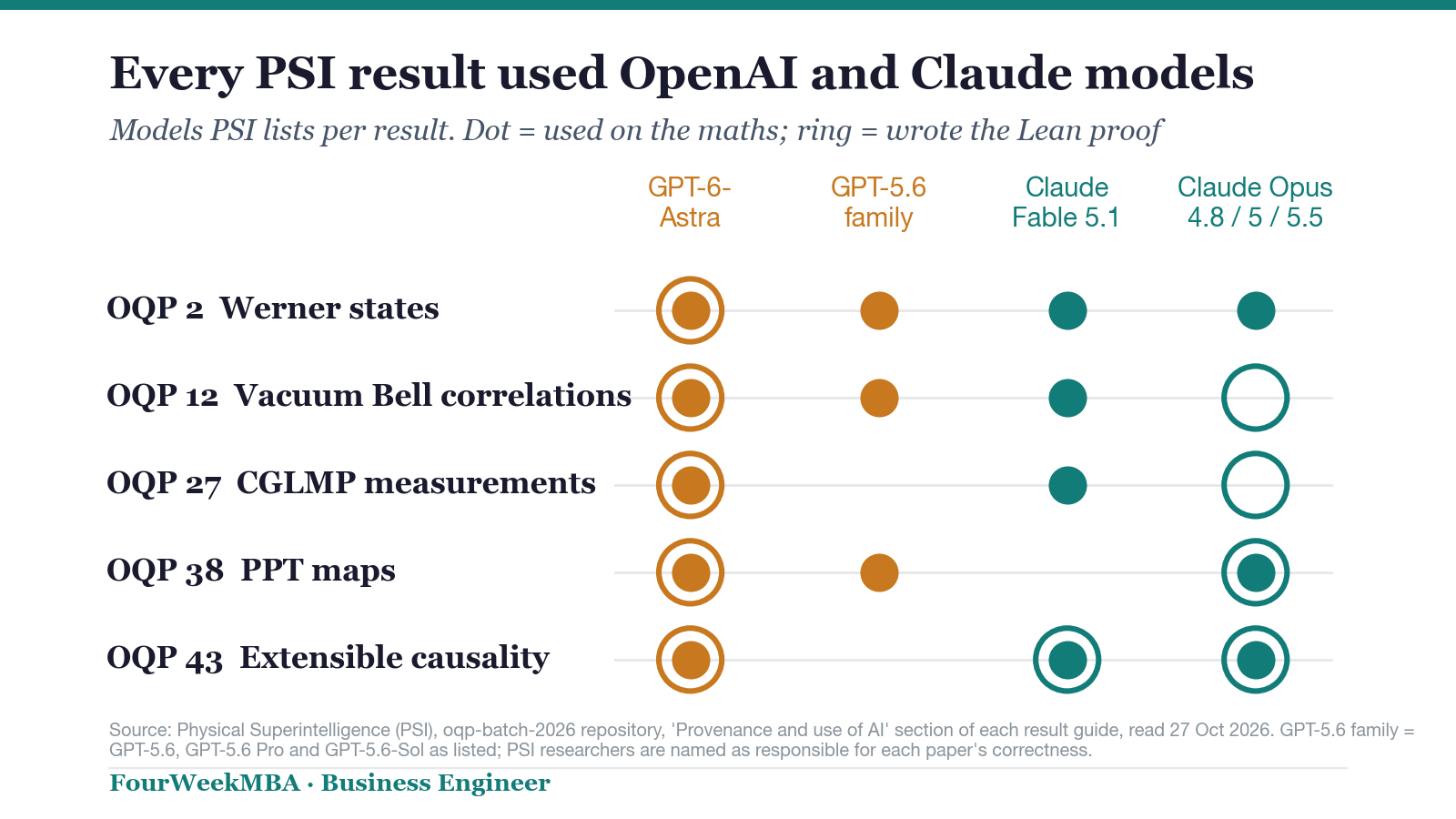
PSI's public repository lists the AI models used for each result. All five results list models from both OpenAI and Anthropic. OpenAI's GPT-6-Astra appears in all five. The announcement came on the same day that OpenAI said its own AI system had disproved the Exponential Time Hypothesis.
Video explainer
A Business Engineer video explains PSI's results and other AI-assisted proofs announced that week. It is narrated using information from our published articles.
What PSI Announced
The results cover five problems from the Open Quantum Problems list: numbers 2, 12, 27, 38 and 43. PSI says its researchers found these results by working with its AI research system. It also says its public repository explains how AI was used for each result. The research page is dated 23 October.
For Open Quantum Problem (OQP) 12, PSI says it proved that no choice of local measurements can violate the CHSH inequalities beyond a certain finite distance between two regions of the vacuum. This remains true even though the two regions stay quantum-entangled no matter how far apart they are.
For OQP 43, PSI says it built an example involving two parts that disproves the claim that every such causal process can come from a larger reversible process with a finite number of dimensions.
Not all five results fully solve their problems. For OQP 2, PSI shows that Bell pairs cannot be extracted from three copies of certain Werner states. It says the question of whether this is possible with any number of copies remains open.
What Was Posted on X
Today Physical Superintelligence PBC is announcing solutions to five long-standing problems in quantum information theory.
— Physical Superintelligence (@psipbc) Oct 26 23:44
https://psi.inc/research/oqp-batch-2026/
Thread 👇
At 23:44 UTC on 26 October 2026, Physical Superintelligence PBC posted on X that it was announcing answers to five long-standing problems in quantum information theory. The post linked to the company's research page, which describes the findings as “new results”.
Physical Superintelligence launched in September with a $58 million seed. Today they announced five new results on open problems in quantum information theory, with a paper and Lean formalization for each of Open Quantum Problems 2, 12, 27, 38, and 43.
— Andrew Curran (@AndrewCurran_) Oct 27 01:02
At 01:02 UTC on 27 October, Andrew Curran shared PSI's announcement on X. He wrote that the company had launched in September with $58 million in seed funding. He also noted that each of the five results, covering Open Quantum Problems 2, 12, 27, 38 and 43, came with a paper and a formal proof written in Lean.
Which AI Models PSI Used
Each result guide has a section called “Provenance and use of AI”. Across the five results, PSI lists OpenAI's GPT-6-Astra, GPT-5.6, GPT-5.6 Pro and GPT-5.6-Sol, as well as Anthropic's Claude Fable 5.1, Claude Opus 4.8, Claude Opus 5 and Claude Opus 5.5. PSI says these models were used for the mathematics.
According to the guides, AI agents wrote the formal proofs in Lean under PSI's direction. GPT-6-Astra worked in Codex on all five results. Claude Opus 5.5 worked in Claude Code on four of them. The guides name PSI researchers, including David Turturean, Ning Bao and Ian MacCormack, as responsible for checking the correctness of each paper.
One result builds directly on earlier work from OpenAI. For OQP 38, PSI notes that two PPT maps are not enough in every case, as reported in a recent OpenAI preprint. PSI says it proved that 2(d − 1) such maps are enough.
Who PSI Is
PSI describes itself as a public benefit corporation building “the world's most advanced physics research lab”. Its website lists more than $58 million in funding, led by Breakthrough Energy Ventures, and more than 25 researchers and engineers. Andrew Curran wrote on X that the company launched in September with $58 million in seed funding.
PSI's website says, “Human scientists direct the missions. Virtual physicists carry out the research.” It identifies the physical infrastructure needed to run AI as its first area for testing this approach.
Connecting the Coverage
Overnight, we reported that Anthropic says Claude also refuted ETH on 16 October, the same date OpenAI gives for its own claim. On 26 October, we reported that OpenAI says its AI refuted the Exponential Time Hypothesis. In September, we covered how Claude formalized Fermat's Last Theorem in Lean.
The Structural Read
In our view, one important feature of PSI's release is how it explains the work. Each result guide names the AI models used, identifies the agents that wrote the Lean formal proof, and names the PSI researchers responsible for the paper's correctness.
The announcement also came in the same week that OpenAI and Anthropic each said their own AI models had refuted the Exponential Time Hypothesis. This means AI-assisted proofs are being reported both by AI companies about their own systems and by a research lab using those systems.
In our view, OQP 38 also shows how research findings can build on one another. PSI's result extends a finding that it credits to a recent OpenAI preprint.
PSI, Five results on Open Quantum Problems, 2026
“Working with our AI research system, PSI researchers have obtained new results on five open problems in quantum information theory”
Three Implications
FOR PHYSICS RESEARCHERS PSI's README says every result folder contains a paper and a Lean 4 formal proof. Each lean/ folder also includes fixed versions of the software dependencies it needs and can be copied and used as a separate project.
FOR MODEL VENDORS PSI's result guides list OpenAI's GPT-6-Astra for all five results and Anthropic's Claude models for all five, based on our count of the guides.
FOR INVESTORS PSI's website lists more than $58 million in funding led by Breakthrough Energy Ventures. It identifies the physical infrastructure needed for AI as its first area of testing.
The Business Engineer Lens
This story relates to the Business Engineer framework The Four Intelligence Moats.
The framework describes “The Verifier Moat” as something built through reinforcement learning from verifiable rewards (RLVR), using rewards designed for a specific field.
In our view, a formal proof written in Lean serves as this kind of mathematical checker, and PSI provides one with every result. The framework was published in July 2026 and does not discuss PSI.
What Is Not Established
PSI's repository describes the five papers as preprints, meaning they have been shared before the usual peer-review process is complete. The Lean files check the formal statements written for the papers. The guides connect each set of files to a specific version of its paper. PSI's post on X calls the findings “solutions”, while its research page calls them “new results”. The result for OQP 2 covers only three copies of the relevant states. The PSI documents we reviewed do not cite an independent outside review.
The Bottom Line
PSI says it used AI-assisted methods to produce results on five open problems in quantum information theory. Each result comes with a paper and a formal proof in Lean. Its repository lists models from both OpenAI and Anthropic for every result, and names PSI researchers who are responsible for each paper.
More than 95,000 executives read Business Engineer for its AI strategy frameworks, which are cited by ChatGPT, Claude and Perplexity.
Note on sources: This article is based on PSI's research page, the README and result guides in its oqp-batch-2026 GitHub repository, its website, posts on X by PSI and Andrew Curran, all viewed on 27 October 2026, and our earlier reporting. We have not examined the papers or run the Lean proofs ourselves. We did not contact PSI.
Sources: PSI, “Five results on Open Quantum Problems” · PSI oqp-batch-2026 repository (README and result guides) · PSI website · PSI on X, 26 Oct 2026 · Andrew Curran on X, 27 Oct 2026